
Few things frustrate a craftsman more than watching a brand-new oscillating plunge blade smoke and dull seconds into a demanding cut. When facing these rapid failures, operators often rely on their standard tooling procurement budgets-frequently opting for cheap, bulk-pack replacements-hoping to brute-force their way through the project. However, understanding your accessory metallurgy is what truly grants you unmatched cost-per-cut efficiency and cleaner finishes. With the important stipulation that no single blade design can flawlessly master every material, selecting between High-Carbon Steel (HCS) and Bi-Metal is a matter of matching the tool to the task. For example, while an HCS blade is ideal for clean softwood, only a Bi-Metal blade can reliably slice through dense oak embedded with framing nails. Below, we will break down the structural differences between HCS and Bi-Metal options, analyze their performance lifespans, and help you select the optimal plunge blade for your next project.
| Factor | Summary |
|---|---|
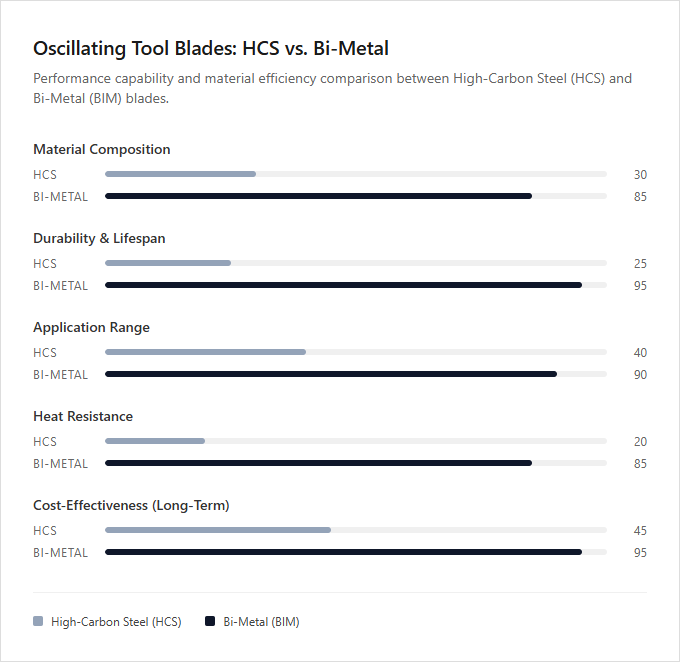
| Material Composition | High-Carbon Steel blades consist of a single flexible carbon-steel alloy, whereas Bi-Metal blades feature high-speed steel teeth electron-beam welded to a spring-steel backing. |
| Durability and Lifespan | Bi-Metal blades offer vastly superior wear resistance and fatigue life compared to High-Carbon Steel blades, making them less prone to premature tooth breakage. |
| Application Range | High-Carbon Steel is optimized for softer materials like wood, plastic, and drywall, while Bi-Metal blades are highly versatile tools capable of cutting through embedded nails, copper pipes, and non-ferrous metals. |
| Heat Resistance | Bi-Metal blades maintain their structural hardness at high operating temperatures, reducing thermal degradation during high-friction plunge cutting where High-Carbon Steel would rapidly dull. |
| Cost-Effectiveness | Although High-Carbon Steel blades have a lower initial procurement cost, Bi-Metal blades deliver a far superior long-term cost-per-cut ratio due to their extended operational longevity. |
HRC Limits: High-Carbon vs. High-Speed Steel Teeth
Oscillating tool blades require specific metallurgical properties to withstand rapid friction and impact. High-Carbon Steel (HCS) blades typically register around 50 to 58 on the Rockwell C hardness scale (HRC). While highly flexible, HCS quickly loses its tempering and structural integrity when exposed to the high frictional temperatures generated by cutting hard materials, leading to rapid teeth degradation.
Bi-metal blades resolve this limitation by electron-beam welding High-Speed Steel (HSS) teeth, which register between 62 to 67 HRC, to a flexible carbon steel backing. This cobalt-alloyed HSS retains its hardness at much higher operating temperatures, ensuring prolonged cutting efficiency through non-ferrous metals and embedded fasteners.
High-Carbon Steel blades are ideal for DIY hobbyists focusing on softwoods and drywall, whereas bi-metal blades are suited for professional tradespeople requiring durability for rigorous, multi-material demolition.
Electron-Beam Bimetal Weld Durability Under High-Frequency Oscillation
High-carbon steel (HCS) oscillating blades offer excellent flexibility for softer materials, yet they wear rapidly when encountering dense substrates. Bi-metal (BIM) blades solve this limitation by joining high-speed steel teeth to a flexible alloy backing. This integration relies on high-precision electron-beam welding to establish a robust transition zone. Under high-frequency oscillation, often reaching 20,000 oscillations per minute, the structural integrity of this molecular bond prevents delamination and absorbs intense shear stresses, ensuring the blade does not fail at the joint.
The superior fatigue resistance of the electron-beam weld allows bi-metal blades to withstand prolonged thermal stress that would otherwise quickly degrade standard HCS. High-carbon steel blades are best suited for occasional DIYers focusing on soft woods and drywall, whereas durable bi-metal blades are essential for professional tradespeople tackling demolition, embedded nails, and hardwoods.
Cobalt Alloy Effects on Thermal Dissipation and Red Hardness
High-Carbon Steel (HCS) oscillating tool blades offer excellent flexibility and sharpness for softer materials, but they rapidly degrade under high-friction metal cutting. In contrast, Bi-Metal blades feature a high-speed steel tooth strip, alloyed with cobalt, electron-beam welded to a flexible carbon steel backing. This cobalt concentration significantly enhances thermal dissipation, preventing heat buildup at the cutting edge during intense metal contact.
This alloy integration directly improves the blade's red hardness, allowing the teeth to retain their structural integrity and cutting efficiency even at extreme operating temperatures. While HCS blades are ideal for DIY hobbyists focusing on wood and drywall projects, Bi-Metal blades are essential for trade professionals requiring durable performance for frequent nail, bolt, and metal pipe extraction.
TPI Geometry Optimization: Wood vs. Nails
High-Carbon Steel (HCS) oscillating blades are engineered with a lower Teeth Per Inch (TPI) ratio and aggressive, deep-gullet tooth geometry. This specific configuration optimizes rapid chip clearance during deep plunge cuts in softwoods, preventing wood fibers from clogging the teeth and reducing friction-induced heat buildup.
In contrast, Bi-Metal blades utilize a higher TPI density featuring hardened High-Speed Steel teeth bonded to a flexible carbon steel backing. This tighter tooth spacing distributes the high-impact forces encountered when plunge cutting through embedded nails, preventing tooth breakage and maintaining cutting structural integrity in metal-embedded timber.
HCS blades are suited for detailed woodworkers and furniture makers prioritizing speed and clean finishes in clean lumber, whereas Bi-Metal blades are essential for renovation contractors and demolition professionals requiring high durability in mixed-material environments.
High-OPM Fatigue and Tooth Stripping Resistance
At high oscillations per minute (OPM), oscillating tool blades experience intense thermal and mechanical stress. High-Carbon Steel (HCS) blades offer excellent flexibility for wood and soft plastics, but they suffer from accelerated fatigue life and rapid tooth stripping when subjected to high OPM against dense materials. The intense friction can quickly overheat the carbon steel teeth, leading to premature wear.
Bi-metal (BIM) blades weld a high-speed steel tooth strip to a flexible alloy steel backing. This construction provides superior fatigue life and high resistance to tooth stripping under demanding, high-OPM conditions. The heat-resistant tooth edge maintains its structural integrity when cutting through nails, hardwoods, and non-ferrous metals.
HCS blades are ideal for DIY hobbyists focusing on precise, soft-material woodworking, whereas BIM blades are suited for professional contractors requiring durability for heavy-duty, multi-material demolition.
Kerf Width Impact on Composite Machining Accuracy
In dense composite materials, the kerf width of oscillating blades directly influences feed rate and heat generation. High-carbon steel (HCS) blades typically feature a thinner kerf, minimizing material displacement and allowing a rapid initial feed rate. Bi-metal (BIM) blades possess a slightly wider kerf due to their robust dual-metal construction, which increases cutting resistance but prevents binding by clearing debris more efficiently during deep plunges.
Blade rigidity dictates plunge depth accuracy when navigating dense fibers. The flexible nature of thin HCS blades can lead to deflection under load, compromising cutting alignment. Bi-metal blades resist bending, maintaining a straight path for precise depth control despite the higher friction of composite matrices. High-carbon steel blades are ideal for budget-conscious DIYers executing shallow, rapid cuts in softer materials, while bi-metal blades suit trade professionals demanding sustained precision and durability in tough, engineered substrates.
Performance disparity when encountering ferrous versus non-ferrous embedded fasteners
High-Carbon Steel (HCS) oscillating blades offer excellent flexibility and speed when cutting soft materials and non-ferrous metals like copper. However, when encountering ferrous embedded fasteners such as steel screws or hardened structural nails, HCS teeth dull rapidly and can shear off completely due to extreme frictional heat.
Bi-metal blades feature a high-carbon steel body fused to high-speed steel teeth, delivering the necessary hardness and thermal resistance to slice through tough ferrous obstacles. They maintain their structural integrity and edge sharpness during mixed-material plunges without sacrificing tool control.
HCS blades are ideal for hobbyist woodworkers performing precise cuts in clean timber, while bi-metal blades are suited for professional remodelers and demolition contractors who require resilient cutting through unpredictable, nail-embedded framing.
Leave a comment