
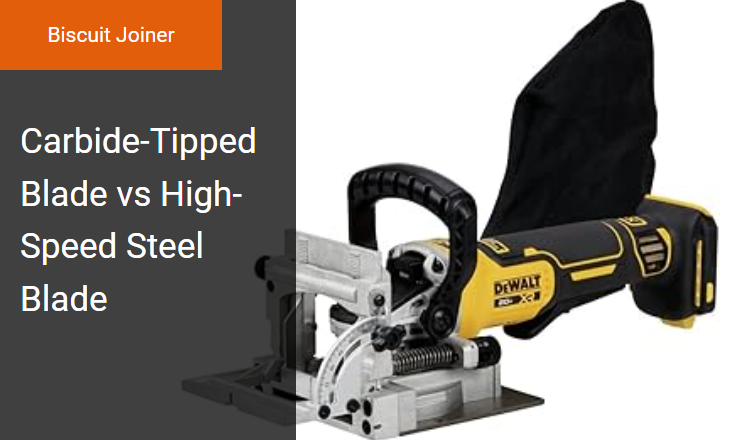
Achieving perfectly aligned, tear-out-free slots in biscuit joinery is a persistent struggle for professional woodworkers, often resulting in misaligned panels and wasted material. Before investing in expensive machinery upgrades, many shops naturally look to stretch their standard workshop tooling budgets, relying on stock OEM blades to solve these precision issues.
However, optimizing your cut quality begins with metallurgy. Selecting the correct cutter material-specifically choosing between Carbide-Tipped (TCT) and High-Speed Steel (HSS)-grants operators immediate control over edge longevity and tool deflection. Stipulation: ultimate joint integrity still requires precise machine calibration and moisture-compatible biscuits. For example, deploying a premium Freud carbide-tipped blade in abrasive materials like MDF or dense white oak delivers vastly superior results compared to standard steel.
Below, we will analyze the durability, cost-per-cut metrics, and specific application profiles of both blade types to optimize your slot-cutting efficiency.
| Factor | Summary |
|---|---|
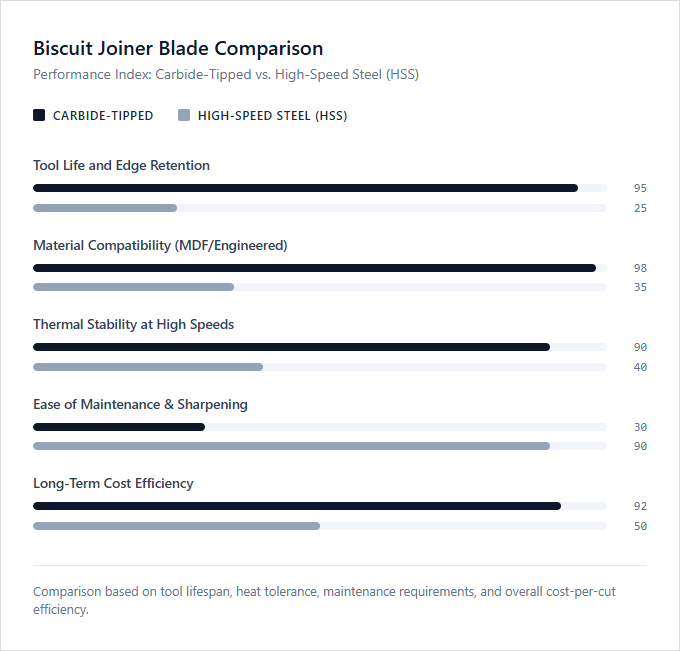
| Tool Life and Edge Retention | Carbide-tipped blades maintain their cutting edge significantly longer than high-speed steel blades due to the superior hardness and wear resistance of C2 or C4 grade tungsten carbide. |
| Material Compatibility | While high-speed steel is suitable for softwoods, carbide-tipped blades are required to cut through highly abrasive engineered materials like medium-density fiberboard (MDF) without rapid dulling. |
| Thermal Stability | Carbide-tipped blades exhibit excellent thermal dissipation at high rotational speeds, whereas high-speed steel blades are more prone to overheating and losing their temper. |
| Maintenance and Sharpening | High-speed steel blades can be easily resharpened using standard aluminum oxide wheels, while carbide teeth require specialized diamond grinding wheels for refurbishment. |
| Cost Efficiency | High-speed steel blades offer a lower initial purchase price, but carbide-tipped blades provide a much lower cost-per-cut ratio over their extended operational lifespan. |
Carbide-Tipped Blades for High-RPM Durability
When selecting a blade for a biscuit joiner, the choice between carbide-tipped and high-speed steel (HSS) significantly impacts cutting efficiency and tool longevity. Carbide-tipped blades offer superior edge retention and wear resistance during high-RPM operations, making them highly effective at enduring the intense thermal stress generated when plunging into dense hardwoods or abrasive composites.
In contrast, high-speed steel blades provide a very keen initial edge and are more budget-friendly, though they dull more rapidly under continuous use. High-speed steel blades are highly suitable for hobbyists working occasionally with softwoods, while carbide-tipped blades are the standard choice for professional cabinetmakers requiring maximum durability for daily production.
Tungsten Carbide Teeth: Superior Heat Resistance
When selecting a blade for a biscuit joiner, the choice between carbide-tipped and high-speed steel (HSS) options hinges on thermal performance. Carbide-tipped blades feature tungsten carbide teeth that provide significantly higher red hardness and thermal stability to resist frictional heat. This allows the cutting edges to withstand the intense thermal stress generated during rapid plunge cuts into dense manufactured boards and hardwoods without losing their temper.
In contrast, high-speed steel blades offer excellent initial sharpness and cost-effectiveness but dull more rapidly when subjected to extreme heat. High-speed steel blades are highly suitable for occasional DIY hobbyists working mainly with softwoods, whereas carbide-tipped blades are the standard choice for professional woodworkers requiring durability for high-volume production and hardwood joinery.
Carbide Tips Ensure Long-Lasting Cutting Precision
Selecting the right blade for a biscuit joiner significantly impacts the precision and longevity of joint creation. Carbide-tipped blades are engineered for demanding environments, featuring extreme hardness that resists thermal degradation. This resilience allows the carbide tips to maintain a highly consistent kerf width and precise cutting tolerance over extended production runs, ensuring that biscuit slots remain perfectly sized for optimal joint alignment.
In contrast, High-Speed Steel (HSS) blades offer a sharper initial edge and greater flexibility at a lower cost, though they dull more rapidly when cutting abrasive engineered materials. High-volume cabinetmakers and production shops benefit most from the enduring precision of carbide-tipped blades, while hobbyists and occasional DIYers will find High-Speed Steel blades well-suited for light-duty, solid wood projects.
ATB Tooth Geometry Minimizes Fiber Tear-Out
In biscuit joining, the choice between carbide-tipped and high-speed steel (HSS) blades directly impacts the precision of the joint slot. While HSS blades offer a highly sharp initial edge suitable for softwoods, carbide-tipped blades provide superior hardness and retain their sharpness significantly longer when cutting abrasive manufactured boards. To achieve the cleanest cuts, high-performance blades in both categories utilize an alternate top bevel (ATB) tooth geometry.
This ATB design alternates the angle of the teeth to optimize the shear angle during high-speed rotation, slicing through wood grain rather than scraping it. This mechanical action minimizes fiber tear-out along the pocket edges, ensuring tight-fitting biscuit insertion and optimal glue adhesion. High-production cabinetmakers and professionals working with plywood require carbide-tipped ATB blades for long-term efficiency, whereas occasional DIY hobbyists working with solid timber find HSS blades to be a cost-effective choice for clean, light-duty applications.
Carbide's Modulus Prevents Blade Deflection at High Feeds
When selecting a biscuit joiner blade, the choice between carbide-tipped and high-speed steel (HSS) significantly impacts cut precision. Carbide-tipped blades feature an exceptionally high modulus of elasticity, which provides superior structural rigidity under stress. This high stiffness prevents blade deflection even at elevated feed rates, ensuring that the half-moon slots remain perfectly flat and aligned during rapid, demanding production runs.
In contrast, high-speed steel blades offer greater structural flexibility and are easier to sharpen, though they are more prone to flexing under heavy loads. HSS blades deliver clean cuts in softer woods but wear faster when encountering abrasive adhesives in plywood or medium-density fiberboard. Hobbyists working occasionally with softwoods find high-speed steel blades highly cost-effective, while high-volume professional woodworkers requiring continuous precision in hardwoods and composites rely on carbide-tipped blades.
Tough High-Speed Steel Prevents Micro-Chipping
Choosing the right blade for a biscuit joiner significantly impacts joint precision and tool longevity. While carbide-tipped blades offer extreme hardness and maintain their sharpness longer when cutting dense manufactured boards, high-speed steel (HSS) blades excel in physical durability. High-speed steel boasts superior impact toughness, making it less susceptible to micro-chipping when encountering hard knots or minor foreign objects within the wood.
Carbide blades remain highly rigid but can be brittle under sudden stress. The resilient molecular structure of HSS absorbs structural shocks during rapid plunging actions, ensuring a reliable cut without premature edge degradation. Carbide-tipped blades are ideal for high-volume production woodworkers handling abrasive composite materials, whereas high-speed steel blades are best suited for general workshop craftsmen who prioritize resilience and frequent utility across varied natural lumbers.
Blade Gullet and Clearance Prevent Thermal Degradation
In biscuit joining, selecting between carbide-tipped and high-speed steel (HSS) blades requires a careful evaluation of tooth geometry. The blade gullet capacity and clearance angle dictate efficient chip evacuation to prevent thermal degradation of both the wooden workpiece and the tool itself. Carbide-tipped blades feature specialized clearance angles that sustain cutting efficiency under extreme heat, facilitating rapid waste removal. Conversely, HSS blades rely on specific gullet depths to manage chip volume at moderate speeds, though they are more prone to heat buildup during continuous operation.
Carbide-tipped blades maintain their hardness when cutting abrasive composites and dense hardwoods, whereas HSS blades offer a keener initial edge for clean cuts in softer fibers. High-volume professional cabinetmakers working with MDF and hardwoods will find carbide-tipped blades indispensable for their durability, while weekend DIY enthusiasts focusing on softwoods will benefit from the precision and affordability of HSS blades.
Leave a comment