
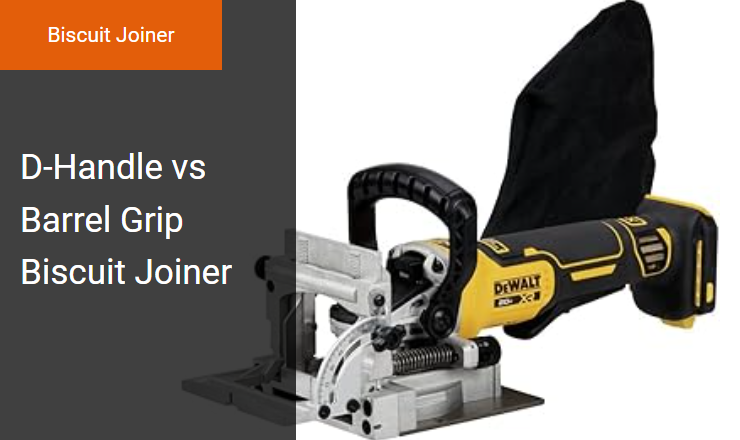
Achieving perfectly flush wood joints is a persistent challenge, as woodworkers frequently battle microscopic offsets during critical glue-ups. When seeking to upgrade shop capabilities, craftsmen typically look to standard funding sources-such as capital equipment budgets or workshop improvement financing-to acquire heavy, expensive machinery. However, simply choosing the correct handheld ergonomics often yields superior, immediate results. Investing in a tool that grants absolute stability during the plunge cut can eliminate alignment drift entirely.
Stipulation: Mechanical accuracy is secondary to user control; a plate joiner is only as precise as your physical ability to keep it flat. For example, when edge-joining heavy maple slabs or assembling cabinet face frames with a DeWalt or Makita unit, body style dictates your success.
Below, we compare the D-Handle and Barrel Grip configurations, evaluating how their physical geometry influences leverage, alignment control, and overall joint quality.
| Factor | Summary |
|---|---|
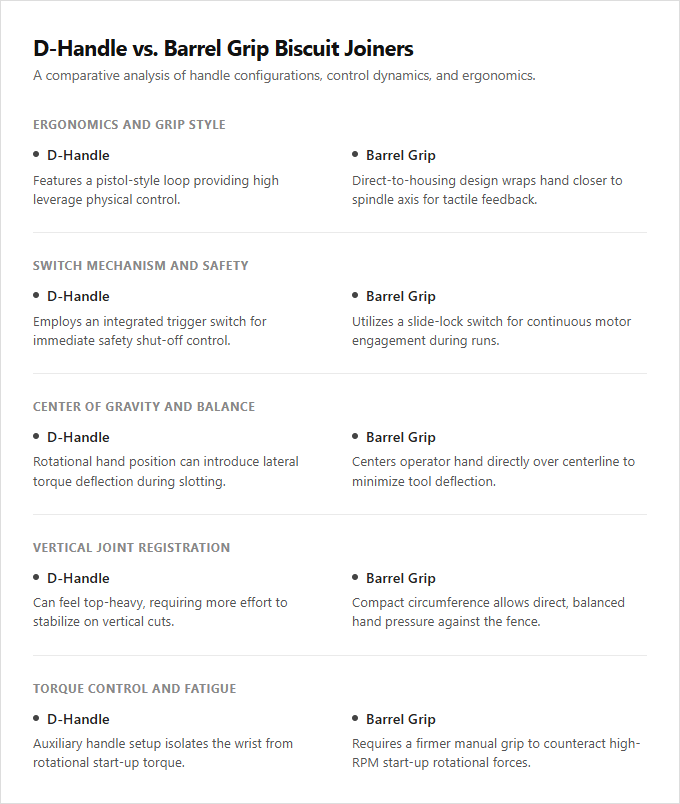
| Ergonomics and Grip Style | D-handle models feature a pistol-style loop providing high leverage, whereas barrel grip designs allow the user's hand to wrap directly around the motor housing closer to the spindle axis for superior tactile feedback. |
| Switch Mechanism and Safety | D-handle units typically employ an integrated trigger switch for immediate power-off capability, while barrel grips utilize a slide-lock switch that maintains continuous motor engagement during extended slotting operations. |
| Center of Gravity and Balance | Barrel grip biscuit joiners position the operator's hand directly over the centerline of the tool, optimizing the center of gravity and reducing lateral deflection during the blade plunge phase. |
| Vertical Joint Registration | The compact circumference of a barrel grip excels in vertical alignment tasks by letting the user press directly against the fence, whereas D-handles can feel top-heavy during vertical plunging. |
| Torque Control and Fatigue | The auxiliary handle configuration on D-handle models helps isolate the wrist from rotational torque reaction, whereas barrel grips require a firmer manual grip to counteract the high-RPM motor start-up force. |
Barrel Grip Lowers Center of Gravity, Reducing Deflection
The design of a biscuit joiner significantly influences its stability and cutting precision. Barrel grip models position the hand directly over the motor housing, closer to the cutting axis. This grip placement lowers the center of gravity relative to the workpiece, reducing angular deflection during blade engagement. Minimizing the leverage that can cause the tool to tilt as it plunges ensures more consistent, flush joints.
D-handle biscuit joiners feature a rear trigger grip, which offers a familiar hand position but raises the center of gravity further from the work surface. This configuration requires more conscious downward pressure to prevent rocking during operation. Barrel grip joiners are ideal for precision-oriented furniture makers who prioritize flat, rock-free plunges, while D-handle models suit general contractors who prefer familiar ergonomics and trigger-based control for rapid jobsite assembly.
D-Handle Ergonomics Optimize Plunge Cutting Force
When selecting a biscuit joiner, the choice between a D-handle and a barrel grip configuration significantly impacts tool control and operator fatigue. The D-handle ergonomics align the thrust vector directly behind the blade arbor, optimizing the linear force required for plunge cutting. This alignment minimizes lateral deflection and ensures highly accurate, repeatable slots during heavy benchtop assembly.
Conversely, barrel grip biscuit joiners offer a lower profile, allowing operators to grasp the motor housing directly for close-quarters work. While this provides excellent tactile feedback, it requires a different leverage angle during the plunge stroke. D-handle models are ideal for workshop cabinetmakers performing repetitive, high-volume joinery, while barrel grip models are preferred by finish carpenters and installers who require maximum maneuverability on-site.
Barrel Grips Prevent Micro-Shifting for Maximum Precision
In professional woodworking, selecting between a D-handle and a barrel grip biscuit joiner significantly impacts joinery precision. Barrel grip models are highly regarded for an ergonomic design that places the operator's hand directly along the tool's centerline. This close hand placement provides superior tactile feedback of the spring-loaded plunge mechanism, allowing woodworkers to feel the exact resistance of the cut. By maintaining a low center of gravity, the barrel grip effectively prevents micro-shifting along the reference fence during the plunge cycle.
D-handle models utilize a loop-style handle and trigger switch, which offers a familiar grip but positions the hand further from the cutting axis. This configuration allows for easy vertical downward pressure, though it sacrifices some lateral control. D-handle joiners are best suited for high-volume production workers prioritizing physical comfort during repetitive tasks, while barrel grip models are ideal for precision-driven custom furniture makers who require flawless joint alignment.
Barrel Grips: Leveraging Stability to Reduce Kickback
Choosing between a D-handle and a barrel grip biscuit joiner involves evaluating control and safety during operation. The barrel grip design offers a distinct mechanical advantage due to its physical profile. Because the operator's hand placement sits further back on a longer chassis, the extended body of a barrel grip acts as a stabilization lever. This extra leverage mitigates rotational torque when the blade engages the workpiece, significantly reducing the risk of cutter kickback and lateral drifting.
In contrast, D-handle models position the hand directly above or behind the motor, offering a compact center of gravity. While this layout provides excellent downward pressure for vertical plunges, it offers less leverage against twisting forces. Professional cabinetmakers prioritizing highly precise, flat-surface alignment often prefer the stable leverage of a barrel grip, whereas general carpenters performing frequent vertical or overhead framing joints benefit more from the compact, top-down control of a D-handle.
D-Handle Trigger Switches Improve Operator Alignment Control
Selecting between a D-handle and a barrel grip biscuit joiner depends on the specific operational requirements of your cabinetry or woodworking projects. D-handle configurations feature a trigger switch for rapid power de-energization, enhancing operator control over duty cycles during repetitive alignment tasks. This immediate shut-off capability optimizes workflow safety and efficiency when cutting multiple slots in quick succession.
In contrast, barrel grip models offer a slim, ergonomic body that allows the hand to sit closer to the workpiece. This configuration provides superior stability and tactile feedback during delicate, flush-joining applications. Production-oriented professionals executing high-volume, rapid assembly tasks will benefit most from the responsive D-handle, while custom furniture makers seeking maximum leverage and precise physical control are ideally suited for the barrel grip.
Barrel Grips Improve Control for Stile-and-Rail Cuts
When selecting a biscuit joiner, ergonomic design directly influences cutting accuracy and control. The choice between D-handle and barrel grip configurations dictates success in specialized joinery tasks. Barrel grip models excel in precision applications because their low-profile body allows the operator's hand to align closely with the motor and blade axis. This positioning facilitates superior hand positioning for vertical coplanar register cuts on narrow stile-and-rail joints, minimizing the risk of tool tilt during critical alignments.
Conversely, D-handle biscuit joiners feature a trigger-actuated rear grip and a top-mounted auxiliary handle, providing excellent leverage for horizontal, flat-surface operations. While the D-handle offers comfortable control for repetitive benchtop panel layouts, it lacks the tactile feedback required for delicate vertical workpiece registration. High-volume furniture makers prioritizing stable downward pressure typically favor the D-handle, whereas custom cabinetmakers and precision joiners requiring maximum dexterity benefit more from the barrel grip.
D-Handle Grip Distance Causes Perpendicularity Errors
When selecting a biscuit joiner, ergonomic configuration directly impacts joinery precision. The D-handle design features a grip positioned further back and higher up from the tool's fence. This physical distance increases the moment arm, meaning any uneven downward pressure exerted by the operator can easily tilt the base. This mechanical disadvantage introduces a distinct risk of perpendicularity errors, which can result in misaligned joints during assembly.
A barrel grip biscuit joiner places the operator's hand much closer to the workpiece and the centerline of the cut. This low-profile positioning minimizes leverage-induced tilting, providing superior stability and control during crucial plunges. Professionals prioritizing maximum control and continuous precision often favor the barrel grip, while hobbyists seeking familiar, comfortable handling for intermittent tasks typically opt for the D-handle.
Leave a comment