
Few workshop errors are as frustrating as discovering misaligned biscuit slots during a critical glue-up. For woodworkers, even a microscopic deviation in fence height can result in stepped panel faces, forcing hours of corrective sanding or resulting in ruined stock.
Traditionally, overcoming this alignment struggle meant relying on standard shop practices: tedious manual fence measurements, multiple test cuts, and constant caliper recalibration. However, investing in a rack-and-pinion fence system grants users absolute, repeatable vertical alignment, stripping the guesswork from joinery operations.
As a necessary stipulation, it must be noted that premium hardware cannot fully compensate for poor technique; maintaining a flat reference face and consistent downward pressure remains essential. Yet, when edge-gluing demanding projects like a thick white oak tabletop, the mechanical precision of a rack-and-pinion fence ensures a level of parallelism that manual friction-lock systems struggle to consistently replicate.
In this guide, we will compare rack-and-pinion versus manual fence adjustments, analyze how each mechanism impacts workflow efficiency, and outline the best practices for achieving flawless slot alignment.
| Factor | Summary |
|---|---|
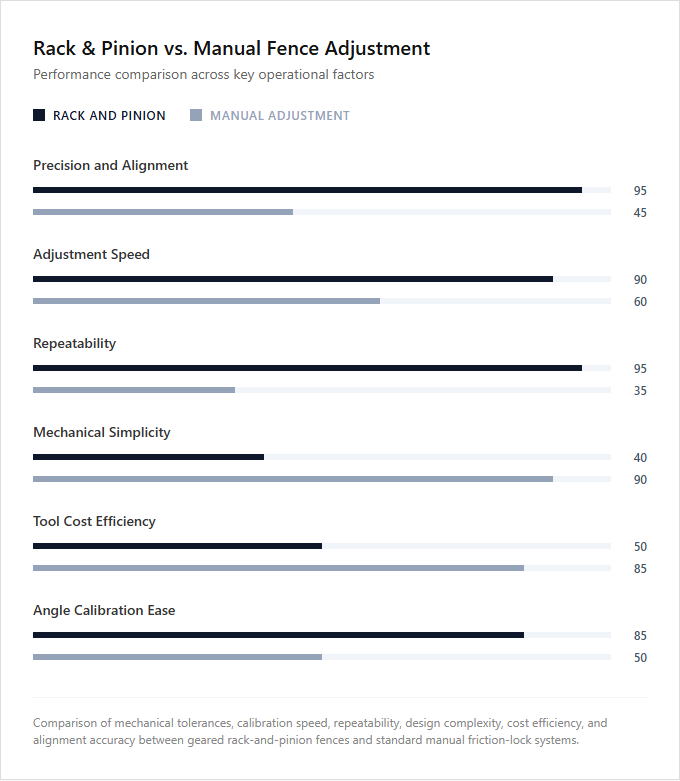
| Precision and Alignment | Rack and pinion systems offer superior parallelism and micro-adjustment capabilities, whereas manual fences are prone to human error and misalignment during locking. |
| Adjustment Speed | Manual fences allow for rapid macroscopic positioning but require extra time for fine-tuning, while geared mechanisms facilitate swift, highly calibrated height changes. |
| Repeatability | The geared rack and pinion ensures high dimensional consistency across multiple cuts, while manual adjustment relies on visual alignment, increasing the risk of parallax error. |
| Mechanical Complexity | Rack and pinion systems involve precise pinion gear engagement which can trap sawdust, whereas manual systems feature a simplified friction-lock mechanism with fewer moving parts. |
| Tool Cost | Biscuit joiners featuring rack and pinion fences command a premium due to tighter machining tolerances, while manual adjustment models offer a lower cost of entry. |
| Angle Calibration | Rack and pinion designs often integrate positive stops at common bevel angles, whereas manual fences require independent calibration against a scale. |
Maintaining Cutter Spindle Parallelism via Rack and Pinion
When selecting a biscuit joiner, the fence adjustment mechanism directly impacts joinery precision. A rack and pinion fence system utilizes geared engagement to maintain absolute parallelism relative to the cutter blade spindle axis. This synchronized mechanical movement eliminates the risk of fence skewing during height adjustments, ensuring highly repeatable, flush wood joints.
Manual fence systems rely on manual alignment along graduated scales and individual locking levers. While highly functional, manual adjustments require careful user verification to prevent minor misalignments that can ruin workpiece registration. Geared rack and pinion systems are ideal for professional cabinetmakers requiring rapid, error-free setups, whereas manual fences are well-suited for budget-conscious hobbyists who do not mind taking extra time to calibrate their cuts.
Manual Fence Height Deviation During Clamping
When selecting a biscuit joiner, the fence adjustment mechanism is critical for ensuring precise joint alignment. Manual fence systems rely on manual positioning and a friction lock clamp lever. However, these manual setups are highly susceptible to height deviations; the downward force applied when tightening the clamp lever can inadvertently shift the fence out of calibration, leading to misaligned biscuit slots.
In contrast, rack and pinion fence systems utilize a geared track that keeps the fence perfectly parallel and secure during adjustment. High-volume furniture makers requiring absolute precision benefit most from rack and pinion systems, whereas hobbyists prioritizing budget over rapid setup times may prefer manual fences.
Micro-Adjusting Geared Fences for Precise Centerline Calibration
When selecting a biscuit joiner, the fence adjustment mechanism significantly impacts accuracy and workflow speed. Rack and pinion fence systems utilize a geared track to keep the fence perfectly parallel to the blade during height transitions. The primary advantage of this geared design is the inclusion of micro-adjustment knobs, which allow operators to perform precise calibrations to the exact centerline of the workpiece, eliminating the minor deviations common in free-hand setups.
In contrast, manual fence adjustments rely on friction locks and direct physical positioning along a scale. While manual fences require more frequent verification and tactile fine-tuning, they offer a simpler, lightweight design with fewer moving parts. High-precision cabinetmakers and furniture craftsmen typically require the exactness of geared rack and pinion fences, whereas general contractors and hobbyists often prefer the rugged simplicity and portability of manual fence systems.
Dual-Pinion Gear Synchronization Eliminates Lateral Play
In high-precision woodworking, the mechanism governing fence adjustment on a biscuit joiner dictates joinery alignment. Rack and pinion fence systems utilize dual-pinion gear synchronization to keep the fence perfectly parallel to the blade throughout its travel. This mechanical engagement eliminates the lateral play and shifting often found in manual systems, where guide rail tolerance slop can introduce minor angling errors during clamping.
Manual fence adjustments rely on sliding rails and user-tightened knobs, which are susceptible to deviation if pressure is applied unevenly. While manual systems are simpler, the synchronized gears of a rack and pinion system ensure repeatable, dead-on accuracy for critical flush joints. High-volume cabinetmakers requiring rapid, foolproof setups benefit most from rack-and-pinion precision, whereas hobbyists tackling occasional joining tasks may find the cost-effective simplicity of a manual fence sufficient.
Geared Vertical Tracking Enhances Datum Face Registration
When selecting a biscuit joiner, the fence adjustment mechanism directly impacts joint alignment precision. A rack and pinion fence utilizes geared vertical tracking to ensure the fence remains perfectly parallel to the blade throughout its travel. This mechanical synchronization reliably preserves constant datum face registration, preventing the slight skewing that often occurs during manual lock-down procedures.
In contrast, manual fence systems rely on user-guided sliding scales and friction locks. While highly functional, manual adjustments demand meticulous double-checking to prevent minor misalignments that can ruin workpiece registration. High-volume furniture makers and precision woodworkers benefit most from the repeatable accuracy of rack and pinion gearing, whereas occasional DIY hobbyists may find the simpler, cost-effective manual adjustment sufficient for basic alignment needs.
Parallax Error in Manual Fence Alignment
When selecting a biscuit joiner, the fence adjustment mechanism significantly impacts joinery precision. Manual fence systems rely on the operator to visually align the height and angle scales before locking the mechanism in place. This manual alignment often introduces subtle inaccuracies due to parallax error, where viewing the scale from an angled perspective misrepresents the actual physical setting and leads to misaligned biscuit slots.
In contrast, rack and pinion fence systems utilize geared tracks to ensure the fence remains perfectly parallel to the blade during adjustments. This mechanical tracking eliminates the guesswork of manual alignment, ensuring consistent depth and spacing across multiple workpieces. Woodworkers requiring rapid, high-volume production benefit most from the precision of rack and pinion fences, while budget-conscious hobbyists performing occasional joints may find the manual fence sufficient for their pacing.
Inconsistent Fence Clamping Causes Joint Misalignment
When selecting a biscuit joiner, the fence adjustment mechanism directly impacts joint alignment. Manual fence systems require the operator to secure the height and angle using independent locking levers. Inconsistent clamping pressure on these manual fences often introduces microscopic shifts during operation, leading to kerf misalignment and uneven flush joints that require extensive correction during assembly.
Rack and pinion fence systems resolve this vulnerability by utilizing geared tracks to maintain perfect parallelism. This mechanical synchronization prevents the fence from slipping under downward pressure, ensuring consistent biscuit slot height. Manual fences suit budget-conscious hobbyists performing occasional alignments, whereas rack and pinion fences are indispensable for production-grade woodworkers requiring rapid, repeatable precision.
Leave a comment