
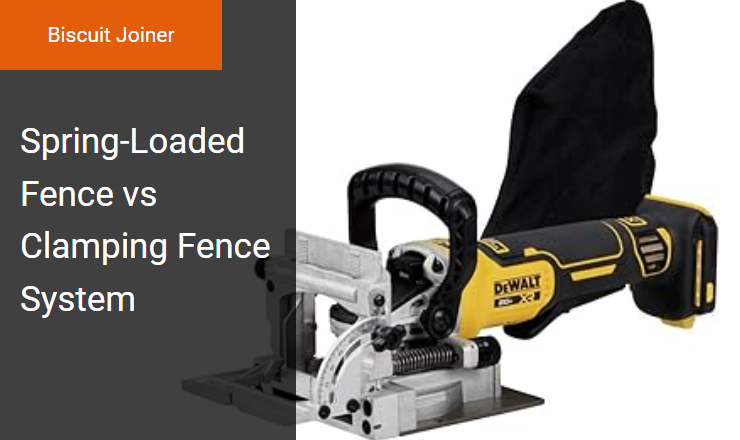
For professional woodworkers, few workshop errors are more frustrating than a misaligned biscuit slot that ruins a critical panel glue-up. While traditional workshop preparation relies on standard manual layouts and basic bench-dog stabilization, these baseline methods often fail to prevent micro-slippage during the physical plunge cut.
Upgrading to a sophisticated fence system grants operators the mechanical repeatability required for flush, paint-ready joints. However, achieving this level of accuracy stipulates that woodworkers carefully evaluate how different fence designs manage tool deflection under lateral pressure. This is especially vital when switching between delicate applications, such as #0 biscuits in mitered frames, and heavy-duty tasks like #20 biscuits in dense white oak.
In this guide, we provide a comparative analysis of spring-loaded fences versus robust clamping fence systems. We will examine how each mechanism impacts plunge-cut registration, setup velocity, and long-term calibration accuracy.
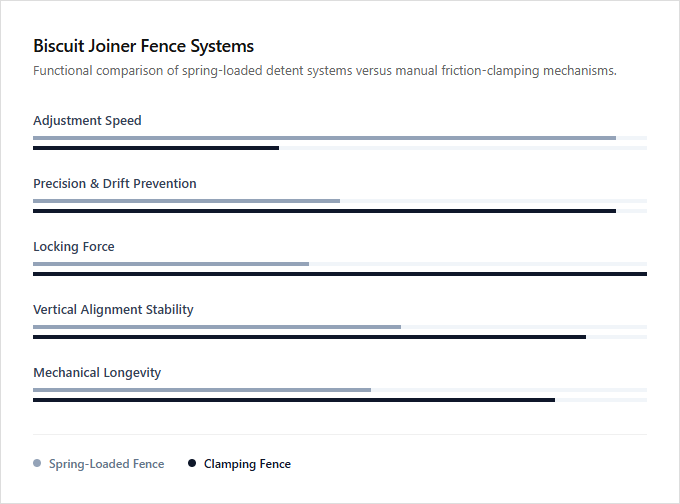
| Factor | Summary |
|---|---|
| Adjustment Speed | Spring-loaded fences offer rapid positioning via pre-set detents, whereas clamping systems require manual locking of a lever which reduces setup efficiency. |
| Precision and Drift | Clamping fences provide superior parallelism to the blade, eliminating the microscopic fence deflection often caused by spring tension during plunge cuts. |
| Locking Force | While a spring-loaded fence relies on internal spring tension, a clamping system utilizes a friction-based mechanical advantage to completely eliminate vertical play. |
| Vertical Alignment | Clamping fences maintain strict coplanar alignment when working vertically, whereas spring-loaded systems are susceptible to slippage prior to the plunge. |
| Mechanical Longevity | Spring-loaded mechanisms are prone to spring fatigue over time, whereas clamping systems feature robust physical linkages that offer superior wear resistance. |
Resistance to angular deflection under plunge force
In biscuit joining, maintaining a precise fence angle during the plunge cut is critical for achieving flush joints. Clamping fence systems excel in resisting angular deflection under plunge force. By utilizing dual locking mechanisms or positive mechanical clamps, these fences remain completely rigid when the tool is pushed forward, preventing any upward or downward pivoting that could ruin workpiece alignment.
Spring-loaded fence designs offer rapid, fluid height adjustments but are inherently more susceptible to micro-deflections under heavy plunge pressure. If the operator applies uneven downward force during the cut, the spring-loaded mechanism can yield slightly, leading to sloped biscuit slots. Rigid clamping fences are best suited for professional cabinetmakers requiring absolute structural precision, while spring-loaded fences are ideal for hobbyists who prioritize setup speed and ease of use.
Stability of the datum surface interface during blade extension
The stability of a biscuit joiner's datum surface during blade extension depends heavily on the fence mechanism. A spring-loaded fence relies on continuous manual pressure to keep the fence flush against the workpiece. As the blade plunges, the opposing force of the internal springs can cause slight deflection if the operator's grip wavers, risking minor misalignments along the cutting plane.
In contrast, a clamping fence system mechanically locks the fence securely in place before the plunge begins. This rigid connection ensures that the datum surface remains perfectly stationary throughout the blade's entry and exit, entirely unaffected by the counter-forces of the cutting action.
Spring-loaded configurations are best suited for fast-paced cabinetmakers who value rapid repositioning, while clamping systems are ideal for detail-oriented artisans who prioritize maximum joint precision over operational speed.
Micro-adjustment accuracy using rack-and-pinion gearing versus spring-loaded sliding scales
When selecting a biscuit joiner, the fence adjustment mechanism directly impacts joinery precision. Clamping fence systems paired with rack-and-pinion gearing deliver superior micro-adjustment accuracy. This geared drive allows operators to make minute, measurable height increments that remain locked securely under heavy physical pressure, eliminating the risk of fence slippage during operation.
Spring-loaded fence systems utilize sliding scales that prioritize speed and fluid movement. This design relies on spring tension to glide along pre-marked scales, allowing rapid vertical positioning, though it lacks the mechanical precision and positive engagement of geared systems.
Cabinetmakers requiring tight-tolerance, flush-mounted joints benefit most from the rack-and-pinion clamping system, whereas general contractors and onsite installers prioritizing rapid setups and workflow speed will find the spring-loaded fence highly efficient.
Prevention of lateral drift with integrated high-friction non-slip fence pads
When utilizing a biscuit joiner, preventing lateral drift during the plunge cut is critical for achieving precise joint alignment. Spring-loaded fence systems rely on manual downward pressure to engage integrated high-friction, non-slip pads against the workpiece, stabilizing the tool just before the blade penetrates the wood. This design allows for rapid, sequential positioning, as the slip-resistant pads compress and grip the surface instantly upon tool engagement.
A clamping fence system mechanically locks the tool directly to the workpiece before the cut begins. This physical lock, combined with embedded non-slip faceplates, completely eliminates any chance of shifting, even under heavy lateral forces. While the spring-loaded fence is ideal for high-production woodworkers prioritizing speed and fluid movement, the clamping fence system is best suited for precision craftsmen executing critical, heavy-duty alignments where zero tolerance for error exists.
Maintenance of strict coplanar alignment during the plunge cycle
In biscuit joining, maintaining strict coplanar alignment during the plunge cycle is critical for achieving perfectly flush joints. Spring-loaded fence systems rely on continuous manual downward pressure to counteract internal spring tension as the blade engages the wood. While this design allows for rapid, sequential slot cutting, any slight variation in operator pressure during the plunge can cause the fence to tilt, resulting in misaligned slots and uneven joint faces.
In contrast, a clamping fence system mechanically locks the fence securely in place before the plunge begins. This rigid immobilization eliminates the risk of fence drift, ensuring the blade enters the workpiece on a perfectly parallel trajectory. Spring-loaded fences are best suited for high-volume production woodworkers prioritizing speed, whereas clamping systems are ideal for precision-oriented craftsmen executing critical, high-tolerance furniture joinery.
Vertical Height Repeatability: Detents vs. Manual Clamps
Biscuit joiner fence systems significantly impact joinery precision, particularly regarding vertical height alignment. Spring-loaded fences utilizing detent-based height registration offer predefined, stepped increments. This design allows operators to rapidly click into common material thicknesses, ensuring highly repeatable vertical positioning without manual measurement. The positive mechanical stops eliminate the minor deviations that often occur during repetitive setups.
Manual clamping fence systems rely on friction locks to secure the fence at any point along a continuous scale. While this provides infinite adjustment for non-standard wood thicknesses, achieving identical height repeatability across multiple workpieces requires careful calibration and manual verification. High-volume production woodworkers prioritizing speed and mistake-proof repetition benefit most from detent-based systems, whereas custom furniture makers requiring highly bespoke, non-standard offsets prefer the micro-adjustability of manual clamping fences.
Centerline Registration Under Dynamic Compression
When utilizing a biscuit joiner, maintaining precise alignment of the centerline registration index under dynamic compression loads is critical for achieving flush joints. Spring-loaded fence systems offer rapid tactile feedback during plunge operations, but the continuous resistance of the spring can cause micro-deflections that temporarily obscure or shift the visual registration line. Conversely, a clamping fence system mechanically locks the vertical and angular settings securely in place, ensuring the registration index remains perfectly stationary and highly visible throughout the entire plunge stroke.
The mechanical rigidity of the clamping system eliminates the risk of fence drift during heavy downward pressure, whereas spring-loaded designs require highly consistent hand pressure to prevent alignment deviation. Spring-loaded fences are ideal for production-focused woodworkers requiring rapid, high-speed adjustments, while clamping fence systems are best suited for precision furniture makers who prioritize absolute joint alignment over cycle speed.
Leave a comment