
Achieving perfectly flush joints with a biscuit joiner can be an exercise in frustration. Even a minor deviation in height registration during slot cutting can result in misaligned faces, requiring hours of corrective sanding or ruined workpieces. Traditionally, woodworkers attempt to resolve these alignment errors by relying on standard workshop capital investments, such as premium clamping tables or expensive aftermarket support jigs, to stabilize their work.
However, understanding the intrinsic engineering of your tool's fence is what ultimately grants craftsmen absolute vertical precision and effortless repeatability. To manage expectations, we must stipulate that no fence design-no matter how advanced-can overcome poor physical technique or improper tool calibration.
When executing demanding projects like mitered cabinet carcases or face-frame assemblies, the choice of fence style becomes critical. Below, we will compare the mechanics of pivot fences versus sliding fences, examine how each affects height registration, and outline key factors to help you optimize your joinery workflow.
| Factor | Summary |
|---|---|
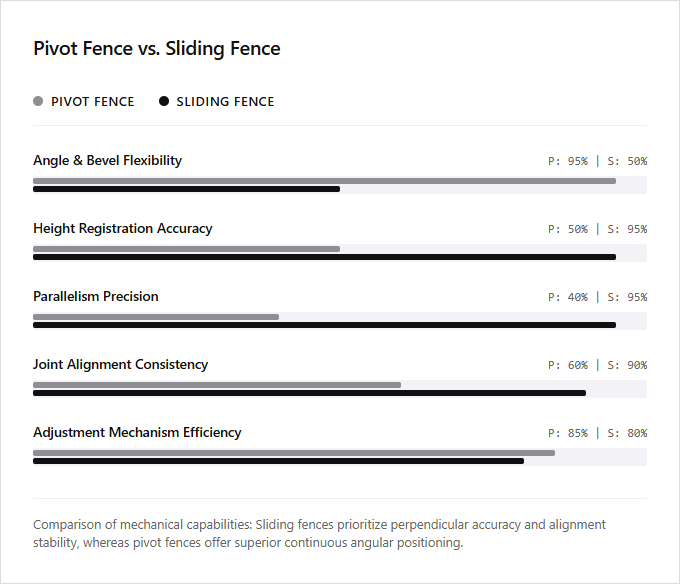
| Adjustment Mechanism | A pivot fence rotates around a fixed axis point, whereas a sliding fence utilizes a rack-and-pinion system to move vertically while remaining parallel to the blade. |
| Height Registration | Sliding fences maintain a constant perpendicular relationship to the cutter head during vertical adjustment, whereas pivot fences alter the reference distance relative to the kerf line when angled. |
| Bevel Capacity | Pivot fences excel at indexing irregular angles along a continuous tilt scale, while sliding fences often rely on positive stops at ninety and forty-five degrees. |
| Parallelism Precision | Sliding fences reduce the risk of coplanar misalignment by keeping the fence face perfectly parallel to the spindle axis during height changes. |
| Joint Alignment | The stable tracking of a sliding fence ensures consistent slot depth registration, whereas a pivot fence requires careful calibration to prevent offset errors in mitered joints. |
Always-Parallel Sliding Fences for Vertical Adjustment
When selecting a biscuit joiner, the fence design significantly impacts joinery precision. Pivot fences rotate on an axis to adjust height, which can introduce minor angular misalignments if not carefully calibrated. In contrast, sliding fences move vertically on a dual-track system, maintaining absolute parallelism to the cutter spindle axis during vertical adjustment. This constant alignment ensures that slots remain perfectly parallel to the workpiece surface, regardless of height changes.
The choice between these mechanisms depends on the operator's specific workflow and precision requirements. Pivot fences offer rapid, intuitive adjustments for standard joinery tasks, while sliding fences provide the exacting accuracy needed for complex, multi-level cabinetry. Pivot fences suit general hobbyists prioritizing speed and simplicity, whereas sliding fences are ideal for professional furniture makers requiring flawless alignment across varied material thicknesses.
Pivot Fence Perpendicularity Risks During Height Changes
When selecting a biscuit joiner, the fence mechanism design significantly impacts joinery precision. Pivot fences rotate around a fixed axis to adjust height, which introduces a risk of perpendicularity errors. Because the adjustment relies on a rotational arc, maintaining a perfect 90-degree angle to the blade becomes mechanically difficult, potentially causing alignment issues during final assembly.
Sliding fences adjust vertically along a precise track, keeping the fence face perfectly parallel to the blade during height changes. This linear movement eliminates the angular deviations inherent in pivoting mechanics, ensuring highly repeatable cuts. Professional furniture makers requiring absolute precision across varying material thicknesses benefit most from sliding fences, while hobbyists performing standard cabinet joinery find the simpler pivot fence highly adequate.
Precise Rack-and-Pinion Sliding Fence Calibration
When selecting a biscuit joiner, the fence mechanism fundamentally dictates your woodworking precision. Pivot fences rotate around a single axis, offering rapid angle adjustments but occasionally compromising vertical alignment. In contrast, sliding fences move perpendicular to the blade, maintaining strict parallelism. Premium sliding fences utilize a rack-and-pinion vertical adjustment system, which allows for precise micrometric height calibration to ensure exact slot centering on diverse wood thicknesses.
This rack-and-pinion drive eliminates the minor shifting common in manual pivot designs, securing the fence firmly for repeatable cuts. Pivot fences are best suited for general DIYers prioritizing quick bevel setups, while sliding fences are essential for professional cabinetmakers requiring flawless, microscopic alignment in production work.
Sliding Fences with Dual-Datum Registration
When selecting a biscuit joiner, the fence design critically impacts joinery precision. Pivot fences rotate around a single axis, which can introduce minor angular drift during height adjustments. In contrast, sliding fences maintain absolute parallelism by moving vertically along dedicated guide rails. This sliding mechanism offers dual-datum surface registration, allowing woodworkers to reference cuts reliably from either the fence face or the tool's cast base plate without losing calibration.
This dual-datum capability ensures consistent slot alignment when working with varying stock thicknesses. While pivot fences suit hobbyists seeking a straightforward tool for quick, occasional miter joints, sliding fences are ideal for precision-oriented professionals who require versatile, error-free registration for complex cabinetry.
Pivot Fence Locking Shifts Cause Centerline Deviation
When selecting a biscuit joiner, the choice between a pivot fence and a sliding fence significantly impacts joinery precision. Pivot fences rotate around a single axis point, which introduces a critical vulnerability: if the locking mechanism shifts even slightly during tightening, the fence angle alters, causing a vertical centerline deviation. This deviation leads to misaligned biscuit slots and uneven joints during assembly.
Sliding fences maintain a perpendicular relationship to the blade throughout their vertical travel, ensuring consistent height adjustments without risk of angular drift. General hobbyists requiring rapid, multi-angle adjustments often favor the versatile pivot fence, while precision-focused cabinetmakers and production shops benefit more from the reliable alignment of the sliding fence.
Sliding Fences Minimize Deflection for Level Kerfs
When selecting a biscuit joiner, the fence mechanism directly influences joint alignment and overall precision. Pivot fences rotate on a single axis, which can occasionally introduce angular deviation if plunge pressure is uneven. Sliding fences, by comparison, adjust vertically along dedicated guide tracks, ensuring the fence remains perfectly parallel to the blade throughout the operation.
Sliding fences minimize cantilever deflection under plunge pressure to keep the kerf level and prevent slot misalignment. This rigid design eliminates the risk of joint mismatch during glue-up. Budget-conscious DIYers and general renovators typically benefit from the simplicity of a pivot fence, while professional cabinetmakers and precision woodworkers require the unyielding accuracy of a sliding fence.
Sliding Fences Simplify Inside-Face Miter Alignment
When selecting a biscuit joiner, the choice between a pivot fence and a sliding fence significantly impacts joinery precision. While pivot fences rotate around a fixed pivot point, sliding fences adjust vertically while remaining parallel to the blade. This parallel movement is particularly advantageous when working with miter joints.
Registering from the inside face of a miter joint requires exact positioning to ensure the exterior surfaces align perfectly. A sliding fence simplifies this coplanar alignment by maintaining a constant 90-degree relationship to the miter face, allowing for consistent height adjustments without introducing angular errors.
Pivot fences are well-suited for casual DIYers undertaking standard right-angle butt joints, whereas sliding fences are ideal for professional cabinetmakers and precision woodworkers who frequently execute complex mitered cabinetry.
Leave a comment