
Many blasting operators regularly struggle with the frustrating reality of sluggish abrasive velocity and unexplained pressure loss at the nozzle, which severely compromises productivity and increases project timelines. While standard troubleshooting manuals typically direct operators to invest in costly compressor upgrades or adjust regulator settings, the root cause of this inefficiency is frequently a fundamental mismatch in the plumbing of the air delivery system.
Understanding the precise relationship between your blast hose Inner Diameter (ID) and the nozzle orifice size is the key variable; optimizing this ratio grants operators maximum kinetic energy transfer and near-zero friction loss. It is important to stipulate, however, that these efficiency gains remain contingent upon system-wide CFM capacity and total hose length.
For example, pairing a 1-1/4 inch ID blast hose with a #5 (5/16-inch) nozzle ensures unrestricted, high-velocity airflow, whereas choking that same nozzle with a restrictive 3/4-inch hose guarantees a severe, energy-killing pressure drop. In this article, we will analyze critical ID-to-orifice sizing charts, explore the physics of pressure drop, and outline how to configure your system for peak performance.
| Factor | Summary |
|---|---|
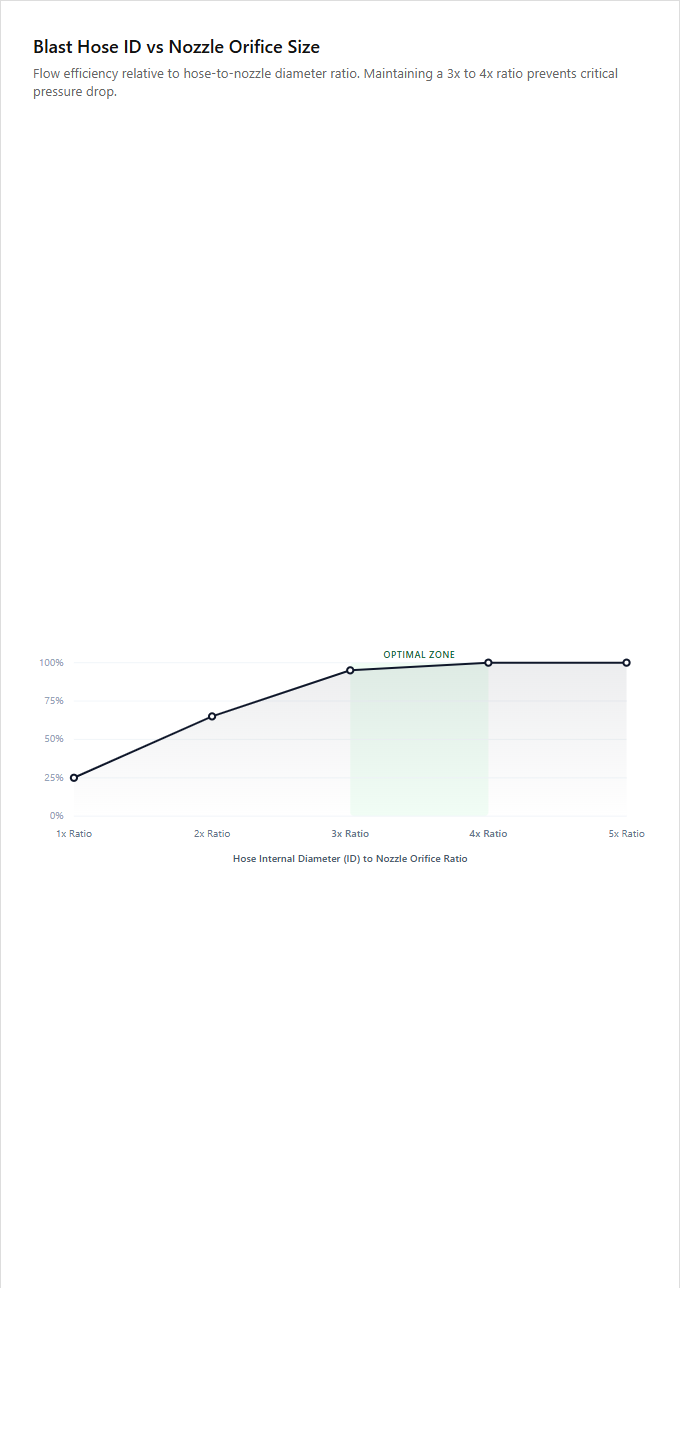
| Hose-to-Nozzle Ratio | Maintaining a blast hose internal diameter (ID) that is three to four times the nozzle orifice size is critical to prevent significant frictional pressure loss. |
| System Pressure Drop | A blast hose ID that is too small relative to the nozzle restricts air flow, resulting in a severe drop in operating pressure at the nozzle tip. |
| Orifice Erosion | As the nozzle orifice expands over time due to abrasive wear, the original hose ID may no longer support the increased volumetric flow rate. |
| Velocity Reduction | The difference in cross-sectional area between the hose and the nozzle dictates the velocity and subsequent kinetic energy of the blasting media. |
| CFM Optimization | Properly matching the hose ID and nozzle size ensures the air compressor can sustain the necessary cubic feet per minute (CFM) output. |
| Flow Turbulence | An improper transition from a large hose ID to a constricted nozzle orifice creates turbulent flow, which accelerates wear at the nozzle coupling. |
4:1 Hose-to-Nozzle Ratio Prevents Friction Loss
In abrasive blasting, maintaining optimal velocity and air pressure is critical for operational efficiency. The relationship between the blast hose inner diameter (ID) and the nozzle orifice size directly dictates overall system performance. To prevent frictional head loss-which significantly reduces impact pressure at the nozzle-industry standards recommend a strict four-to-one ratio. This means the blast hose ID must be at least four times the size of the nozzle orifice to ensure unrestricted airflow.
Deviating from this ratio restricts air volume and accelerates internal hose wear, leading to severe drop-offs in productivity. Ensuring the proper pairing guarantees that the air-abrasive mixture flows smoothly without turbulent restriction. This precise 4:1 configuration is standard for high-production industrial operators requiring continuous peak performance, while smaller, non-standard ratios are typically limited to hobbyists undertaking light-duty, intermittent spot cleaning.
Undersized Blast Hoses Cause Flow and Pressure Drop
In abrasive blasting, matching the blast hose inner diameter (ID) to the nozzle orifice size is critical for system efficiency. An undersized blast hose restricts the volumetric flow rate of air and abrasive, creating a bottleneck before the media reaches the nozzle. This restriction causes a significant pneumatic pressure drop, which reduces particle velocity and decreases overall blasting productivity. For optimal performance, the hose ID should be three to four times the size of the nozzle orifice.
Properly sizing these components ensures that pneumatic energy is fully utilized at the blast surface rather than lost to frictional resistance. Industrial contractors requiring high-production rate paint removal utilize large-diameter hoses paired with wide orifices, while precision restorers performing detailed etching favor smaller, highly flexible setups to maintain control.
Optimizing Hose Size for Maximum Abrasive Velocity
Achieving maximum kinetic energy transfer in abrasive blasting requires a precise relationship between the blast hose inner diameter (ID) and the nozzle orifice size. To maintain high abrasive velocity and minimize pressure drop caused by friction, the hose ID should ideally be three to four times the size of the nozzle orifice. This proportional sizing ensures that air volume is preserved, preventing energy loss before the media reaches the discharge point.
When the pressurized air-media mixture transitions from a wider hose into the restricted nozzle orifice, it accelerates rapidly to its peak velocity. This velocity spike is critical for delivering the high-impact force needed to efficiently shear away tough surface contaminants. High-volume industrial contractors require large-diameter hose and nozzle setups for rapid bulk coating removal, whereas precision-focused automotive restorers are better suited to smaller, highly maneuverable configurations that offer targeted control.
Nozzle Wear: Adjusting Hose Size for Increased CFM
In abrasive blasting, the ratio between the blast hose inner diameter (ID) and the nozzle orifice size is critical for maintaining velocity. As the nozzle orifice wears from use, its diameter expands, which increases the cubic feet per minute (CFM) demand required to sustain pressure. If the hose ID is too narrow for this increased air volume, frictional pressure loss occurs, reducing efficiency.
To prevent this, operators must scale the hose ID proportionally to accommodate the higher CFM. Small-ID hoses with narrow orifices are ideal for precision-focused DIY hobbyists, whereas large-ID hoses paired with wider orifices are essential for industrial contractors managing high-volume, continuous operations.
Nozzle as the Primary Flow Restriction Point
In abrasive blasting, maintaining pressure at the nozzle is critical for system efficiency. The inner diameter (ID) of the blast hose must remain larger than the nozzle orifice to ensure the nozzle serves as the primary restriction point. If couplings, fittings, or whip hoses restrict the flow prematurely, the system suffers from significant pressure drops and accelerated wear rather than achieving maximum velocity at the target surface.
Properly sizing the hose ID to be three to four times the nozzle orifice diameter preserves air velocity and optimizes abrasive impact. Large-bore systems with matching high-flow nozzles are suited for industrial contractors performing heavy-duty paint and rust removal, whereas smaller hose and nozzle combinations benefit automotive restorers and hobbyists who require precise, detailed media control.
Larger Diameters Reduce Shear Stress and Maintain Flow
Selecting the correct ratio between the blast hose inner diameter (ID) and the nozzle orifice size is critical for optimizing pneumatic blasting efficiency. A larger hose ID minimizes the boundary layer shear stress experienced by the air-abrasive mixture along the conduit walls. This reduction in friction maintains optimal flow velocity and pressure, ensuring that kinetic energy is fully transferred directly to the nozzle restriction.
To prevent significant pressure drops, industry standards dictate that the hose ID should be three to four times the size of the nozzle orifice. Maintaining this proportion ensures constant media velocity and prevents premature wear of the blast equipment. High-volume industrial contractors require large-ID hoses with wide orifices for rapid, heavy-duty coating removal, while precision automotive restorers find smaller, highly flexible hose configurations ideal for delicate detailing work.
Nozzle Pressure Drop Cuts Blasting Productivity
Optimizing a sandblasting system requires precisely matching the blast hose inside diameter (ID) to the nozzle orifice size. A restrictive hose ID creates friction, leading to pressure loss before the abrasive reaches the target. In industrial blasting, pressure directly correlates with efficiency. Each PSI of pressure drop at the nozzle causes a corresponding one percent decrease in blasting productivity, making proper sizing critical for maintaining velocity.
Selecting the correct configuration depends on the specific operational demands and user priorities. Small-diameter hoses paired with narrow nozzles suit detail-oriented restorers prioritizing maneuverability, while large-bore hoses paired with wide orifices are designed for heavy-duty industrial operators requiring maximum coverage speed.
Leave a comment