
Choosing the incorrect abrasive media for your sand blaster can permanently warp sheet metal or destroy delicate substrates, turning a high-stakes restoration project into an expensive setback. While workshop budgets and standard equipment funding sources often prioritize the blasting unit itself, the true variable of success lies in the media running through it.
Selecting the correct media grants operators unparalleled precision and surface integrity. However, achieving these professional results is strictly stipulated on understanding the physical limitations, hardness ratings, and breakdown rates of each material. For instance, restoring vintage automotive panels or stripping delicate log homes requires a vastly different approach than cleaning heavy structural steel.
This article provides a comparative analysis of two industry standards-organic walnut shells and recyclable glass beads-examining their cutting speeds, finish profiles, and ideal applications to optimize your restoration workflow.
| Factor | Summary |
|---|---|
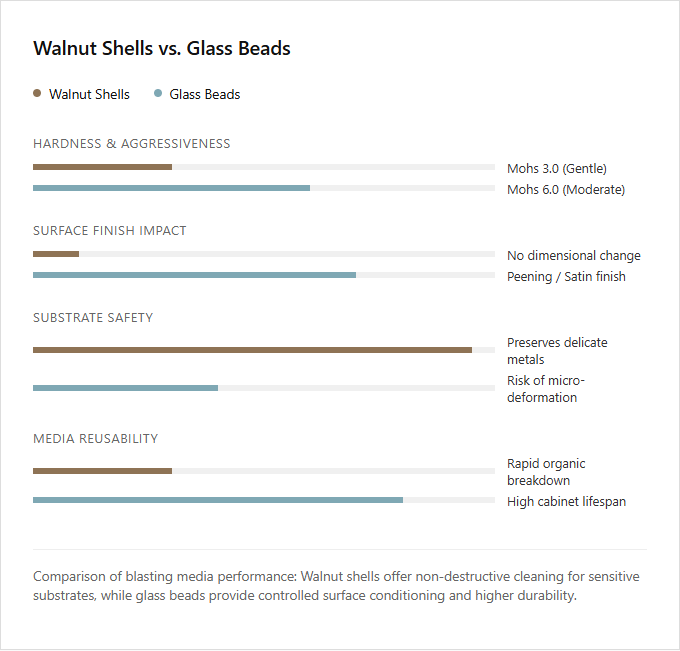
| Hardness | Walnut shells rank lower on the Mohs hardness scale than glass beads, making them much less aggressive during abrasive blasting operations. |
| Surface Finish | Glass beads alter the metal surface through a peening action to create a satin finish, whereas walnut shells clean surfaces without causing any dimensional change. |
| Substrate Damage | Walnut shells preserve substrate integrity on delicate surfaces like aluminum, while glass beads can cause micro-deformation if used on soft metals. |
| Common Applications | Walnut shells are widely used for deflashing electronic components, whereas glass beads are preferred for removing mill scale and rust from steel. |
| Reusability | Glass beads have a lower media breakdown rate in blast cabinets compared to the quicker degradation of organic walnut shell abrasives. |
| Health and Safety | Walnut shells offer a completely biodegradable option, while glass beads provide a silica-free composition that mitigates the risk of silicosis. |
Walnut Shells: Gentle Blasting for Delicate Metals
When selecting media for a sand blaster, understanding material hardness is essential to prevent substrate damage. Walnut shells feature a lower Mohs hardness rating than glass beads, making them highly effective for stripping coatings from delicate metals without altering the underlying surface. This gentle action preserves the structural integrity of softer alloys during the cleaning process.
In contrast, glass beads possess a higher Mohs rating, offering a more aggressive action suited for removing rust and creating a uniform, satin finish. Choosing the correct abrasive depends on the vulnerability of the workpiece. Walnut shells are ideal for automotive restorers working on fragile aluminum trim, whereas glass beads are suited for industrial fabricators seeking a smooth, peened finish on robust steel parts.
Glass Bead Peening for Satin Finishes
When selecting abrasive media for a sand blaster, the choice between walnut shells and glass beads depends on the desired surface finish and material integrity. Glass beads are ideal for cleaning and finishing metal without removing base material. They create a bright, satin finish through a surface deformation process known as peening, which strengthens the metal's surface by compressing it.
Walnut shells offer a softer, biodegradable alternative that effectively removes paint and corrosion from delicate surfaces like wood or fiberglass without etching. Technicians working on structural metal restoration benefit most from glass beads, while automotive restorers working with fragile, non-ferrous components will find walnut shells ideal.
Damage-Free Coating Removal Using Walnut Shells
When selecting abrasive media for sandblasting engineered components, the choice between walnut shells and glass beads depends on the required surface impact. Walnut shells are a soft, organic abrasive ideal for delicate operations. They excel at selective coating removal, allowing operators to strip paint, dirt, or carbon deposits without causing any dimensional change to the engineered workpiece.
Glass beads serve a different purpose by providing a harder, spherical media designed for cleaning, finishing, and light deburring. This media produces a bright, satin finish by peening the metal surface, which can slightly alter surface dimensions. Vintage vehicle restorers favor walnut shells for stripping paint without damaging underlying brass or aluminum, while industrial machinists prefer glass beads for deburring and polishing robust steel fabrications.
Low-Friability Glass Beads Increase Reclaim Cycles
When selecting abrasive media for blast cabinet systems, understanding material durability is key to operational efficiency. Glass beads are highly valued for their low friability, meaning they resist fracturing upon impact. This physical resilience allows the media to be reclaimed and reused through multiple cycles, making glass beads a highly cost-effective option for consistent, satin-like surface finishing without dimensional change to the workpiece.
In contrast, walnut shells are a biodegradable, soft abrasive designed for delicate cleaning without altering underlying substrates. Restoration technicians requiring gentle, non-destructive paint and carbon removal on sensitive components utilize walnut shells, whereas industrial machinists focusing on efficient metal peening and high-volume part cleaning benefit most from glass beads.
Walnut Shells: A Biodegradable, Silica-Free Media
Selecting the correct abrasive media for sandblasting depends heavily on the workpiece material and safety standards. Walnut shells are a biodegradable, organic media that eliminates the risk of free silica exposure, protecting operators from respiratory hazards. This soft, agricultural aggregate effectively cleans delicate surfaces without causing surface etching or dimensional changes.
In contrast, glass beads offer a harder, reusable alternative that delivers a smooth, satin finish by peening the metal surface. This process removes light deposits and improves fatigue strength without removing base metal. Walnut shells are best suited for automotive restorers cleaning sensitive engine parts, whereas glass beads are preferred by metal fabricators requiring a bright, uniform finish on steel machinery.
Glass Bead Blasting Enhances Metal Fatigue Resistance
When selecting blasting media for surface preparation, the choice between walnut shells and glass beads depends on the specific material requirements. Glass bead blasting is highly effective for metal finishing because it cleans the surface without removing parent material. This process induces compressive stress on the metal surface, which significantly improves metal fatigue resistance and prevents stress corrosion cracking over time.
In contrast, walnut shell grit is a soft, biodegradable organic media used for gentle cleaning. It effectively removes paint, dirt, and grease from delicate substrates like wood, fiberglass, or thin metals without causing surface profiling or structural damage. Glass beads are ideal for automotive machinists and aerospace technicians seeking structural reinforcement, while walnut shells are best suited for restoration specialists and DIYers working on fragile surfaces.
Walnut Shells: Damage-Free Carbon Removal
In professional abrasive blasting, selecting the appropriate media is critical to achieving the desired surface finish without damaging the underlying substrate. Walnut shell grit is a soft, biodegradable media designed for delicate cleaning applications. It is particularly ideal for removing stubborn carbon deposits, paint, and scale from sensitive components without altering the metal's original anchor pattern or surface profile.
Conversely, glass beads offer a slightly more aggressive cleaning action that excels at honing, deburring, and finishing. This media produces a bright, satin-like surface and can gently stress-relieve metal parts, though it may marginally affect the surface profile compared to organic alternatives.
Walnut shells are best suited for automotive technicians restoring delicate engine components, while glass beads are ideal for machinists seeking a clean, polished finish on fabricated metal parts.
Leave a comment