
For industrial abrasive blasting operators, premature nozzle wear is a constant, costly frustration. Frequent bore enlargement leads to sudden pressure drops, distorted blast patterns, and expensive project downtime. Historically, operations have relied on standard, budget-friendly pink alumina ceramic nozzles as their default, go-to replacement solution to manage upfront costs.
However, upgrading to specialized nozzle metallurgy grants operators dramatically extended service hours and consistent velocity, ultimately lowering the total cost of operation. It is important to stipulate that no single material is a universal cure; longevity depends heavily on operational variables, such as whether you are blasting aggressive aluminum oxide or round glass beads.
This article provides an objective comparison between Ceramic and Tungsten Carbide nozzles, evaluating their wear resistance, cost-to-benefit ratios, and media compatibility to help you select the optimal tool for your blasting system.
| Factor | Summary |
|---|---|
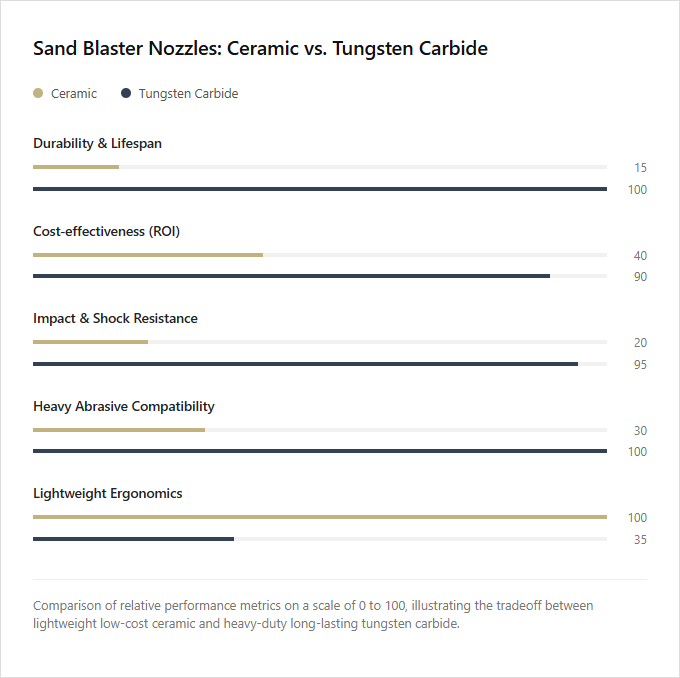
| Durability | Tungsten carbide nozzles offer significantly higher abrasive wear resistance compared to ceramic nozzles, lasting up to ten times longer under high-pressure conditions. |
| Cost-effectiveness | While ceramic nozzles have a lower initial purchase price, tungsten carbide options provide a superior return on investment due to their extended operating lifespan. |
| Impact Resistance | Ceramic nozzles are highly brittle and susceptible to fracture toughness failure when dropped, whereas tungsten carbide possesses high mechanical shock resistance. |
| Media Compatibility | Ceramic is best suited for less aggressive blasting agents like glass beads, while tungsten carbide is ideal for highly abrasive media such as aluminum oxide. |
| Weight and Ergonomics | Ceramic nozzles feature a much lower material density, making them lighter and reducing operator fatigue during prolonged sandblasting applications. |
Fracture toughness differences determining impact resistance and brittleness
When selecting sandblasting nozzles, fracture toughness is the critical factor determining overall durability. Ceramic nozzles offer excellent hardness but possess low fracture toughness. This inherent brittleness makes them highly susceptible to cracking or shattering upon sudden physical impact or when subjected to rough handling on the job site.
Tungsten carbide nozzles feature significantly higher fracture toughness. This metallurgical composition provides superior impact resistance, allowing the component to withstand accidental drops and the high-velocity internal wear of aggressive abrasives without structural failure.
Ceramic options are ideal for budget-conscious DIY hobbyists performing light, occasional tasks, while tungsten carbide alternatives are suited for industrial operators requiring rugged, long-lasting reliability under harsh daily use.
Orifice enlargement rates affecting Venturi effect efficiency and pressure maintenance
In abrasive blasting, nozzle material directly dictates pressure maintenance and Venturi effect efficiency. Ceramic nozzles experience rapid orifice enlargement under high-velocity abrasive flow. As the bore expands, the velocity of the air-abrasive mix drops, degrading the Venturi vacuum necessary to draw media efficiently and maintain uniform impact velocity.
Tungsten carbide nozzles offer superior wear resistance, maintaining their precise internal geometry for significantly longer periods. This durability ensures consistent blasting velocity and stable operating pressure by preventing the pressure drops associated with orifice erosion. Ceramic nozzles are ideal for low-frequency hobbyists on a budget, while tungsten carbide nozzles are designed for industrial professionals requiring prolonged daily operation.
Vickers hardness comparison influencing abrasive wear rates with high-Mohs media
In abrasive blasting, nozzle material selection directly dictates operational longevity when utilizing high-Mohs media like aluminum oxide or silicon carbide. Ceramic nozzles, typically composed of alumina, offer a respectable Vickers hardness of around 1,500 to 2,000 HV. In comparison, tungsten carbide nozzles provide superior structural integrity, boasting a Vickers hardness rating ranging from 1,800 to over 2,200 HV. This elevated hardness significantly mitigates the rapid abrasive wear rates caused by aggressive, high-velocity media particles.
While ceramic nozzles degrade relatively quickly under the relentless friction of high-Mohs abrasives, tungsten carbide maintains its internal bore diameter for much longer periods, ensuring consistent pressure and media flow. Ceramic options are best suited for occasional hobbyists or light-duty operators seeking a cost-effective, short-run solution, whereas tungsten carbide is ideal for high-volume industrial professionals requiring sustained precision and minimal downtime during extended blasting cycles.
Material density variance impacting nozzle weight and operator ergonomics
In abrasive blasting, the material density of the nozzle significantly influences operator comfort and control during extended use. Ceramic nozzles feature a low material density, resulting in an exceptionally lightweight component. This minimal weight reduces wrist strain and muscle fatigue, allowing operators to maintain precise maneuverability and ergonomics over long shifts.
Tungsten carbide nozzles possess a much higher material density, making them substantially heavier than their ceramic counterparts. While this additional weight increases physical exertion during manual operation, the extra mass provides a stabilizing effect that helps dampen high-pressure hose recoil.
Lightweight ceramic nozzles are ideal for DIY hobbyists performing intermittent, light-duty cabinetry work, whereas heavy tungsten carbide nozzles are best suited for industrial contractors requiring durability during continuous, high-volume blasting operations.
Cobalt binder leaching susceptibility in tungsten carbide during wet blasting
When selecting nozzle materials for abrasive blasting, the choice between ceramic and tungsten carbide involves evaluating wear resistance against specific operating conditions. While tungsten carbide offers superior durability in dry applications, it faces unique degradation in wet blasting environments. The water and chemical additives used in vapor blasting cause cobalt binder leaching, a process where the cobalt matrix holding the carbide grains together dissolves, leading to premature nozzle failure and micro-fracturing.
Ceramic nozzles, being chemically inert, are completely immune to this electrochemical leaching, maintaining their structural integrity during wet operations despite their lower overall impact resistance. Ceramic nozzles are ideal for DIY hobbyists or occasional users performing wet surface preparation, whereas tungsten carbide nozzles are best suited for high-volume industrial professionals engaged in continuous, heavy-duty dry blasting.
Operational wear life cycle and cost-per-hour efficiency ratios
Ceramic nozzles offer a budget-friendly entry point for abrasive blasting but exhibit a relatively short operational wear life cycle, typically lasting only a few hours depending on the media. While the initial purchase price is low, the rapid bore expansion increases air demand and reduces blasting pressure. This frequent degradation leads to regular downtime for replacements, resulting in a higher cost-per-hour efficiency ratio over extended projects.
Tungsten carbide nozzles deliver superior durability, lasting up to tens of hours even when utilizing highly aggressive abrasives. The higher upfront investment is offset by this prolonged life cycle, yielding a significantly lower cost-per-hour efficiency ratio during continuous operations. Ceramic options serve hobbyists and occasional DIYers executing light-duty tasks, whereas tungsten carbide is ideal for industrial contractors and high-volume professionals requiring sustained, daily performance.
Nozzle geometry degradation influencing CFM consumption and air compressor demand
Ceramic nozzles offer a lower initial investment but suffer from rapid bore erosion under abrasive wear. As the internal nozzle geometry degrades and the orifice enlarges, the tool's CFM (Cubic Feet per Minute) consumption increases exponentially. This degradation disrupts pressure consistency and forces the air compressor to run continuously, accelerating system wear and energy consumption.
Tungsten carbide nozzles resist this geometric deformation, maintaining a consistent aperture and stable CFM demand over long operational cycles. This durability ensures predictable compressor performance and optimal blasting velocity. Ceramic nozzles are suitable for occasional hobbyists undertaking short-term projects, whereas tungsten carbide nozzles are designed for high-volume professionals requiring sustained efficiency and durability.
Leave a comment