
Achieving the perfect surface finish with an abrasive sand blaster is notoriously frustrating, often leading to warped metal or profile depths that are far too aggressive for the workpiece. Typically, operators default to standard, general-purpose abrasives found at any local supplier, hoping for a one-size-fits-all result.
However, understanding the science behind specialized media grants you the exact precision needed to preserve substrate integrity while maximizing efficiency. Of course, this comes with a vital stipulation: no single abrasive works for every application; success hinges strictly on matching the media's physical properties to your specific PSI and material limits. For instance, prepping delicate aluminum components requires a vastly different approach than stripping heavy rust from structural steel.
In this guide, we will analyze the performance of Glass Beads versus Aluminum Oxide, evaluating their material removal rates, finish profiles, and cost-efficiency to help you select the ideal media for your blasting cabinet.
| Factor | Summary |
|---|---|
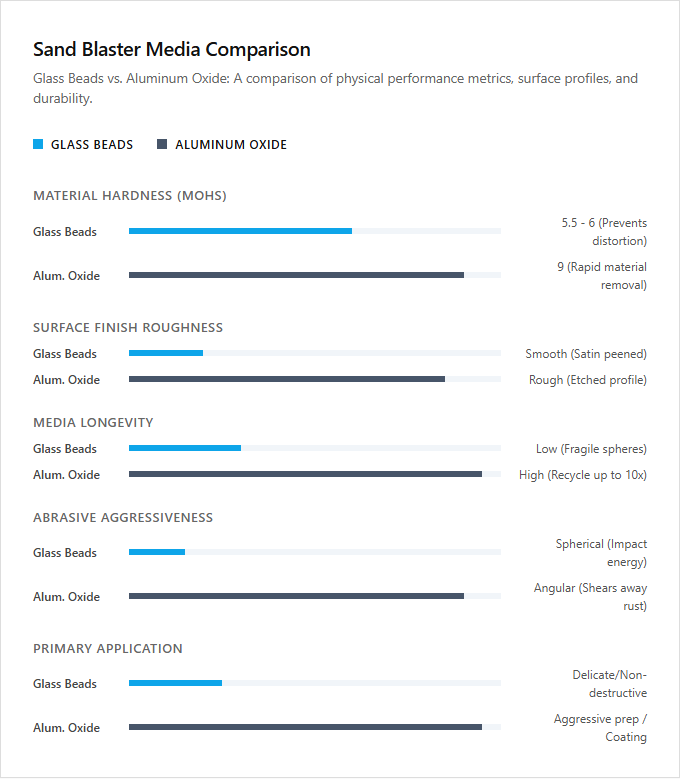
| Material Hardness | Glass beads possess a lower Mohs hardness of 5.5 to 6 to prevent dimensional change of the workpiece, while aluminum oxide features a high Mohs hardness of 9 for rapid material removal. |
| Surface Finish | Glass beads create a smooth, satin finish through a process called peening, whereas aluminum oxide creates a rough, etched profile necessary for the mechanical bonding of coatings. |
| Media Longevity | Aluminum oxide has a low friability rate allowing it to be recycled up to ten times, while fragile glass beads break down much faster under high blasting pressures. |
| Abrasive Shape | The spherical geometry of glass beads cleans surfaces via impact energy, whereas the sharp, angular grains of aluminum oxide physically shear away heavy mill scale and rust. |
| Primary Application | Glass beads are ideal for non-destructive cleaning of delicate automotive parts, whereas aluminum oxide is preferred for aggressive substrate preparation prior to powder coating. |
Aluminum Oxide vs. Glass Beads: Hardness and Applications
When selecting abrasive media for sandblasting applications, understanding material hardness is essential for achieving the desired surface finish. Aluminum oxide features a Mohs hardness of 9 for aggressive substrate profiling, making it highly effective for rapidly removing heavy rust, mill scale, and tough coatings. Glass beads measure 5.5 to 6 on the Mohs scale, offering a much gentler approach suited for non-destructive cleaning, satin finishing, and deburring without altering dimensional tolerances.
Each medium serves distinct operational requirements based on workpiece sensitivity and project goals. Heavy-duty industrial fabricators requiring deep surface etching benefit from the fast-cutting action of aluminum oxide, while automotive restorers and precision machinists working with delicate components prefer glass beads to preserve structural integrity.
Glass Bead Peening vs. Aluminum Oxide Etching
In abrasive blasting, the choice of media determines the physical impact on the target substrate. Spherical glass beads are designed for non-destructive finishing, utilizing compressive peening to stress-relieve the metal. This action improves fatigue life and resistance to stress corrosion without removing base material, resulting in a clean, satin finish.
Angular aluminum oxide is a highly aggressive media engineered for rapid material removal. It relies on a precise micro-cutting action to etch surfaces, creating a profile that optimizes subsequent coating and paint adhesion.
Glass beads are ideal for restoration specialists seeking to clean delicate components without dimensional change, whereas aluminum oxide is best suited for industrial fabricators requiring deep surface preparation for heavy-duty coatings.
Aluminum Oxide Anchor Patterns Enhance Coating Adhesion
Choosing the correct abrasive medium for sandblasting determines the quality and longevity of the final surface finish. Aluminum oxide is highly prized for its angular, aggressive profile. This medium efficiently strips tough surfaces and generates a precise anchor pattern required for high-performance coating adhesion, ensuring that subsequent paints or epoxies bond securely to the substrate.
Glass beads offer a non-destructive alternative designed for cleaning, deburring, and honing without removing base metal. This spherical media produces a smooth, satin finish that enhances the aesthetic appeal of the workpiece. Aluminum oxide is ideal for industrial coating specialists requiring maximum adhesion, while glass beads are perfect for automotive restorers and machinists seeking a clean, undamaged finish.
Aluminum Oxide Outlasts Glass Beads in Reclamation
When selecting abrasive media for sandblasting, understanding material durability is essential for operational efficiency. Aluminum oxide is highly valued for its low friability, meaning the particles resist fracturing under high-pressure impact. This structural integrity yields a high reclamation cycle rate, allowing operators to recycle the media multiple times before it degrades.
Glass beads exhibit a much faster breakdown rate upon impact. While they excel at creating a clean, satin finish without dimensional change to the substrate, their higher friability results in a rapid decline in usability. This faster degradation reduces the number of times the media can be reclaimed and reused in a blasting cabinet.
Aluminum oxide is ideal for industrial fabricators requiring aggressive, repeatable profile creation on hard metals, whereas glass beads are best suited for automotive restorers and precision machinists focusing on gentle cleaning and aesthetic finishing of delicate components.
Glass Beads Preserve Precision Machined Tolerances
When selecting abrasive media for sandblasting, the choice between glass beads and aluminum oxide depends on the required surface impact. Glass beads are ideal for applications demanding strict adherence to design specifications. Due to their spherical shape and low stock removal rate, glass beads clean, deburr, and finish surfaces without altering dimensional tolerances, preserving the integrity of delicate, precision-machined components.
Aluminum oxide is an angular, highly aggressive medium designed for rapid material removal, profiling, and deep etching. While aluminum oxide excels at stripping tough coatings, it can easily compromise the precise measurements of sensitive parts. Precision machinists and restoration specialists require glass beads for gentle surface conditioning, while heavy-duty industrial painters and weld-preparation technicians benefit most from the fast-cutting action of aluminum oxide.
Inert Glass Beads Eliminate Ferrous Contamination
When selecting abrasive media for precision sandblasting, the choice between glass beads and aluminum oxide depends heavily on the metallurgical requirements of the workpiece. Glass beads are chemically inert, which eliminates the risk of ferrous contamination on stainless steel and non-ferrous substrates. This characteristic ensures a clean, satin-like finish while preserving the dimensional integrity of delicate components.
In contrast, aluminum oxide is an aggressive, sharp-edged abrasive engineered for rapid material removal and deep surface profiling. While aluminum oxide excels at stripping heavy rust and preparing surfaces for high-performance coatings, glass beads are designed for gentle cleaning and stress-relieving peening. Precision fabricators working with specialty alloys benefit most from the contamination-free finishing of glass beads, whereas industrial restoration specialists requiring fast, abrasive cutting favor aluminum oxide.
Aluminum Oxide Strips Tough Mill Scale and Corrosion
When selecting abrasive media for sandblasting, understanding the material characteristics of glass beads and aluminum oxide is essential for achieving the desired surface finish. Aluminum oxide rapidly strips heavy mill scale and corrosion through high-velocity abrasive impact. Its sharp, angular grains continuously fracture during use, maintaining a highly aggressive cutting edge that is ideal for profiling metal surfaces prior to coating.
Glass beads offer a non-destructive approach, utilizing spherical particles to clean, peen, or polish surfaces without removing base metal. This media creates a smooth, satin finish and is excellent for delicate components or decorative applications. Professional fabricators requiring rapid material removal and paint preparation benefit most from aluminum oxide, while restoration specialists and machinists focusing on dimensional preservation are better suited for glass beads.
Leave a comment