
Few things are more frustrating for abrasive blasting operators than watching a sandblaster lose pressure mid-job, resulting in sputtering media and wasted downtime while waiting for the air tank to refill. Traditionally, operators attempt to resolve this by focusing on standard metrics like horsepower or tank size. However, understanding the fundamental distinction in compressor mechanics is what truly grants you uninterrupted productivity and consistent abrasive velocity.
As an educational stipulation, it is vital to recognize that sandblasting is uniquely demanding, requiring a continuous, high-volume airflow that typical utility compressors cannot sustain. For instance, running a common #4 nozzle at 80 PSI requires a massive, steady CFM stream that quickly overwhelms inadequate systems.
This article provides a comprehensive comparison of rotary screw versus reciprocating compressors. We will examine their duty cycles, output capacities, and long-term efficiency to help you determine the optimal air source for your blasting setup.
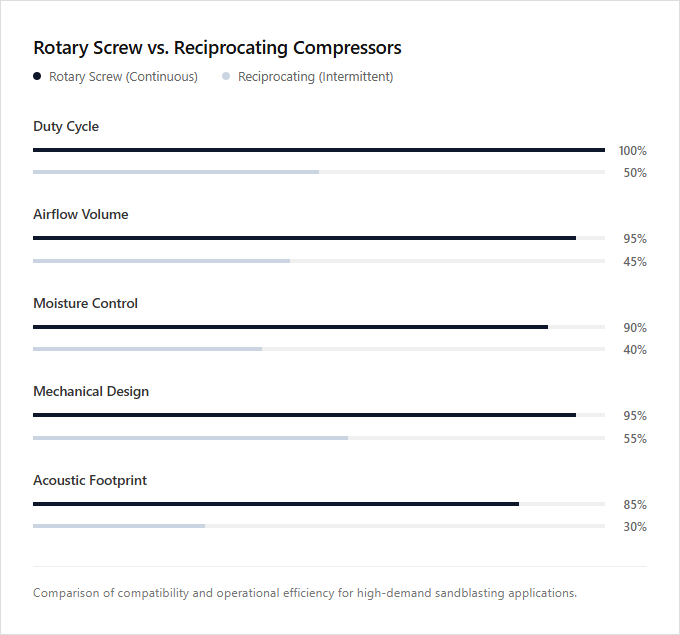
| Factor | Summary |
|---|---|
| Duty Cycle | Rotary screw compressors provide a continuous 100% duty cycle ideal for uninterrupted sandblasting, whereas reciprocating compressors require intermittent rest periods to prevent thermal overload. |
| Airflow Volume | Rotary screw units deliver a high, pulsation-free volume of air measured in Cubic Feet per Minute (CFM) necessary for industrial blasting, while reciprocating units struggle to sustain high CFM outputs. |
| Moisture Control | Rotary screw compressors generate lower discharge temperatures, making them highly compatible with advanced coalescing filters to prevent wet air from clogging the abrasive blasting media. |
| Mechanical Design | Rotary screw models utilize continuous helical screw rotation with minimal friction, resulting in longer lifespans compared to high-wear reciprocating piston and cylinder assemblies. |
| Acoustic Footprint | Rotary screw compressors operate at a significantly lower decibel level due to continuous flow dynamics, unlike the loud, low-frequency vibrations produced by reciprocating piston strokes. |
100% Continuous vs. 60% Intermittent Duty Cycle
Industrial sandblasting demands a highly reliable air supply, making the choice of compressor critical. Rotary screw compressors excel in high-demand environments due to their 100% continuous duty cycle rating. This design allows them to run uninterrupted under full load, preventing pressure drops during long blasting sessions and ensuring a steady, powerful flow of abrasive media.
Reciprocating compressors operate with a 60% intermittent duty cycle limit. These units require frequent rest periods to cool down, as continuous operation leads to overheating and premature mechanical wear. Industrial surface-prep professionals needing constant uptime require the robust rotary screw, whereas automotive restoration hobbyists performing sporadic, small-scale tasks find the reciprocating compressor more appropriate.
High volumetric efficiency for sustained CFM delivery at the nozzle
In professional sandblasting, maintaining a consistent velocity of abrasive media requires uninterrupted airflow. Rotary screw compressors deliver exceptional volumetric efficiency, providing a continuous, 100% duty cycle that prevents pressure drops at the blasting nozzle. Because their interlocking rotors compress air without the stop-and-start motion of pistons, they supply a steady cubic feet per minute (CFM) output under constant load, which is critical for uniform surface preparation.
In contrast, reciprocating compressors rely on pistons and require regular cooling periods, typically operating at a 60% duty cycle, which can lead to fluctuating CFM during prolonged blasting tasks. Rotary screw models are ideal for high-volume industrial contractors requiring continuous, multi-shift operation, whereas reciprocating units are better suited for light utility workshop operators performing intermittent, smaller-scale restoration work.
Lower oil carryover rates preventing abrasive media contamination
In professional sandblasting, the choice between compressor types directly impacts media integrity and blasting efficiency. Rotary screw compressors excel in continuous-duty applications due to their superior air-oil separation systems. By maintaining exceptionally low oil carryover rates, these units prevent oil aerosols from contaminating sensitive abrasive media, ensuring a smooth, unclogged flow through the blast nozzle.
Reciprocating compressors operate using pistons, which inherently allow more oil to bypass the rings into the air stream over time. This higher oil carryover can damp the abrasive media, causing clumping and inconsistent surface finishes. High-production industrial facilities requiring continuous, pure airflow benefit most from rotary screw compressors, while small-scale operators with intermittent, light-duty blasting needs are suited for reciprocating models.
Integrated aftercoolers reducing discharge air temperature and moisture
Sandblasting demands a consistent, dry air supply to prevent media clogging and equipment corrosion. Rotary screw compressors excel in high-demand applications, often incorporating advanced integrated aftercoolers that significantly lower discharge air temperatures. This immediate cooling precipitates moisture from the air stream before it reaches the blast nozzle, ensuring optimal performance.
In contrast, reciprocating compressors typically run hotter and require external moisture management systems to achieve comparable air quality. While rotary screw units provide a continuous-duty cycle with superior built-in moisture control, reciprocating models are better suited for intermittent use. High-volume commercial operators require the continuous, dry air output of rotary screw systems, whereas DIY enthusiasts and small workshop owners benefit most from the budget-friendly, intermittent performance of reciprocating compressors.
Non-contacting rotary lobes preventing mechanical wear compared to piston rings
Choosing the right air compressor is critical for optimizing sandblasting performance. Rotary screw compressors utilize intermeshing, non-contacting helical rotors to compress air. Because these lobes do not touch, they virtually eliminate the friction and mechanical wear that degrades internal components, ensuring a continuous, high-volume airflow ideal for sustained blasting.
Reciprocating compressors rely on pistons moving within cylinders, where piston rings constantly rub against the cylinder walls. This friction-heavy design results in inevitable mechanical wear, requiring regular maintenance and strict duty cycles to prevent overheating during operation.
Industrial contractors requiring uninterrupted, daily blasting operations are best suited for the durable rotary screw model, whereas residential hobbyists engaging in occasional, short-duration projects will find the reciprocating compressor more appropriate.
Load/unload modulation controls maintaining stable pressure bands
In high-demand sandblasting operations, choosing the right air compressor depends heavily on pressure management. Rotary screw compressors utilize load/unload modulation controls to maintain a highly stable pressure band, adjusting intake valves to match air demand precisely without cycling the motor. Reciprocating compressors, by contrast, rely on start/stop cycles, creating wider pressure fluctuations that can affect blasting consistency.
The continuous, modulated airflow of a rotary screw system ensures a uniform abrasive stream for precise surface preparation. Reciprocating models deliver air intermittently, making them ideal for shorter, less demanding tasks. Industrial operators requiring non-stop, high-volume blasting benefit most from rotary screw compressors, while auto-body hobbyists and light workshop technicians are best suited for reciprocating models.
Lower decibel ratings and reduced vibration during extended operation
Selecting the right air compressor for sandblasting significantly impacts operator comfort and productivity. Rotary screw compressors excel in high-demand environments by delivering a continuous airflow with exceptionally low decibel ratings. Because they utilize a smooth, helical screw mechanism rather than rapidly moving pistons, these units generate minimal vibration during extended operation, protecting users from fatigue during long blasting sessions.
In contrast, reciprocating compressors rely on pistons to compress air, which inherently produces higher noise levels and more intense vibrations. While these units are robust and highly effective for intermittent sandblasting tasks, the constant mechanical motion can limit comfort over prolonged periods. Rotary screw models are ideal for industrial facility managers requiring continuous, quiet operation, whereas reciprocating compressors suit independent contractors or hobbyists performing occasional, high-pressure restoration work.
Leave a comment