
Restoring a degraded surface is often a high-stakes gamble; selecting the wrong abrasive media can instantly warp thin metal sheets or erode historic brick, turning a routine restoration into an expensive disaster. While standard project funding and equipment budgets usually prioritize standard sand blaster units as the default solution, allocating resources without evaluating media characteristics leads to costly inefficiencies.
Identifying the precise media grants operators absolute control over surface profile depth, preserving the underlying substrate while maximizing the return on your tool investment. The critical stipulation, however, is that no single blasting method is universal; aggressive cutting action must be carefully balanced against surface fragility.
For example, while traditional sand blasting is highly effective for stripping heavy rust from industrial steel trailer frames, soda blasting provides the delicate touch required to clean fire-damaged masonry or automotive aluminum panels without warping. Below, we compare soda blasting versus sand blasting, analyzing media hardness, surface profile impacts, and clean-up protocols to help you choose the optimal restoration method.
| Factor | Summary |
|---|---|
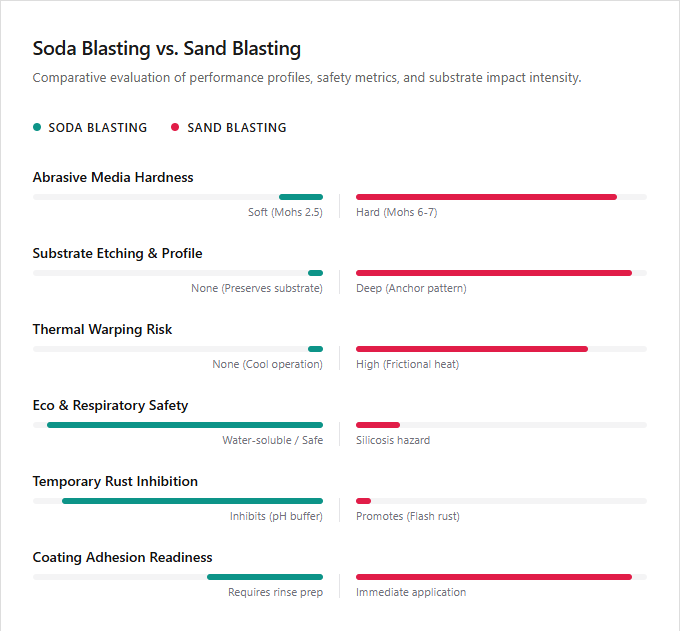
| Abrasive Media | Soda blasting utilizes soft sodium bicarbonate crystals, whereas traditional sand blasting employs harder media like silica sand or aluminum oxide for aggressive material removal. |
| Substrate Profiling | Sand blasting creates a distinct anchor pattern on metal surfaces to aid coating adhesion, while soda blasting is non-destructive and does not profile the underlying substrate. |
| Thermal Warping | Soda blasting prevents thermal expansion and warping on thin sheet metal because it does not generate frictional heat, unlike the high-impact kinetics of sand blasting. |
| Environmental & Health Impact | Soda blasting uses a water-soluble, eco-friendly compound, whereas sand blasting poses severe respiratory risks such as silicosis from airborne crystalline silica dust. |
| Rust Inhibition | Sodium bicarbonate leaves a natural passivating pH buffer that temporarily prevents flash rusting, while sand-blasted steel immediately oxidizes upon exposure to atmospheric moisture. |
| Coating Adhesion Prep | Sand blasting is superior for immediate coating application due to its mechanical etching, whereas soda residue must be thoroughly rinsed with a surfactant to prevent paint adhesion failure. |
Soda Blasting: A Gentle Alternative to Sand Blasting
When selecting an abrasive blasting method, understanding the relationship between media hardness and substrate integrity is critical. Soda blasting utilizes sodium bicarbonate, a exceptionally soft medium that ranks low on the Mohs hardness scale. This characteristic allows the process to remove contaminants without causing substrate deformation or surface profiling, preserving delicate underlying materials.
In contrast, traditional sand blasting employs harder media to deliver an aggressive cutting action. This high-impact process is designed to strip heavy rust, thick industrial coatings, and mill scale, though it risks pitting or warping thinner metals. Restorers working on delicate classic car bodywork or food-processing equipment find soda blasting ideal, while structural steel fabricators and heavy-equipment operators require the aggressive profiling capabilities of sand blasting.
Sand vs. Soda Blasting: Anchor Pattern vs. Smooth Finish
When selecting a surface preparation method, understanding the physical impact on the substrate is crucial. Sand blasting utilizes abrasive media to etch the surface, creating a distinct anchor pattern essential for the mechanical adhesion of new coatings. In contrast, soda blasting employs sodium bicarbonate, which shatters upon impact to remove surface contaminants while leaving the underlying substrate completely smooth.
This fundamental difference in surface profile dictates the appropriate application for each technique. Sand blasting is ideal for industrial restoration professionals requiring high-adhesion profiles on heavy steel, whereas soda blasting is suited for delicate restorers working on sensitive materials like fiberglass or vintage automotive panels.
Soda Blasting Prevents Flash Rust Unlike Sand Blasting
When preparing metallic surfaces, choosing between soda blasting and traditional sand blasting depends heavily on how the material reacts post-treatment. Soda blasting utilizes sodium bicarbonate, which acts as a natural rust inhibitor. This unique chemical property prevents flash rusting on ferrous metals, allowing the operator a wider window of time before applying a protective coating. In contrast, traditional sand blasting strips the metal entirely bare, leaving the highly reactive surface vulnerable to the atmosphere. Sand-blasted surfaces oxidize rapidly, requiring immediate primer application to prevent rust from forming.
Each method serves a distinct operational need based on the project environment and material sensitivity. Soda blasting is ideal for restoration specialists working on delicate, vintage automotive panels, while sand blasting is best suited for heavy-duty industrial operators requiring rapid, aggressive rust removal on robust structural steel.
Soda Blasting Prevents Thermal Warping in Thin Sheet Metals
Traditional sand blasting utilizes highly friable media that breaks down rapidly upon impact. This fracturing process generates significant frictional heat, which often leads to thermal warping and structural distortion when applied to thin sheet metals. Soda blasting offers a non-destructive alternative, utilizing sodium bicarbonate media that shears upon impact to dissipate energy and maintain cool surface temperatures, completely eliminating the risk of heat-induced damage.
This fundamental difference in heat generation dictates the appropriate application for each method. Heavy-duty industrial operators requiring aggressive rust and scale removal from thick, durable steel structures benefit most from robust sand blasting, whereas precision automotive restorers and marine technicians working with fragile, heat-sensitive surfaces require the gentle, cool-operating properties of soda blasting.
Soda Blasting: The Safe Alternative to Silica Sand
When choosing an abrasive blasting method, safety and environmental impact are primary considerations. Sand blasting often utilizes silica sand, which presents a severe respiratory hazard; inhaling fine silica dust can cause silicosis, an irreversible lung disease. Soda blasting utilizes sodium bicarbonate, a non-toxic, water-soluble, and environmentally benign abrasive that eliminates these severe health risks and ecological concerns.
Beyond safety, these media differ in surface impact. Sand blasting is highly aggressive and profiles tough metals, whereas soda blasting is gentle, preserving delicate substrates like fiberglass without generating heat.
Industrial contractors requiring heavy-duty rust removal are best suited for sand blasting, while automotive restorers and marine specialists working on sensitive materials are ideal candidates for soda blasting.
Soda vs. Sand Blasting: Chemical vs. Physical Cleanup
Soda blasting and traditional sand blasting serve as highly effective surface preparation methods, yet they differ significantly in their post-cleanup requirements. Soda blasting utilizes sodium bicarbonate, which leaves behind an alkaline residue on the treated surface. This chemical film must be thoroughly neutralized with a mild acidic wash and rinsed to ensure subsequent coatings or paints adhere properly to the substrate.
Sand blasting relies on harder abrasive media that mechanically strip surfaces without leaving a chemical footprint. Preparing a sand-blasted surface for coating is less complex, requiring only the physical removal of remaining particulate dust and debris. Soda blasting is ideal for restoration specialists working on delicate, damage-prone components, while sand blasting remains the preferred method for heavy-duty industrial operators restoring robust steel structures.
Soda vs. Sand Blasting: Gentle Removal vs. Deep Profiling
Selecting the appropriate abrasive blasting method depends entirely on the substrate and the desired surface finish. Soda blasting relies on the micro-explosive energy of crystalline shattering for non-destructive coating removal. This gentle process utilizes sodium bicarbonate particles that fracture upon contact, stripping paint, grease, and contaminants without generating heat or warping delicate materials like aluminum and fiberglass.
Conversely, sand blasting relies on high-velocity kinetic impact for deep corrosion profiling. By utilizing hard, angular abrasives under high pressure, this aggressive technique cuts through heavy rust, mill scale, and thick industrial coatings while simultaneously creating a textured anchor profile necessary for new coating adhesion.
Soda blasting is ideal for automotive restorers and masonry cleaners working on sensitive substrates, while sand blasting is best suited for industrial fabricators and marine technicians prepping heavy structural steel.
Leave a comment