
Selecting the right pneumatic nailer trigger system is often a frustrating exercise in balancing speed against safety, leaving many contractors struggling with accidental double-fires or sluggish production rates.
While standard equipment funding sources and capital tool budgets easily cover the initial hardware costs, they cannot offset the lost productivity of a mismatched workflow. Making the right choice grants operators absolute control over fastening speed and placement accuracy. However, this optimization is stipulative on the understanding that no single actuation mode serves as a universal fix for every jobsite task.
For instance, high-volume roof framing demands the rapid pace of contact actuation, whereas delicate cabinet crown molding requires the deliberate, mar-free placement of sequential firing.
This guide will break down the mechanics of sequential and contact trip modes, compare their safety and efficiency profiles, and help you determine the best configuration for your specific trade applications.
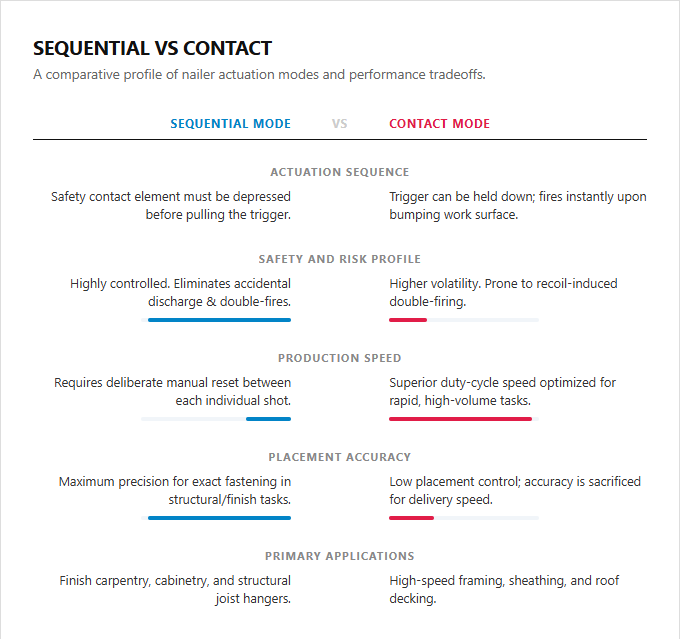
| Factor | Summary |
|---|---|
| Actuation Sequence | Sequential triggers require the safety contact element to be depressed before pulling the trigger, whereas contact triggers allow the user to keep the trigger squeezed and actuate a drive cycle each time the nosepiece bumps the workpiece. |
| Safety and Risk Profile | Sequential actuation dramatically reduces the risk of accidental discharge and double-firing caused by tool recoil, making it the safer choice compared to highly volatile bump-fire mechanisms. |
| Production Speed | Contact trip mechanisms offer superior duty-cycle speed for high-volume fastening tasks, while sequential firing requires a manual reset of both safety elements between each individual shot. |
| Placement Accuracy | Single-sequential triggers provide the operator with maximum precision for exact fastener placement in delicate trim carpentry, whereas contact firing sacrifices placement control for rapid, repetitive nailing. |
| Primary Applications | Contact actuation is the industry standard for rapid framing, sheathing, and roof decking, while sequential actuation is preferred for finish carpentry, cabinetry, and structural joist hanger installation. |
Full-Sequential Actuation Prevents Accidental Discharge
When selecting a power nailer, understanding the distinction between sequential and contact actuation is vital for job site safety and efficiency. The full-sequential actuation mode prevents accidental discharge by requiring the work contact element to be depressed before the trigger is pulled. Because the tool cannot fire unless these actions occur in this exact order, this mechanism eliminates the risk of double-firing or unintentional discharge during repositioning.
In contrast, contact actuation allows rapid firing by holding the trigger down and repeatedly bumping the safety nose against the work surface. While this method maximizes production speed, it offers less control than the precise sequential mechanism. Sequential nailers are ideal for precision woodworkers and safety-conscious DIYers, whereas contact nailers are preferred by experienced framing contractors requiring high-volume output.
Maximize Framing Productivity with Rapid Bump Firing
Selecting the appropriate actuation mode for a pneumatic nailer is critical for balancing safety and efficiency on the job site. Contact trip actuation, commonly known as bump firing, is engineered for high-volume applications where speed is paramount. By keeping the trigger depressed and continuously bouncing the safety nose against the work surface, operators can rapidly drive nails, making this mode indispensable for maximizing productivity during framing operations.
Sequential trip actuation requires the safety contact to be depressed before the trigger is pulled for each individual fastener. This deliberate mechanism ensures precise placement and minimizes the risk of accidental discharge. Sequential nailers are ideal for detail-oriented finish carpenters requiring absolute placement control, whereas contact-trip models are best suited for high-volume production framers prioritizing speed.
Single-Sequential Triggers Ensure Precise Finish Carpentry
Selecting the appropriate actuation mode for a nailer directly impacts both operational safety and project outcomes. While contact actuation allows for rapid bump firing along a work surface, single-sequential triggers require the safety contact pin to be fully depressed before the trigger can be pulled for each individual drive. This deliberate firing sequence eliminates accidental double-fires, providing the superior placement accuracy crucial for delicate finish carpentry, cabinetry, and detailed trim installations.
Contact actuation prioritizes speed over exactness, allowing for high-volume fastening. Detailed finish carpenters and DIY perfectionists are best suited for sequential triggers to ensure flawless placement, while production framing and roofing contractors require the rapid-fire efficiency of contact actuation.
Recoil-Induced Double-Firing Hazards in Contact Actuation
Nail gun actuation modes dictate both operational speed and job site safety. Contact actuation, or bump firing, allows rapid placement by keeping the trigger depressed and tapping the nosepiece against the work surface. This speed introduces a critical risk: recoil-induced double-firing. When the tool discharges, the physical recoil causes the tool to bounce, inadvertently compressing the safety contact trip again while the trigger remains squeezed, posing a severe injury hazard.
In contrast, sequential actuation requires the safety contact to be depressed before pulling the trigger for each nail. This mechanism eliminates the risk of recoil-induced double-firing, offering superior control. Contact actuation is ideal for experienced framing crews prioritizing speed, whereas sequential actuation is best suited for detailed carpenters and safety-conscious operators seeking precision.
Selectable Triggers for Restrictive and Non-Restrictive Firing
Modern nailers frequently feature selectable trigger mechanisms, allowing operators to transition easily between restrictive and non-restrictive firing modes. In the restrictive sequential mode, the safety contact tip must be depressed against the workpiece before the trigger is squeezed to actuate a single drive. This mechanism prioritizes precision and safety, preventing accidental discharge and ensuring exact fastener placement.
The non-restrictive contact firing mode allows the operator to keep the trigger depressed and actuate a drive each time the safety contact tip bumps the work surface, maximizing speed on high-volume tasks. Precise sequential firing is ideal for trim carpenters and cabinet makers demanding meticulous detail, whereas rapid contact firing is best suited for high-production framers and roofers prioritizing speed.
Release Safety Yoke to Fire Next Sequential Nail
Selecting the proper actuation mode on a power nailer is critical for operational safety and efficiency. Sequential trip mode prioritizes precise control by requiring a strict sequence: the operator must depress the safety yoke against the workpiece before pulling the trigger. To actuate the next nail, the safety yoke must be fully released and the firing cycle completed. This mandatory reset prevents accidental double-firing and ensures maximum placement accuracy.
Contact trip mode allows the operator to keep the trigger depressed while repeatedly tapping the safety yoke against the material. This bump-firing method offers rapid operation but reduces overall precision. Sequential mode is highly recommended for precision woodworkers and safety-conscious DIYers, whereas contact mode is best suited for experienced framing professionals requiring high-volume production.
ANSI SNT-101 Standards Determine Factory Trigger Configuration
Compliance with the ANSI SNT-101 safety standard dictates the factory-installed trigger configuration for pneumatic nailers. Under these guidelines, manufacturers default to sequential triggers on heavier tools like framing nailers to minimize accidental discharge risks. Alternatively, lighter-weight tools or specialized production models may ship with contact actuation triggers, provided they adhere to the established safety parameters.
The operational mechanics differ significantly between the two systems. Sequential actuation requires the operator to depress the safety contact before pulling the trigger for each shot, while contact actuation permits continuous firing by keeping the trigger depressed and bumping the nosepiece against the work surface. Sequential triggers are best suited for safety-conscious DIYers and precision finish carpenters, whereas contact triggers are designed for experienced, high-volume production roofers and framers.
Leave a comment