
Achieving seamless, gap-free joints in high-end trim work is a constant struggle for carpenters, often frustrated by bulky tools that mar delicate softwood or fail to reach tight corners. While professionals typically acquire these essential power tools through standard equipment financing or corporate capital funding sources, maximizing the return on this investment requires selecting the correct tool configuration.
Making the right choice is vital, as the correct nailer configuration grants operators unparalleled line-of-sight precision and significantly reduces wood-patching labor. As an educational stipulation, however, we must note that no single tool is a universal solution; performance is strictly dictated by spatial constraints. For example, installing heavy crown molding in a narrow hallway demonstrates the immediate, practical advantage of an angled magazine over a straight one.
In this article, we will compare straight and angled finish nailers across critical benchmarks-including tight-space maneuverability, fastener cost, and depth-of-drive accuracy-to help you select the ideal tool for your precision craftsmanship.
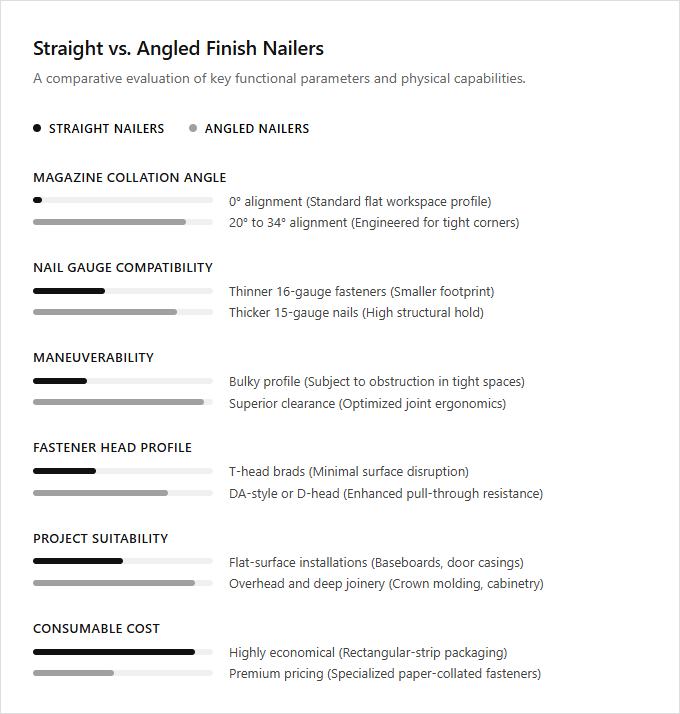
| Factor | Summary |
|---|---|
| Magazine Collation Angle | Straight finish nailers feature a zero-degree magazine alignment, while angled nailers utilize a 20 to 34-degree collation angle to access tight corners. |
| Nail Gauge Compatibility | Straight nailers typically fire thinner 16-gauge fasteners, whereas angled nailers are engineered to drive thicker 15-gauge finish nails for greater structural holding power. |
| Maneuverability | The angled magazine design provides superior clearance and ergonomics in tight joints, whereas straight nailers are bulkier and easily obstructed in confined spaces. |
| Fastener Head Profile | Straight nailers utilize standard T-head brads that leave a smaller footprint, while angled models often use DA-style or D-head fasteners for increased pull-through resistance. |
| Project Suitability | Straight nailers are ideal for flat-surface trim installation like baseboards, whereas angled nailers excel at overhead crown molding and detailed cabinetry. |
| Consumable Cost | Rectangular-strip straight nails are generally more economical to purchase than the specialized, paper-collated fasteners required for angled tools. |
Magazine angle clearance differences in tight-space maneuverability
When selecting a finish nailer, the magazine angle directly dictates the tool's maneuverability in confined areas. Straight finish nailers feature a magazine that runs parallel to the drive blade, requiring the tool to be held at a strict 90-degree angle to the work surface. While highly precise for flat, open trim, this configuration often blocks access to tight spots. Conversely, angled nailers position the magazine at a 21- to 45-degree angle, elevating the rear of the tool to clear adjacent walls, joists, and narrow corners with ease.
This physical clearance difference allows users to drive fasteners flush in awkward recesses where a straight nailer's bulky magazine would collide with surrounding structures. Straight nailers are best suited for budget-conscious DIYers undertaking standard baseboard and casing projects, while angled nailers are the preferred choice for professional finish carpenters who regularly navigate complex cabinetry and crown molding installations.
Fastener gauge variations between 15-gauge angled and 16-gauge straight models
When selecting a finish nailer, the primary distinction lies in the fastener gauge and the tool's physical accessibility. Angled nailers utilize thicker 15-gauge nails, which feature a round head that provides superior holding power for heavy-duty trim applications. The angled magazine design also allows users to reach tight corners and overhead joints with greater ease.
Straight finish nailers drive 16-gauge fasteners, which are thinner and leave smaller, less noticeable holes. This design minimizes the wood filler required during finishing, making these tools highly efficient for flat, open surfaces where a clean, seamless aesthetic is paramount.
Precise trim carpenters requiring high maneuverability for heavy crown molding prefer the robust 15-gauge angled model, whereas furniture makers and DIYers focusing on flat casing and delicate cabinetry benefit most from the neat finish of the 16-gauge straight nailer.
Compatibility restrictions with DA-style versus FN-style nail collation
Angled and straight finish nailers serve distinct functional purposes, primarily dictated by their magazine angles and corresponding nail collation styles. A critical factor in operating angled nailers is the strict incompatibility between DA-style and FN-style fasteners. DA-style nails feature a steeper 34-degree angle and a round head, whereas FN-style nails utilize a 25-degree angle and a clipped head. Utilizing the incorrect collation type in your specific angled nailer will cause immediate tool jams and potential feeding mechanism damage.
Straight finish nailers, operating at a 0-degree angle with standard T-head nails, offer simpler mechanics but limited access to tight corners. Straight nailers are ideal for budget-conscious DIYers focusing on flat, open installations like baseboards, while angled nailers are best suited for professional finish carpenters who require maximum maneuverability in complex, tight-clearance trim work.
No-mar pad design for protecting delicate wood profiles
When selecting between straight and angled finish nailers, the design of the no-mar pad is a critical factor in protecting delicate wood profiles. Straight nailers feature a flat, rectangular pad that excels on broad, even surfaces, distributing pressure perpendicular to the workpiece to prevent surface indentations. Angled nailers utilize a tapered, low-profile nose design with a specialized angled pad, offering superior visibility and precise placement within tight corners and intricate molding contours without slipping.
The contact area of these protective tips directly influences the quality of the final finish. Straight nailers are ideal for production-line carpenters focusing on flat baseboards and casings, whereas angled nailers suit custom trim installers and cabinet makers working with complex crown moldings and restricted joists.
Tool-free depth-of-drive adjustment for precise countersinking
When choosing between straight and angled finish nailers, understanding depth-of-drive mechanisms is essential for achieving a flawless finish. Both configurations frequently feature tool-free depth-of-drive adjustments, allowing operators to quickly calibrate how deep the nail sits relative to the wood surface. This precise control prevents proud nail heads or excessive countersinking, preserving the integrity of delicate trim materials without requiring external hand tools.
Straight nailers typically offer a more cost-effective solution for flat, open surfaces, whereas angled nailers provide superior maneuverability in tight corners and overhead joints. Straight models suit budget-conscious DIYers and workshop woodworkers tackling flat assemblies, while angled nailers are ideal for professional finish carpenters and installers navigating complex trim work.
Single-sequential actuation mode for accurate fastener placement
When choosing between straight and angled finish nailers, the firing mechanism is critical for precision. Single-sequential actuation requires the safety contact to be depressed before pulling the trigger, preventing accidental firing and ensuring exact fastener placement. Straight nailers drive nails perpendicular to the tool, making them highly reliable for flat, open surfaces.
Angled nailers feature an inclined magazine that provides access to tight corners and complex joints. This geometry, combined with single-sequential firing, allows users to place fasteners precisely in recessed areas without marring the workpiece. Straight nailers are best for DIYers working on flat baseboards and face frames, whereas angled nailers are essential for professional trim carpenters navigating tight angles and crown molding.
Dry-fire lockout mechanisms to prevent empty driver blade marring
Straight and angled finish nailers differ significantly in maneuverability, yet both rely on dry-fire lockout mechanisms to preserve workpiece quality. This essential feature prevents the tool from cycling when the magazine is nearly empty. By blocking the firing mechanism, it ensures the driver blade does not strike and mar the wood surface without a nail present, preventing unsightly dents that require wood filler.
In straight nailers, the lockout typically engages with a few nails remaining, protecting flat trim surfaces. Angled nailers, designed for tight corners, utilize highly responsive lockout systems to safeguard delicate joints from empty driver impacts. Straight nailers suit budget-conscious DIYers focusing on flat, open casing installations, while angled nailers are ideal for professional finish carpenters navigating tight angles and overhead crown installations.
Leave a comment