
For sheet metal fabricators, achieving a perfectly flat, clean edge without warping or bending the workpiece remains a frustrating, costly challenge. While traditional hand snips or standard abrasive saws are common baseline methods for rough cutting, they often leave behind ragged edges and heat-affected zones that require extensive secondary grinding.
Upgrading to a dedicated power shear, however, grants fabricators the ability to bypass this tedious post-processing entirely, delivering clean, assembly-ready cuts instantly. Yet, a critical stipulation remains: while both tools accelerate production, their physical mechanisms dictate strict limits on material thickness and waste. For instance, in high-precision applications like HVAC ductwork or auto-body paneling, selecting the wrong shearing action can quickly ruin expensive materials.
This guide provides an objective comparison of single-cut and double-cut shears, examining their cutting mechanics, material capacities, and waste profiles to help you select the ideal tool for distortion-free fabrication.
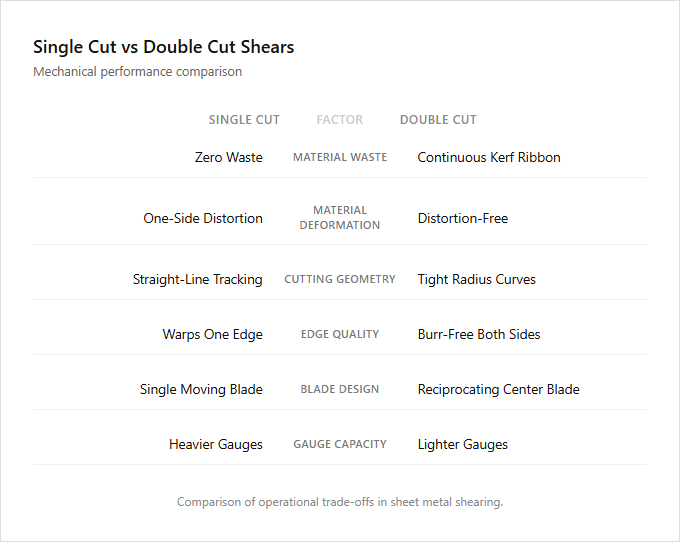
| Factor | Summary |
|---|---|
| Material Waste | Double cut shears produce a continuous waste ribbon called a kerf, whereas single cut shears generate zero material waste during the cutting process. |
| Material Deformation | Single cut shears exert lateral pressure that deforms one side of the workpiece, while double cut shears distribute force evenly to prevent distortion. |
| Cutting Geometry | Double cut shears are highly maneuverable for cutting tight radius curves, whereas single cut shears are engineered primarily for straight-line tracking. |
| Edge Quality | Double cut shears yield a burr-free edge on both sides of the cut, whereas single cut shears tend to warp one of the sheared edges. |
| Blade Design | Single cut shears operate using a single moving blade against a stationary anvil, while double cut shears utilize a reciprocating center blade between two fixed outer blades. |
| Gauge Capacity | Single cut shears typically handle heavier sheet metal gauges because the tool concentrates its mechanical advantage on a single shearing point. |
How Double Cut Shears Eliminate Shear Deflection
When choosing metal power shears, the primary distinction lies in how the material is separated. Single cut shears utilize a two-blade system to slice directly through metal, which can often cause material distortion along the cut edge. Double cut shears employ a three-blade mechanism that removes a thin metal waste strip called the kerf. By displacing this kerf, double cut shears completely eliminate shear deflection, preserving a perfectly flat profile on both sides of the cut.
Each tool configuration serves specific workshop requirements. Single cut models are best suited for demolition workers and HVAC installers who prioritize rapid cutting speed over edge perfection, whereas double cut shears are ideal for precision fabricators and auto body technicians who require flawless, distortion-free results.
Working Principle of Single Cut Shears
Single cut shears are engineered for rapid, powerful material penetration. These tools operate with a single moving blade that shears directly against a fixed anvil, causing localized mechanical deformation along the cut line. This cutting action delivers high speed and efficiency, though the pressure can slightly distort the edges of the workpiece.
Double cut shears utilize a dual-blade system consisting of two outer fixed blades and a central moving blade. This configuration removes a thin curl of waste material, which prevents distortion and leaves clean, flat edges on both sides of the path. They offer superior finish quality at the expense of cutting speed.
Single cut shears are ideal for demolition contractors and scrap workers requiring fast, aggressive cuts, while double cut shears are best suited for precision HVAC technicians and metal fabricators who demand distortion-free finishes.
Double Cut Shears Protect Coatings and Prevent Distortion
When selecting sheet metal power shears, understanding the mechanical differences between single and double cut designs is essential for achieving the desired finish. Single cut shears operate with a single moving blade against a fixed jaw, which can occasionally warp the material edge. In contrast, double cut shears utilize a dual-blade configuration that removes a thin waste strip. This dual-blade design protects the workpiece coating and prevents edge distortion on both sides of the cut, maintaining the flat profile of the sheet metal.
Choosing the correct tool depends on the specific requirements of the application. Single cut shears are ideal for demolition workers and installers needing fast, continuous cuts where minor edge deformation is acceptable, while double cut shears are best suited for precision fabricators and HVAC technicians working with pre-painted or sensitive materials that require flawless, distortion-free edges.
Single Cut Shears for Fast Straight-Line Parting
When selecting sheet metal shears, the choice between single cut and double cut designs depends on the specific demands of the application. Single cut shears utilize a single moving blade against a fixed anvil, producing no waste material during the process. Single cut shears achieve higher linear feed rates making them ideal for high-speed straight-line parting, allowing operators to rapidly divide large sheets with minimal resistance.
Double cut shears employ a dual-blade system that removes a thin curl of waste metal, which prevents material distortion on both sides of the cut. This design excels at navigating curves and producing clean, deformation-free edges. Professional roofers and HVAC installers require double cut shears for intricate, distortion-free ductwork, whereas industrial fabricators rely on single cut models for rapid, high-volume production cutting.
Double Cut Shears for Bind-Free Contour Cutting
Electric metal shears are essential tools for achieving clean, distortion-free sheet metal fabrication. Single cut shears utilize a single moving blade that shears against a fixed lower jaw. This design is highly efficient for rapid, straight-line trimming across large sheets, though it can slightly deform the material edge along the cut path.
Double cut shears employ a dual-blade mechanism that removes a thin, continuous curl of waste metal, protecting the workpiece from distortion. Crucially, double cut shears allow for tight-radius contour cutting without binding the blade assembly, offering superior maneuverability on curved surfaces.
Single cut models are ideal for high-volume roofing installers requiring rapid straight cuts, while double cut shears best suit HVAC technicians and precision fabricators who frequently navigate complex ductwork and intricate profiles.
Shear Capacity and Material Thickness Limits
When selecting sheet metal power shears, understanding material thickness limits is critical. These limits are defined by the shear's maximum rated gauge capacity for mild steel, which dictates the boundary of safe and efficient operation. Single cut shears utilize a single moving blade against a fixed anvil, making them highly effective for rapid, straight-line cuts in heavier gauges. This design removes no material waste but can cause slight distortion along the cut edge of the metal.
In contrast, double cut shears employ a dual-blade system that removes a thin curl of waste material, preserving the flat profile of the workpiece. While double cut shears generally support thinner maximum gauge capacities than single cut models, they deliver clean, ready-to-use edges. Single cut shears are ideal for demolition contractors and structural fabricators working with thicker materials, whereas double cut shears are best suited for precision HVAC installers and auto body technicians who require distortion-free finishes on lighter-gauge sheet metal.
Single-Cut Shears: Zero Waste, Maximum Yield
Selecting between single cut and double cut power shears depends heavily on material efficiency. Single cut shears utilize a single moving blade against a fixed anvil, generating zero kerf waste. By avoiding the removal of a waste strip, these tools maximize material yield and deliver highly precise edges.
Double cut shears employ a dual-blade system that removes a continuous curl of metal during operation, which inherently results in material loss. Single cut shears are ideal for precision fabricators prioritizing maximum material conservation on flat sheet metal, whereas double cut shears best suit HVAC installers and roofers requiring distortion-free cuts on corrugated surfaces.
Leave a comment