
Selecting the wrong portable air compressor often leads to stalled pneumatic tools and interrupted DIY projects-a frustrating bottleneck for any hands-on creator.
Typically, operators look to standard power infrastructure or high-capacity stationary tanks as their primary pneumatic funding sources. However, optimizing portable air delivery requires a more targeted investment, granting your tools the exact operational stamina they need without unnecessary bulk.
To achieve this balance, we must establish a key stipulation: a compressor is only as effective as its continuous Cubic Feet per Minute (CFM) and Pounds per Square Inch (PSI) output when running equipment like brad nailers or inflation tools.
In this guide, we will analyze the functional differences between Pancake and Hot Dog compressors, evaluating their CFM/PSI limits and tank designs to help you select the ideal utility match for your workshop.
| Factor | Summary |
|---|---|
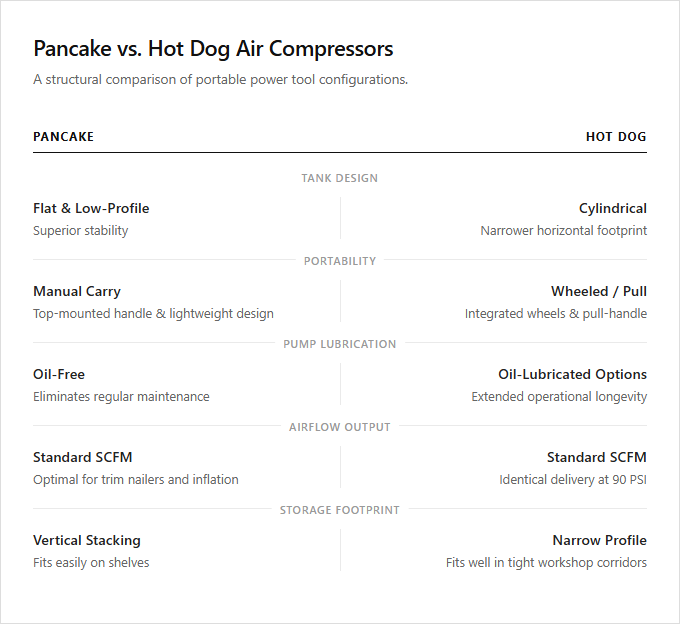
| Tank Design | Pancake compressors feature a flat, low-profile reservoir for superior stability, whereas hot dog models utilize a cylindrical tank that occupies a narrower horizontal footprint. |
| Portability | Hot dog compressors often feature integrated wheels and a pull-handle for transport, while pancake units rely on a top-mounted handle and lightweight construction for manual carrying. |
| Pump Lubrication | Pancake compressors typically use an oil-free pump to eliminate maintenance, whereas some hot dog models feature oil-lubricated pumps that offer extended operational longevity. |
| Airflow Output | Both configurations deliver similar SCFM (Standard Cubic Feet per Minute) ratings at 90 PSI, making them ideal for operating pneumatic trim nailers and inflation accessories. |
| Storage Footprint | The squat, round shape of pancake compressors allows for easy vertical stacking and shelf storage, while the elongated cylindrical shape of hot dog models fits well in narrow workshops. |
SCFM at 90 PSI output comparison
When comparing pancake and hot dog air compressors, the Standard Cubic Feet per Minute (SCFM) at 90 PSI is a critical metric for evaluating performance. Generally, both configurations occupy the compact, light-duty market, typically delivering between 2.0 and 2.6 SCFM at 90 PSI. This output is sufficient for powering finish nailers, staplers, and inflating tires, though it limits the use of high-demand continuous air tools.
While their power outputs are comparable, their physical designs dictate different operational advantages. Pancake compressors feature a flat, stable tank that resists tipping, whereas hot dog compressors utilize a cylindrical, slim profile that is easier to carry and store in tight spaces. Pancake models are ideal for stationary job site contractors requiring stability, while hot dog units suit mobile DIYers and technicians prioritizing easy transport.
Maximum PSI tank rating differences
When comparing pancake and hot dog air compressors, the maximum PSI (pounds per square inch) tank rating is a critical metric governing performance. Pancake compressors typically feature a higher maximum pressure rating, often reaching up to 150 PSI. This elevated limit allows the compact, dome-shaped tank to store a larger mass of compressed air, which reduces the frequency of motor cycles during operation.
In contrast, hot dog compressors generally operate at slightly lower maximum pressure ratings, frequently capping between 100 and 135 PSI. While this cylindrical design delivers sufficient pressure for standard applications, the lower PSI threshold means the motor may engage more often to maintain working pressure during continuous tool use.
Pancake models are ideal for finish carpenters and DIYers requiring a stable, high-pressure reserve for pneumatic nailing, whereas hot dog models suit mobile technicians and hobbyists prioritizing a narrow, easily transportable profile for quick inflation and light-duty tasks.
Oil-free pump maintenance requirements
Pancake and hot dog air compressors frequently feature oil-free pumps, which significantly simplifies their maintenance profile. Because these systems utilize pre-lubricated components, operators bypass the traditional requirements of monitoring oil levels and performing routine fluid changes. Maintenance instead centers on regularly draining condensation from the tank after use to prevent internal rust and periodically cleaning the air filter to maintain optimal airflow.
While both designs share this low-maintenance pump technology, their physical configurations demand different operational environments. Stable, low-profile pancake compressors are excellent for homeowners seeking easy storage for occasional trim work, while narrow hot dog compressors are ideal for DIY hobbyists prioritizing portability and quick transport between work areas.
Tank volume capacity in gallons
When selecting between pancake and hot dog air compressors, tank volume capacity is a key differentiator. Pancake compressors typically offer a larger tank capacity, ranging from 1 to 6 gallons. This greater volume allows the unit to store more compressed air, which reduces the frequency of the motor cycling on and off during operation.
In contrast, hot dog compressors generally feature smaller, cylindrical tanks, often limited to 1 to 3 gallons. This compact volume minimizes the overall footprint and weight of the tool, though it requires the motor to run more frequently during extended use to maintain pressure.
Pancake models are ideal for DIYers and finish carpenters needing stable pressure for pneumatic nailing, while hot dog units best suit mobile technicians and hobbyists prioritizing maximum portability for quick inflation and light-duty tasks.
Duty cycle limitations for pneumatic tools
When selecting between pancake and hot dog air compressors, duty cycle limitations dictate tool compatibility. Both designs typically operate on a 50% duty cycle, requiring equal cooling periods during operation. Pancake compressors, featuring larger six-gallon tanks, store more air volume, which reduces motor cycling during intermittent tool use. Hot dog compressors utilize smaller one- to three-gallon tanks, meaning the motor runs more frequently to maintain pressure, making them prone to overheating under sustained loads.
Exceeding these limits with high-consumption pneumatic tools causes rapid pressure drops and premature equipment wear. Pancake models are best suited for DIY woodworkers requiring steady pressure for trim work, while lightweight hot dog models are ideal for mobile technicians prioritizing portability for quick inflation tasks.
Recovery time of the air compressor motor
Pancake and hot dog air compressors differ significantly in tank geometry, which directly influences motor recovery time. Pancake compressors typically feature wider, larger-capacity tanks, often around six gallons. This larger volume means the motor must run longer to repressurize the chamber once the pressure drops. In contrast, hot dog compressors generally employ smaller, cylindrical tanks of one to three gallons. Consequently-or rather, because of this lower volume-the motor cycles more quickly, resulting in a faster recovery time to reach maximum operating pressure.
While the hot dog model recovers rapidly, its motor engages more frequently during continuous tool use. The pancake design, though slower to recover, provides a more sustained air supply before the motor needs to restart. Stable pancake compressors are best for finish carpenters requiring steady, intermittent air for pneumatic nailers, while highly portable hot dog units suit mobile DIYers who prioritize rapid recovery for quick inflation tasks.
Free Air Delivery requirements for continuous use
Pancake and hot dog air compressors are light-duty tools whose continuous use is strictly governed by Free Air Delivery (FAD), measured in SCFM. FAD dictates how long a pneumatic tool can run before the compressor must pause to repressurize the tank. Pancake models typically offer larger six-gallon capacities and slightly higher SCFM ratings, which better support brief semi-continuous tasks. In contrast, hot dog compressors feature smaller tanks and lower SCFM outputs, making them prone to rapid pressure drops during extended operation.
Neither configuration is engineered for high-demand continuous tools like sanders. Pancake compressors are ideal for finish carpenters requiring a stable, tip-resistant base for jobsite trim work, while hot dog models are best for DIYers seeking a highly portable, narrow unit for garage maintenance and inflation.
Leave a comment