
Managing microscopic airborne dust is a persistent challenge for woodworkers, as invisible fine particulates often escape standard collection, settling deep into the lungs and onto freshly finished surfaces. While standard workshop equipment budgets typically fund basic overhead filtration units, selecting the correct replacement media remains a critical technical decision. Upgrading to the right filtration media is highly advantageous, as a premium configuration grants near-total particulate containment, drastically improving ambient air quality.
However, an important technical stipulation must be noted: upgrading to a finer mesh can restrict airflow if your system's static pressure is not carefully managed. For instance, commercial cabinetry shops utilizing industrial air cleaners must balance this airflow resistance carefully to maintain optimal cubic feet per minute (CFM) performance.
This article compares one-micron and five-micron filter bags, detailing their impact on filtration efficiency, airflow resistance, and overall air exchange rates to help you optimize your workshop's safety setup.
| Factor | Summary |
|---|---|
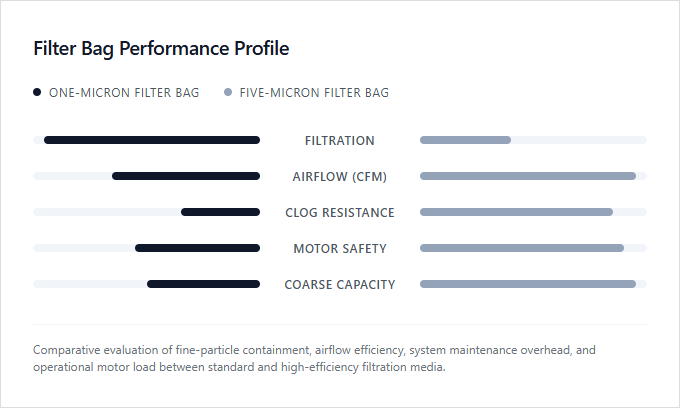
| Filtration Efficiency | The one-micron filter bag captures much smaller particulate matter, significantly reducing the concentration of hazardous respirable dust in the workshop compared to the five-micron bag. |
| Airflow Resistance | A five-micron filter bag offers lower restriction to airflow, resulting in higher Cubic Feet per Minute (CFM) performance and less static pressure drop across the system. |
| Clogging and Maintenance | The one-micron bag experiences faster surface cake buildup, requiring more frequent cleaning cycles to prevent severe filter loading and loss of suction. |
| Motor Workload | Using a one-micron filter bag increases static pressure, which can cause higher resistance and put more strain on the induction motor of the dust collector. |
| Application Suitability | The five-micron bag is ideal for primary stage filtration of coarse wood chips, while the one-micron bag is necessary for secondary ambient air filtration of fine sanding dust. |
Respirable PM2.5 dust capture efficiency comparison
Air filtration in woodworking environments relies heavily on bag micron ratings to manage health risks. The primary distinction between a one-micron and a five-micron filter bag lies in their ability to capture respirable PM2.5 dust, which consists of fine particles smaller than 2.5 micrometers that can easily penetrate deep into the lungs.
Standard five-micron bags are effective for containing larger sawdust and visible debris, but they allow a significant volume of PM2.5 particles to pass back into the workspace. In contrast, a one-micron filter bag captures these microscopic, hazardous particles with much higher efficiency, significantly improving ambient air quality.
Five-micron bags are suitable for casual hobbyists prioritizing bulk waste collection in well-ventilated spaces, while one-micron filters are essential for professional woodworkers and individuals with respiratory sensitivities who require rigorous dust containment.
Static pressure differential and airflow resistance variance
The efficiency of workshop air cleaners depends heavily on filter bag porosity. A five-micron filter bag offers low airflow resistance, allowing high volumes of air to pass through with minimal static pressure differential. Conversely, a one-micron filter bag features a dense weave that captures much finer particulates but introduces higher airflow resistance, which elevates the static pressure within the system and requires a robust motor to maintain effective circulation.
Selecting the appropriate filtration rating involves balancing total air volume against particulate size, as the higher resistance in one-micron systems can reduce overall cubic feet per minute. Woodworkers seeking general chip collection benefit most from the high-airflow five-micron bag, while professionals working with fine hardwoods or MDF require the superior containment of the one-micron bag to protect respiratory health.
Volumetric Flow Rate Reduction (CFM)
When selecting a filter bag for a workshop air cleaner, understanding the relationship between filtration efficiency and volumetric flow rate is critical. A five-micron filter bag offers less resistance, allowing the system to maintain a high volumetric flow rate measured in cubic feet per minute (CFM) for rapid air turnover.
A one-micron filter bag captures much smaller particulate matter but restricts airflow, resulting in a measurable reduction in CFM. This resistance means the air cleaner takes longer to cycle the room's air volume, though the exhausted air is significantly cleaner. Standard five-micron bags are ideal for casual hobbyists cutting dimensional lumber, whereas one-micron bags are best suited for professional CNC operators and individuals with respiratory sensitivities.
Filter media fiber denier density and pore size distribution
The efficiency of workshop air cleaners relies heavily on the physical structure of their filter media. A one-micron filter bag features high denier density, utilizing tightly packed, ultra-fine synthetic fibers that restrict the pore size distribution to capture microscopic PM2.5 particles and hazardous hardwood dust. In contrast, five-micron filter bags employ a lower denier density with larger, more open pore sizes, which optimizes volumetric airflow and prevents premature surface blinding when handling coarser debris.
Selecting the appropriate filtration level depends on specific shop processes and health priorities. One-micron bags are ideal for precision woodworkers and CNC operators requiring pristine ambient air quality, while five-micron bags best serve high-production builders operating planers and jointers where maximum CFM and bulk chip collection are paramount.
Surface dust cake filtration versus depth loading characteristics
In workshop air filtration, the choice between filter bags lies in their loading mechanics. One-micron filter bags rely primarily on surface dust cake filtration, where a microscopic layer of captured dust quickly accumulates on the exterior fabric to act as its own highly restrictive, high-efficiency filter barrier. Conversely, five-micron filter bags utilize depth loading characteristics, trapping larger debris throughout the thickness of the media fabric, which maintains a higher rate of airflow by resisting premature surface blinding.
The five-micron bag is ideal for high-volume hobbyists prioritizing maximum airflow and coarse dust collection, whereas the one-micron bag is best suited for professional woodworkers and health-conscious individuals requiring rigorous containment of fine, respirable particulates.
Fractional collection efficiency curves for sub-micron particulate matter
The fractional collection efficiency curve of an air cleaner determines its ability to capture hazardous sub-micron particulate matter. A standard five-micron filter bag exhibits a steep efficiency decline for particles below 2.5 microns, allowing a significant portion of respirable dust to pass through. The one-micron filter bag maintains a much higher efficiency curve within this sub-micron spectrum, capturing the ultra-fine particles that present the greatest long-term health risks.
This variance in filtration efficiency directly impacts workshop air quality. Five-micron media often allow fine dust to recirculate back into the breathing zone, while one-micron media successfully trap these invisible particulates. One-micron bags are ideal for professional woodworkers and CNC operators handling fine hardwoods or MDF, whereas five-micron bags are suitable for general hobbyists primarily managing coarse sawdust and larger wood chips.
Exfiltration of hazardous respirable crystalline silica through porous media
When mitigating the health risks associated with hazardous respirable crystalline silica, the porosity of your air cleaner's filtration media is a critical safety consideration. Standard five-micron filter bags are insufficient for this hazard, as they allow dangerous sub-micron silica particles to readily exfiltrate through the porous fabric and remain airborne. In contrast, a high-efficiency one-micron filter bag provides the necessary density to capture and retain these microscopic crystalline structures, preventing them from recirculating into the workplace breathing zone.
Selecting the appropriate filtration level depends directly on the specific materials and occupational hazards present in your workspace. Five-micron bags are suitable for hobbyist woodworkers managing coarser, non-toxic sawdust, whereas one-micron filtration is indispensable for industrial masonry, concrete, and stone fabrication professionals who require maximum protection against fine toxic dust.
Leave a comment