
For tradespeople and precision craftspeople, few setbacks are as disruptive as stripped fasteners, sheared screw heads, or marred workpieces caused by runaway torque. Traditionally, operators have relied on tactile trigger feathering or basic physical clutch collars to mitigate this risk, hoping manual intervention would prevent material damage. However, modern drive technology grants operators unprecedented control over fastener depth and material integrity by automating force regulation.
It is crucial to stipulate that neither system is a universal panacea; the ideal choice depends heavily on material density and task repeatability. For instance, driving delicate brass screws into premium hardwood requires a vastly different torque profile than sinking heavy-duty lag bolts into construction lumber.
This article will analyze the engineering behind mechanical slip clutches versus digital electronic torque control (ETC). By comparing their responsive precision, mechanical wear, and situational utility, we will clarify which technology best optimizes your fastening workflow.
| Factor | Summary |
|---|---|
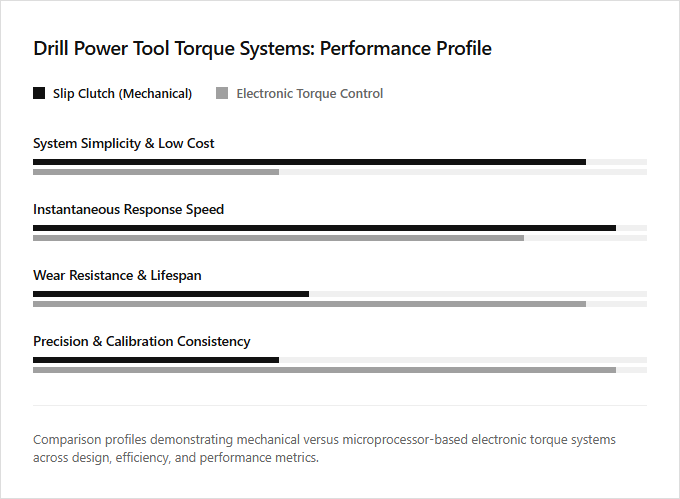
| Operating Mechanism | Slip clutches rely on mechanical spring-loaded plates that physically disengage when resistance is met, whereas electronic torque control utilizes microprocessors to monitor motor current draw and dynamically cut power. |
| Precision and Calibration | Electronic torque control provides highly accurate digital feedback-loop adjustments, whereas mechanical slip clutches offer stepped settings that can drift over time due to spring fatigue. |
| Wear and Lifespan | Mechanical slip clutches suffer from friction-induced wear on internal mating surfaces, while electronic sensors regulate torque with zero physical contact to ensure longer component longevity. |
| Response Speed | Slip clutches disengage instantaneously upon reaching the physical torque threshold, whereas electronic systems rely on rapid sensor polling rates to detect stall conditions and prevent user injury from kickback. |
| Cost and Complexity | Mechanical slip clutches are simple, robust, and cost-effective to manufacture, whereas electronic torque control requires sophisticated microprocessor circuitry and brushless motor integration. |
How Spring-Loaded Slip Clutches Interrupt Torque
In cordless drills, effective torque management prevents material damage and fastener stripping. Traditional mechanical slip clutches physically interrupt torque transfer using a spring-loaded detent plate. When the resistance of the fastener exceeds the pre-selected spring tension, the detent plate slips, producing a familiar clicking sound and instantly halting chuck rotation to protect the work surface.
Electronic torque control utilizes digital sensors to monitor motor current, cutting power electronically when a specific threshold is reached. While electronic systems offer wear-free operation, mechanical clutches provide immediate tactile feedback. Mechanical clutches are ideal for general contractors who value tactile responsiveness, while electronic control best serves precision technicians requiring delicate, highly repeatable fastening.
Electronic torque control regulates motor output via real-time current-sensing microprocessors.
When selecting a drill, the choice between a mechanical slip clutch and electronic torque control dictates how the tool handles resistance. Traditional slip clutches rely on physical, spring-loaded plates that slip when a pre-set threshold is reached, protecting the fastener and workpiece from damage. This mechanical approach offers reliable, tactile feedback for standard fastening applications.
In contrast, electronic torque control regulates motor output via real-time current-sensing microprocessors. When the system detects a spike in electrical current-signaling resistance-it instantly cuts or adjusts power to the motor. This digital precision reduces mechanical wear, minimizes tool recoil, and allows for highly accurate torque adjustments without the friction of moving clutch plates.
Mechanical slip clutches are best suited for traditional tradespeople who rely on tactile feedback and repetitive driving, while electronic torque control is ideal for precision technicians and woodworkers handling delicate or varied materials.
Wear and Heat Degrade Mechanical Calibration Accuracy
When evaluating drill power tools, the choice between slip clutches and electronic torque control is critical for operational efficiency. Traditional mechanical slip clutches rely on physical spring tension and friction plates to disengage the drive. Because these mechanical systems suffer from thermal dissipation and component wear under heavy use, they inevitably experience a reduction in long-term calibration accuracy.
Electronic torque control systems bypass these physical limitations by digitally monitoring motor current to cut power at precise thresholds, ensuring consistent performance without wear-related degradation. Traditional mechanical clutches are best suited for general construction workers who prefer tactile feedback, whereas electronic torque control is ideal for high-precision assemblers requiring enduring accuracy and repeatable specifications.
Closed-Loop Electronic Clutches: Wear-Free, Precise Torque
Traditional mechanical slip clutches rely on physical friction plates that wear down over time, leading to inconsistent torque delivery. In contrast, modern electronic torque control systems utilize advanced closed-loop feedback mechanisms. These digital systems continuously monitor motor current and speed, shutting off power instantly when the predefined threshold is met, which delivers high torque repeatability without any physical wear on the tool.
While mechanical clutches offer immediate, tactile feedback during heavy-duty fastening, electronic systems provide superior precision and a longer operational lifespan for delicate or highly repetitive tasks. Traditional slip clutches remain ideal for general contractors seeking rugged simplicity, whereas electronic torque control is best suited for precision assemblers and professionals working with sensitive materials requiring exact, repeatable torque tolerances.
How Sensor Polling Minimizes Operator Wrist Kickback
When selecting professional drill drivers, understanding the distinction between mechanical slip clutches and electronic torque control is essential. Mechanical systems rely on physical spring-loaded plates that slip at a predetermined resistance level to protect the fastener. In contrast, electronic torque control utilizes microprocessors to monitor motor feedback. Reaction time in electronic systems is governed by sensor polling rates, allowing the tool to cut power within milliseconds and significantly minimizing operator wrist kickback during sudden bit binds.
Mechanical slip clutches remain highly suited for traditional carpenters seeking rugged, tactile feedback during high-volume fastening, whereas electronic systems are ideal for precision-focused assembly technicians who prioritize advanced joint safety and programmable settings.
How Brushless Motors Prevent Fastener Cam-Out
Traditional mechanical slip clutches rely on physical spring tension to disengage the drive train at a preset resistance. In contrast, modern electronic torque control leverages brushless motor commutation to continuously monitor electrical current and rotational speed. By analyzing these feedback loops in real time, the electronic system dynamically scales power output to prevent fastener cam-out and material damage before it occurs.
This digital regulation provides precise torque delivery without the physical wear of mechanical plates. Mechanical slip clutches are best suited for general contractors seeking rugged, tactile feedback, whereas electronic torque systems are ideal for precision assembly specialists and woodworkers requiring exact, repeatable depth control on delicate materials.
Electronic Limiters vs. Mechanical Clutches: Energy Loss Comparison
In cordless drill design, managing torque delivery is critical for preventing fastener damage and motor strain. Traditional mechanical slip clutches rely on physical spring-loaded plates that slide against each other when a pre-set torque threshold is met. This friction-based slippage generates high parasitic energy loss and heat, which reduces overall battery efficiency during prolonged operation.
Electronic torque control utilizes digital sensors to monitor motor current. When resistance reaches the designated limit, the system instantly shuts off power to the motor, eliminating the energy waste and mechanical wear associated with friction. This digital interruption preserves battery life and ensures consistent depth control.
Mechanical slip clutches remain ideal for traditional carpenters who prefer tactile feedback, while electronic torque systems are best suited for high-volume assembly technicians requiring maximum battery runtime and precision.
Leave a comment