
Woodworkers and contractors often struggle to achieve clean, durable fastenings, frequently facing the frustration of split delicate trim or structural failure in heavy sheathing. While standard workshop tool budgets typically prioritize versatile finish nailers or general-purpose fasteners as primary capital investments, pneumatic staplers require a far more specialized selection process. Selecting the precise crown width grants professionals unmatched holding power and flawless aesthetic control, transforming both finishing and framing efficiency.
However, a critical stipulation remains: peak performance depends strictly on matching tool PSI and wire gauge thickness to your specific substrate to prevent material blowout. Whether you are installing fine cabinet backing with a Senco FinishPro or securing rugged subflooring using Bostitch heavy-duty models, matching the tool to the application is essential. This article compares narrow versus wide crown staplers, analyzing holding power, material compatibility, and application parameters to guide your next workshop investment.
| Factor | Summary |
|---|---|
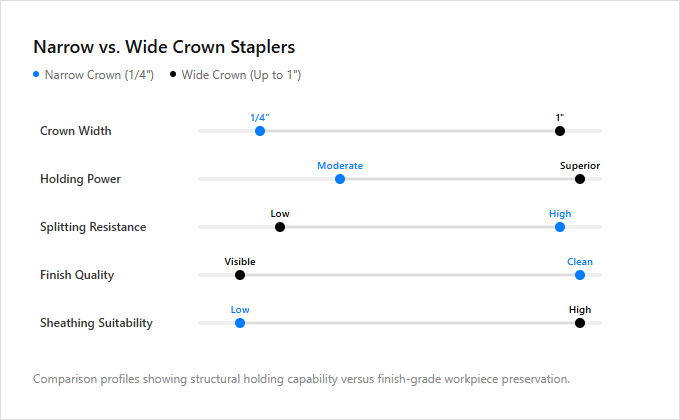
| Crown Width | Narrow crown staplers utilize a narrow bridge (typically 1/4 inch) for discreet fastening, whereas wide crown staplers feature a larger bridge (up to 1 inch) to secure broader material spans. |
| Holding Power | Wide crown staplers provide superior shear strength and pull-through resistance due to their larger surface area footprint, while narrow crown staplers offer moderate holding strength suited for lighter joint assembly. |
| Material Splitting | Narrow crown staples minimize the risk of workpiece splitting in delicate trim molding due to their thin wire gauge, whereas wide crown staples require more robust wooden substrates to prevent structural fracturing. |
| Primary Applications | Wide crown staplers are ideal for heavy-duty construction tasks like house wrapping and roof sheathing, whereas narrow crown staplers excel in precision woodworking, cabinetry fabrication, and finish carpentry. |
| Aesthetic Impact | Narrow crown staples leave a minimal entry profile that is easily concealed with wood putty, while wide crown staples leave a highly visible footprint that is generally unacceptable for finish-grade surfaces. |
Narrow vs. Wide Crown Staplers Compared
When selecting a pneumatic stapler, understanding crown width and wire gauge is essential for project success. Narrow crown staplers typically utilize a fine 18-gauge wire, which minimizes the footprint of the fastener. This design is engineered to prevent splitting in delicate trim, detailed moulding, and thin cabinetry, preserving the aesthetic integrity of finish work.
In contrast, wide crown staplers employ heavy-duty 16-gauge wire to provide maximum holding power across a broader surface area. These robust tools are designed for demanding, structural applications such as framing, securing sheathing, and installing subfloors where holding power is paramount. Finish carpenters and furniture makers will benefit most from the precision of a narrow crown model, whereas general contractors and roofers require the sheer strength of a wide crown stapler.
Wide vs. Narrow Crown Staples: Key Differences
Selecting the appropriate crown width is essential for optimizing structural integrity and aesthetic outcomes in fastening. Wide crown staplers are engineered for heavy-duty applications, deploying fasteners with a broad surface area. This design provides superior pull-through resistance and high shear strength, making them the industry standard for securing subfloors, sheathing, and lathing.
For detailed woodworking, narrow crown staplers offer low-profile fastening that minimizes wood splitting and remains virtually inconspicuous. These tools excel in cabinetry, trim work, and fascia installation where clean, seamless joints are required.
Heavy-duty construction installers requiring maximum holding power prefer wide crown models, whereas precision woodworkers and cabinetry specialists favor the discreet finish of narrow crown systems.
No-Mar Narrow Crown Tools Protect Sensitive Surfaces
When selecting a pneumatic stapler, understanding the distinction between narrow and wide crown tools is essential for project success. Narrow crown staplers are engineered for precision tasks, offering a subtle holding solution that is easily concealed. Fine finish narrow crown tools feature a no-mar contact safety trip to protect sensitive substrates from indentation, preserving the aesthetic value of delicate trim, cabinetry, and detailed woodworking.
Wide crown staplers are designed for heavy-duty applications where maximum holding power is required. These robust tools accommodate wider staples that bridge across larger surface areas, making them ideal for securing structural sheathing, subfloors, and framing. Narrow crown staplers are best suited for finish carpenters requiring seamless, cosmetic fastening, while wide crown models are ideal for framing contractors and roofers performing high-volume, structural installations.
Power Requirements for Heavy-Duty Wide Crown Staplers
When selecting pneumatic staplers, the primary distinction lies in crown width, which dictates both holding power and the tool's pneumatic requirements. Narrow crown staplers are ideal for delicate trim and cabinetry, requiring minimal airflow. In contrast, heavy-duty wide crown staplers demand significantly higher CFM and operating PSI to successfully drive large, heavy-gauge fasteners into dense engineered lumber and structural sheathing.
Operating these robust wide crown systems requires high-capacity air compressors capable of maintaining consistent pressure during rapid firing. Fine woodworkers and cabinet makers benefit most from the precision of narrow crown models, while framing contractors and roofers require the sheer holding power of wide crown staplers for heavy-duty construction applications.
Narrow vs. Wide Crown Staples: Key Differences
Selecting the appropriate pneumatic stapler depends heavily on the structural and aesthetic requirements of your project. Narrow crown staplers utilize fasteners that rely on specialized glue-collation, which ensures a clean separation during tool cycling and prevents material splitting. This design delivers a low-profile finish, making it highly suitable for delicate trim work and cabinetry where visible fastening must be kept to a minimum.
Wide crown staplers are engineered for maximum holding power in structural applications. These wide crown staples feature coated shanks designed to heat up during driving and bond with the wood fibers, which significantly enhances their overall withdrawal capacity. Detail-oriented finish carpenters and cabinetmakers excel with the precision of narrow crown systems, whereas heavy-duty builders, roofers, and packaging specialists rely on the superior holding power of wide crown staplers.
Staple Depth Adjustment: Countersinking vs. Flush Seating
Narrow crown and wide crown pneumatic staplers serve distinct structural and aesthetic purposes in woodworking and construction. Choosing the correct tool depends entirely on the material thickness and the required finish. For delicate applications involving veneers and finish trim, a narrow crown stapler is essential. Achieving a flawless countersink in these thin materials requires a highly precise, tool-free depth-of-drive adjustment to prevent splitting the delicate surface.
Wide crown staplers are engineered for heavy-duty fastening where maximum holding power is the primary objective. These tools prioritize flush seating across expansive materials like sheathing, packaging, and subflooring, rather than micro-adjusted depth control. Detail-oriented cabinetmakers and finish carpenters benefit most from the surgical precision of narrow crown staplers, whereas framing contractors and roofers require the high-production speed and holding capacity of wide crown systems.
Wide vs. Narrow Crown Staplers: Structural vs. Finish
Wide crown staplers are engineered for high-load shear wall sheathing and lathing applications where structural integrity is paramount. The expansive bridge of these fasteners distributes clamping force over a broader surface area, preventing structural panels from pulling through under intense wind or seismic loads. This makes them indispensable for heavy-duty exterior framing and backing installation.
In contrast, narrow crown staplers are optimized for delicate fascia and soffit installations where aesthetic discretion is critical. Their slim profile allows fasteners to sink deeply into tight grooves without splitting fragile wood or vinyl components. Structural framing contractors rely on wide crown staplers for maximum holding power, while trim carpenters and siding installers benefit from the precision and low visibility of narrow crown tools.
Leave a comment