
Achieving a flawless, swirl-free finish with a random orbital sander is often hindered by a frustrating reality: abrasive discs that slip, tear, or fly off mid-job. While standard workshop procurement budgets typically allocate fixed funding for consumable abrasives, selecting the wrong disc interface can quietly drain those resources through wasted downtime and ruined workpieces.
Choosing the optimal disc attachment system grants operators a significant advantage in both surface quality and daily operational efficiency. It is important to stipulate, however, that neither system is a universal cure-all; specific environmental factors and application demands must dictate your tooling choice. For example, heavy-duty applications like stripping old varnish from oak doors require different heat resistance than fine-grit contour sanding.
This guide analyzes the critical distinctions between Hook and Loop (H&L) and Pressure Sensitive Adhesive (PSA) systems, comparing their durability, swap speed, and cost-per-use to help you optimize your sanding workflow.
| Factor | Summary |
|---|---|
| Attachment Mechanism | Hook and Loop utilizes a fabric-based hook-and-pile fastening system, whereas Pressure Sensitive Adhesive relies on a polymer-based chemical backing that bonds under applied force. |
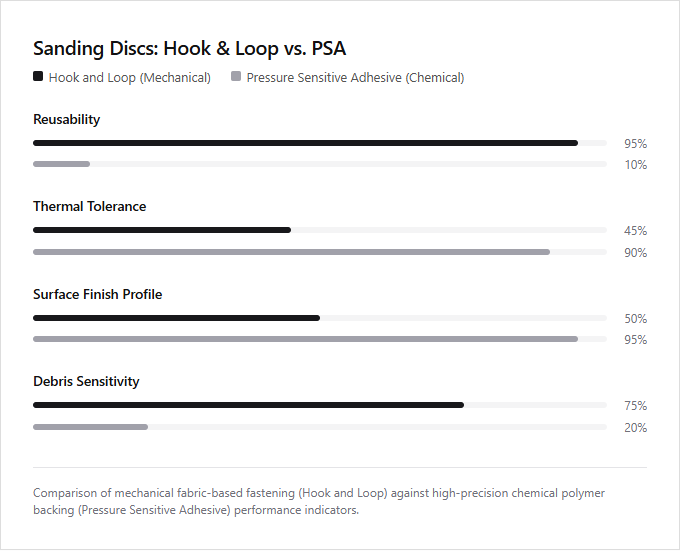
| Reusability | Hook and Loop discs can be peeled off and reattached multiple times due to their non-destructive mechanical bond, while PSA discs typically lose their adhesive tack and suffer from substrate tearing upon removal. |
| Thermal Tolerance | High-friction sanding generates thermal energy that can degrade the thermoplastic resin of hook-and-loop backings, whereas high-quality PSA backing adhesives are engineered to resist shear-thinning at elevated temperatures. |
| Surface Finish Profile | PSA discs offer a flatter, more rigid interface that minimizes abrasive deflection for superior flat-surface sanding, unlike the cushioned hook-and-loop interface which can introduce minor orbital runout or rounding on edges. |
| Debris Sensitivity | Fine particulate sawdust can clog the interlocking fibers of a hook-and-loop pad over time, while dust contamination on a PSA backing instantly compromises the adhesive's surface energy and prevents bonding. |
Mechanical interlocking of hook-and-loop backing enables efficient grit cycling
When selecting abrasives for power sanders, the attachment mechanism significantly impacts project efficiency. Hook-and-loop systems utilize a mechanical interlocking design that allows users to peel and reattach discs repeatedly without degrading the backing. This capability enables efficient grit cycling, allowing operators to step through various grits and save partially used discs for future tasks.
In contrast, Pressure Sensitive Adhesive (PSA) backing offers a flat, rigid connection for high-precision sanding, though the adhesive is typically single-use. Hook-and-loop is ideal for versatile woodworkers executing multi-stage finishing, while PSA is preferred by automotive restorers requiring flat, high-accuracy surface prep.
Thermal Degradation Causes Sticky Adhesive Failure
When selecting abrasives for power sanders, the choice between hook-and-loop and pressure-sensitive adhesive (PSA) attachments hinges on thermal tolerance. Frictional heat generated during intensive sanding causes thermal degradation of pressure-sensitive adhesives, leading to cohesive failure. This breakdown leaves a difficult, sticky residue on the backup pad and ruins the disc. In contrast, hook-and-loop systems utilize mechanical interlocking fibers that resist heat, permitting clean disc changes and consistent performance under high temperatures.
Hook-and-loop systems are ideal for DIYers and woodworkers who require frequent grit changes during a project, whereas PSA discs are best suited for high-volume automotive technicians or cabinet makers who perform dedicated, single-grit sanding operations requiring a flat, stiff backing.
Hole Alignment: Key to Efficient Dust Extraction
Choosing between hook-and-loop and pressure-sensitive adhesive (PSA) sanding discs significantly impacts workshop cleanliness and finish quality. Hook-and-loop systems offer the advantage of reusability and quick changes, but their performance relies heavily on precise vacuum hole alignment. Perfect alignment between the disc and the sander pad holes is critical for optimal dust extraction efficiency, preventing clogging and extending abrasive life.
PSA discs lay flatter on the pad, providing a stiffer backing that excels in high-precision, flat-surface sanding. Hook-and-loop systems suit woodworkers and refinishers who require frequent grit changes and a dust-free environment, while PSA systems are ideal for metalworkers and auto body technicians seeking maximum flatness and single-use economy.
Low-Profile PSA Discs for Precision Sanding
When selecting backing systems for power sanders, the choice between hook-and-loop and pressure-sensitive adhesive (PSA) configurations directly impacts finish quality. Hook-and-loop systems utilize a fabric interface that provides cushioning, which is highly effective for contoured surfaces but can introduce minor flexing. Low-profile PSA discs adhere directly to a rigid backing pad, eliminating this compliance to offer superior flatness tolerance. This rigid connection ensures maximum stability, making PSA the ideal choice for precision sanding applications where strict surface uniformity is critical.
The operational demands of the project dictate the ideal system for the task. PSA systems are best suited for precision cabinetmakers, luthiers, and metal fabricators executing flawless flat leveling, while hook-and-loop systems benefit general contractors and refinishers who require rapid grit changes during multi-stage preparation.
Hook-and-Loop Shear Strength Resists High-RPM Slippage
Hook-and-loop fastening systems excel in high-demand sanding applications due to their exceptional lateral shear strength. Under high-RPM orbital vibration, the interlocking mechanical hooks grip the loop backing securely to resist lateral slippage and heat buildup. This robust connection ensures the abrasive disc remains firmly centered under intense rotational forces, maintaining consistent contact with the workpiece.
Pressure Sensitive Adhesive (PSA) discs offer a flatter sanding profile by eliminating the cushioning of the hook-and-loop interface, though they remain more vulnerable to adhesive breakdown from heat and dust. Hook-and-loop systems are ideal for high-volume woodworkers requiring rapid disc changes and high vibration resistance, whereas PSA backings are best suited for automotive refinishers and precision craftsmen seeking ultra-flat, flawless finishes.
Dust contamination prevents reuse of pressure-sensitive adhesives
In the selection of sanding discs, the attachment mechanism significantly impacts efficiency and operating costs. While Hook and Loop systems utilize a reusable fabric backing, Pressure Sensitive Adhesive (PSA) discs rely on a flat chemical bond for a smoother finish.
The primary limitation of PSA is its high contaminant sensitivity. Once a PSA disc is peeled off, the exposed adhesive immediately attracts airborne wood dust and debris, neutralizing its bonding capacity and preventing any reapplication. In contrast, Hook and Loop fasteners tolerate heavy dust exposure, allowing the user to peel, clear, and reuse the disc multiple times.
Hook and Loop is ideal for versatile woodworkers who frequently switch grits during a project, whereas PSA is best suited for high-volume production operators performing continuous, single-grit sanding where disc reuse is unnecessary.
Rigid interface of pressure-sensitive adhesive maximizes aggressive stock removal rates
When selecting abrasives for power sanders, the backing attachment method directly influences tool performance. Pressure Sensitive Adhesive (PSA) discs establish a direct, rigid interface between the abrasive paper and the backing pad. This flat, unyielding contact ensures maximum energy transfer, maximizing aggressive stock removal rates and maintaining flatter surfaces during heavy leveling tasks.
Hook and Loop systems employ a fabric interlayer that cushions the sanding action, facilitating quick disc changes at the expense of absolute rigidity. High-production woodworkers prioritizing rapid, flat material removal prefer pressure-sensitive adhesives, while automotive refinishers and hobbyists requiring frequent grit changes and contour flexibility benefit most from hook and loop configurations.
Leave a comment