
Every professional woodworker and refinisher knows the frustration of a ruined workpiece-either spending hours stripping stubborn coatings with an underpowered tool, or watching a beautiful veneer get gouged by an overly aggressive machine. While standard workshop investments like manual sanding blocks and basic sheet sanders are suitable for minor touch-ups, they fall short during complex restorations or high-volume production.
Upgrading to the correct specialized power sander grants operators the precise mechanical control needed to slash labor times while ensuring flawless, swirl-free surface prep. However, an important technical stipulation remains: no single tool is a universal solution. Attempting to use a high-torque rotary sander for delicate finish work, or a random orbital sander for heavy material removal, will yield substandard results. For example, stripping thick varnish from an oak door requires raw rotary power, whereas prepping a walnut tabletop for a high-gloss stain demands dual-action precision.
In this guide, we will analyze the key mechanical differences between random orbital and rotary sanders, explore their ideal applications, and help you select the optimal tool for your workshop's specific finishing needs.
| Factor | Summary |
|---|---|
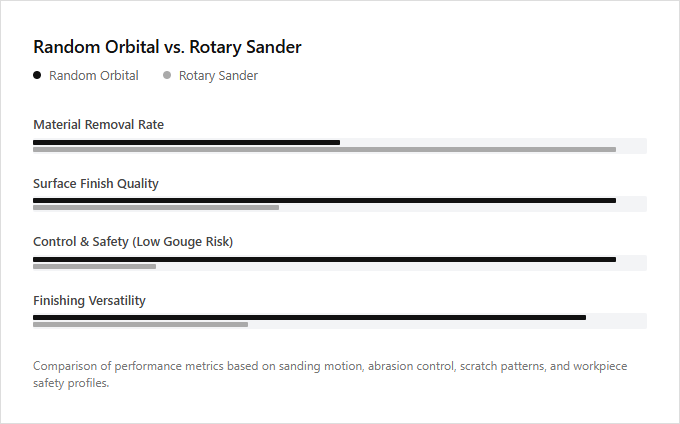
| Motion Action | While the rotary sander utilizes a direct-drive circular rotation, the random orbital sander employs a dual-action mechanism that combines spinning with an elliptical orbit. |
| Material Removal Rate | Rotary sanders excel at rapid stock removal on rough surfaces, whereas random orbital sanders offer a controlled, moderate rate of abrasion. |
| Surface Finish Quality | The random orbital sander prevents visible scratch patterns through its randomized path, while the high-velocity rotary sander can cause hologramming if used improperly. |
| Risk of Gouging | Rotary sanders carry a high risk of surface gouging and friction-induced burning, whereas random orbital sanders feature a free-spinning pad that stops under excessive pressure to protect the workpiece. |
| Primary Application | Rotary sanders are ideal for heavy-duty stripping and leveling, whereas random orbital sanders are the industry standard for ultra-smooth intercoat abrasion and final finishing. |
Rotary sanders utilize a direct-drive spindle for high-torque stock removal
Rotary sanders utilize a direct-drive spindle for high-torque stock removal, making them highly efficient at stripping thick layers of paint, varnish, or rust. This direct connection between the motor and the backing pad delivers continuous, aggressive rotation that quickly levels uneven wooden or metal surfaces.
Random orbital sanders employ an elliptical motion combined with rotation, which prevents distinct scratch patterns on the workpiece. This dual-action movement produces an ultra-smooth finish, making it ideal for final preparation before applying stain or sealant.
Heavy-duty rotary units are best suited for professional restorers and metalworkers needing rapid material removal, whereas versatile random orbital sanders are ideal for cabinetmakers and DIY enthusiasts seeking a flawless, swirl-free finish on delicate wood projects.
How Random Orbital Sanders Prevent Swirl Marks
Selecting the appropriate sanding tool is vital for achieving a professional-grade finish. The primary distinction between these machines lies in their movement patterns. Random orbital sanders feature an eccentric orbit combined with free rotation to prevent swirl marks, ensuring a ultra-smooth, scratch-free surface. This randomized motion prevents the abrasive paper from traveling the same path twice, making it highly forgiving on delicate wood grains.
By contrast, rotary sanders operate on a fixed, direct rotation that delivers high-torque material removal. While highly efficient for stripping thick coatings or leveling uneven joints, this aggressive action requires precise control. Precision-focused DIYers and cabinetmakers will find the random orbital sander ideal for fine finishing, whereas heavy-duty restoration specialists and professional fabricators will benefit more from the rapid stock removal of the rotary sander.
Sander Speeds: RPM vs. OPM
When selecting professional sanding equipment, understanding the distinct mechanical actions of rotary and random orbital sanders is essential. Rotary sanders operate using a direct, singular spinning motion. This performance is measured in revolutions per minute (RPM), which indicates how many times the pad completes a full 360-degree rotation. This high-speed, direct drive system provides the high torque necessary for rapid material removal and aggressive stripping tasks.
In contrast, random orbital sanders employ a dual-action movement that combines rotation with an eccentric looping path. This complex motion is quantified in orbits per minute (OPM), reflecting the speed of these tiny, overlapping elliptical paths. The non-directional pattern prevents swirl marks, ensuring an ultra-smooth finish across various wood grains.
Rotary sanders are ideal for heavy-duty restoration specialists needing fast stock removal, while random orbital sanders are best suited for cabinetmakers and finishers requiring a pristine, scratch-free surface.
Sander Counterweights Reduce Hand-Arm Vibration
Selecting the appropriate sanding technology requires balancing material removal rates with operator comfort and safety. Rotary sanders operate on a direct, fixed-axis rotation, delivering high-torque performance ideal for aggressive stock removal but transmitting significant physical strain to the user. In contrast, random orbital sanders employ an integrated counterweight system to minimize hand-arm vibration syndrome. This sophisticated engineering dampens the oscillation feedback, protecting operators from long-term nerve damage during extended industrial applications.
While the dual-action motion of the orbital system prevents swirl marks, the single-direction spin of the rotary alternative maximizes speed on stubborn coatings. Fine woodworkers and finish carpenters seeking swirl-free surfaces prefer the random orbital sander, whereas heavy-duty fabricators and boat restorers stripping thick paint layers benefit most from the aggressive power of the rotary sander.
Rotary Sander Heat: Warping and Melting Risks
Selecting the correct sanding technology is essential for maintaining material integrity during surface preparation. Rotary sanders operate through a direct, high-speed spinning motion designed for aggressive stock removal. This continuous circular friction generates significant heat buildup, which can warp sensitive substrates or melt delicate coatings like paint and varnish.
In contrast, random orbital sanders utilize an elliptical, dual-action movement that disperses energy. This random pattern prevents heat concentration and eliminates unsightly swirl marks. Heavy-duty restoration specialists requiring rapid stripping favor the aggressive rotary sander, while detail-oriented woodworkers and refinishers seeking a flawless, burn-free finish prefer the random orbital sander.
How Sander Pad Brakes Prevent Surface Gouging
Choosing between a random orbital sander and a rotary sander depends on the required precision and material removal rate. Random orbital sanders employ a dual-action spinning and oscillating motion to deliver a swirl-free finish. These machines rely on a backing pad braking system to prevent deep gouging upon surface contact, ensuring a controlled and safe start on delicate workpieces.
Rotary sanders spin directly on a fixed axis at high speeds to offer rapid material stripping. These tools lack a pad brake, requiring experienced handling to avoid surface damage. DIY enthusiasts and cabinetmakers benefit from the forgiving nature of random orbital sanders, while professional restorers and boat builders require the high-torque power of rotary sanders for heavy-duty stripping.
How Forced-Rotation Dual-Action Sanders Work
When selecting professional sanding equipment, understanding the mechanical distinction between rotary and random orbital sanders is essential. Rotary sanders operate on a direct-drive system to deliver rapid material removal, while standard random orbital sanders rely on a free-spinning pad to minimize swirl marks. Bridging this gap, forced-rotation dual-action sanders use a gear-driven mechanism to combine high-torque cutting with an orbital path, preventing stalling under heavy pressure.
This hybrid design provides the aggressive leveling capabilities of a rotary tool alongside the refined finish quality typically associated with orbital action. Heavy-duty fabricators and restorers benefit most from the aggressive material removal of rotary and forced-rotation units, whereas woodworkers and finishing technicians requiring flawless, swirl-free surfaces are best suited for standard random orbital sanders.
Leave a comment