
Managing a social media pipeline often feels like controlled chaos, particularly when rough brainstorms clutter your active publication schedule. Traditionally, creators rely on external spreadsheets or Trello boards to separate raw ideas from finished posts-standard planning sources that ultimately fragment your workflow.
Mastering the distinction between the Buffer Queue and Buffer Drafts grants you a seamless, single-platform pipeline that eliminates this friction. Stipulation: While utilizing Drafts effectively requires a disciplined review process to prevent ideation bloat, it ensures your active Queue remains pristine.
For example, savvy digital agencies use Drafts to store half-formed campaign concepts, while utilizing the Queue to automate scheduled assets like their "Weekly Tech Roundup."
In this article, we will analyze the core differences between Buffer Queue vs. Drafts, outline specific use cases for each, and provide a blueprint to streamline your publishing workflow.
| Factor | Summary |
|---|---|
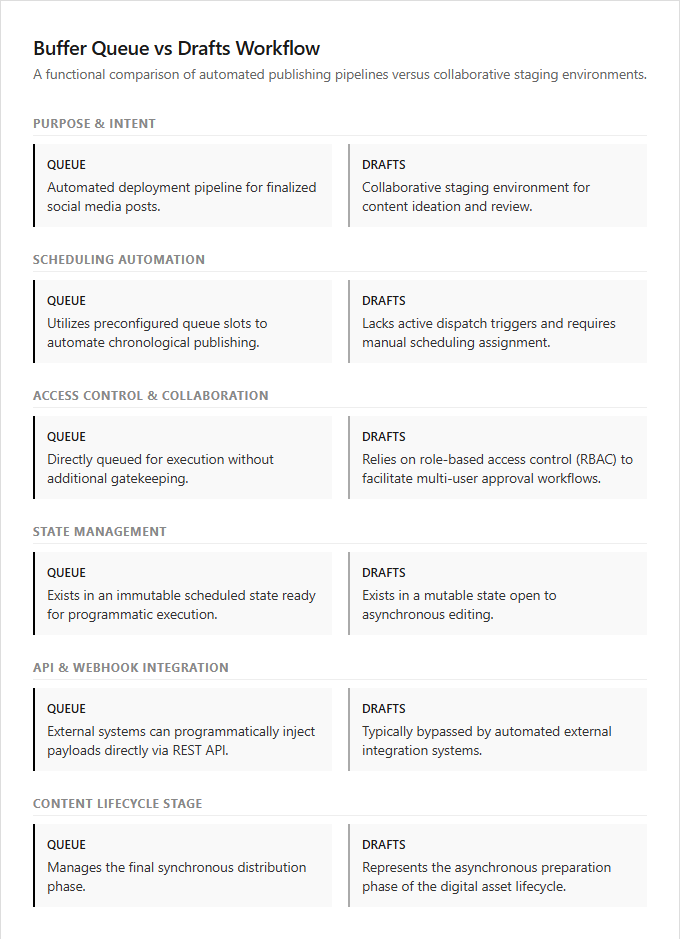
| Purpose & Intent | While the Buffer Queue functions as an automated deployment pipeline for finalized social media posts, the Drafts Workflow serves as a collaborative staging environment for content ideation and review. |
| Scheduling Automation | The Queue utilizes preconfigured queue slots to automate chronological publishing, whereas Drafts lack active dispatch triggers and require manual scheduling assignment. |
| Access Control & Collaboration | Drafts rely on role-based access control (RBAC) to facilitate multi-user approval workflows before content is escalated to the active Queue. |
| State Management | Content in the Queue exists in an immutable scheduled state ready for programmatic execution, while Drafts exist in a mutable state open to asynchronous editing. |
| API & Webhook Integration | External integration systems can bypass the Drafts Workflow to programmatically inject payloads directly into the Queue using automated REST API endpoints. |
| Content Lifecycle Stage | The Drafts Workflow represents the asynchronous preparation phase of the digital asset lifecycle, whereas the Queue manages the final synchronous distribution phase. |
Transitioning Drafts to the Active Pipeline
Buffer's Drafts and Queue functions serve distinct roles in the digital content lifecycle. Drafts act as a non-executable repository for raw ideas, collaborative feedback, and unfinished copy. Transitioning this content into the active pipeline requires promoting a draft to the Queue, where it immediately inherits the next available chronological slot in the automated publishing schedule.
This structural shift ensures that strategic planning remains decoupled from immediate publishing pressures until assets are fully vetted. Drafts are ideal for collaborative marketing teams requiring multi-step approval workflows, whereas the Queue is best suited for agile creators and community managers focused on maintaining a consistent, automated posting cadence.
Automating Queue Dispatch for Optimal Audience Engagement
The Buffer Queue serves as an automated engine for social media distribution, utilizing pre-determined, cron-style scheduling slots to target peak audience engagement windows. Once content is added to the queue, it automatically populates the next available slot, streamlining the publishing pipeline. This hands-off dispatch system eliminates the need for manual scheduling for every individual post, maintaining a consistent brand presence effortlessly.
Conversely, the Drafts Workflow provides a collaborative space for content ideation, review, and refinement before entering the active publishing cycle. This stage allows teams to workshop copy and secure approvals without disrupting the established automation queue. The automated Queue is ideal for data-driven marketers seeking high-frequency consistency, while the Drafts Workflow is best suited for collaborative teams requiring multi-level approval processes before publication.
Ingesting Collaborative Content into Drafts via REST API
Buffer's robust API provides distinct endpoints to manage content pipelines, separating the immediate Queue from the collaborative Drafts repository. When integrating external team contributions, ingesting raw content directly into the Drafts repository via REST API endpoints ensures that incoming posts undergo necessary internal review before scheduling. This programmatic staging prevents unvetted content from entering the active Queue, maintaining strict brand consistency across all connected social channels.
While the Queue acts as a finalized, automated timeline for publishing, the Drafts workspace serves as a flexible sandbox for refinement. Sending API payloads to the drafts endpoint allows stakeholders to edit, tag, and approve posts before promotion to the active queue. The automated Queue is designed for solo creators seeking rapid, direct publishing, whereas the collaborative Drafts workflow is best suited for cross-functional marketing teams requiring multi-layered approval processes.
RBAC Approval Gates for Queue Promotion
Buffer's content distribution engine operates through two primary states: the active Queue and the collaborative Drafts space. While the Queue automates the immediate publishing schedule for verified posts, the Drafts workflow serves as a secure staging environment. Integrating Role-Based Access Control (RBAC) into this pipeline establishes strict approval gates, ensuring that content proposed by contributors must receive formal authorization before promotion to the active Queue.
These permission-based gates mitigate brand risk by preventing unauthorized or unreviewed posts from going live. Contributors can freely brainstorm and construct posts within the Drafts area, while designated administrators retain exclusive scheduling privileges. The direct Queue is ideal for autonomous creators who manage their own distribution, whereas the RBAC-enabled Drafts workflow is designed for corporate marketing teams requiring multi-layered quality assurance and strict compliance oversight.
Spacing queue intervals to mitigate platform-specific API rate limiting penalties
Buffer's Queue and Drafts workflows serve distinct operational roles in social media management, particularly regarding API rate limiting. The Buffer Queue automatically spaces out posts at predetermined intervals. This consistent spacing is crucial for mitigating platform-specific API rate penalties, which often trigger when accounts publish content too rapidly. By distributing posts evenly throughout the day, the Queue ensures continuous compliance with network restrictions without manual oversight.
In contrast, the Drafts workflow acts as a collaborative sandbox, where posts remain unscheduled until they undergo review. While the Queue automates spacing to prevent account restriction, Drafts allow teams to refine messaging without risking immediate API pressure. The Buffer Queue is ideal for systematic marketers managing high-volume, automated schedules, whereas the Drafts workflow suits collaborative teams requiring multi-level approval before publication.
Parsing High-Res Drafts in Cloud Blob Storage
The Buffer Drafts workflow provides a dedicated staging environment for content preparation, particularly when managing heavy media files. Unlike the active Buffer Queue which holds ready-to-publish posts, the Drafts phase allows teams to upload and parse high-resolution images and video assets directly into secure cloud blob storage. This decoupled storage approach ensures that large files undergo necessary transcoding and metadata parsing asynchronously, maintaining optimal platform performance before scheduling.
Once these digital assets are processed and approved, they transition into the structured Buffer Queue for automated distribution. The Drafts workflow is ideal for collaborative marketing teams requiring rigorous approval pipelines and asset optimization, whereas the Buffer Queue is best suited for independent creators and social managers executing immediate, pre-formatted content calendars.
Auto-Appending UTM Parameters to Queued Links
Buffer's Queue and Drafts workflows offer distinct approaches to campaign preparation, particularly regarding telemetry tracking. Utilizing the active Queue allows teams to automate data ingestion by instantly appending serialized UTM parameters to all outbound links upon scheduling. This automated serialization ensures consistent, error-free campaign attribution across digital channels. In contrast, the Drafts folder serves as a collaborative staging environment where automated UTM injection is deferred, preserving raw links until the content is approved for scheduling.
Aligning these features with operational needs optimizes the precision of your marketing analytics. The automated Queue workflow is ideal for systematic social media managers requiring hands-off, standardized tracking for high-volume publishing, while the Drafts workflow suits collaborative editorial teams who prioritize multi-stage reviews and manual approval before finalizing link configurations.
Leave a comment