
For scaling digital brands, managing multi-channel social publishing quickly becomes a bottleneck. Teams often struggle to synchronize complex content calendars across disparate networks, resulting in delayed campaigns. While standard built-in schedulers and basic native connectors offer a temporary bridge, they fall short of supporting highly customized enterprise workflows.
Leveraging the Buffer Developer API grants organizations absolute programmatic control over their content pipelines, enabling dynamic, automated publishing straight from internal databases. However, implementing this powerful developer-centric approach requires a foundational stipulation: it demands dedicated engineering resources, unlike plug-and-play tools. For instance, teams can seamlessly connect headless platforms like Strapi or automate Shopify product launches directly into their social queues.
In this article, we will evaluate the Buffer API against Zapier integrations, analyzing scalability, development costs, and implementation complexity to help you architect the ideal publishing workflow.
| Factor | Summary |
|---|---|
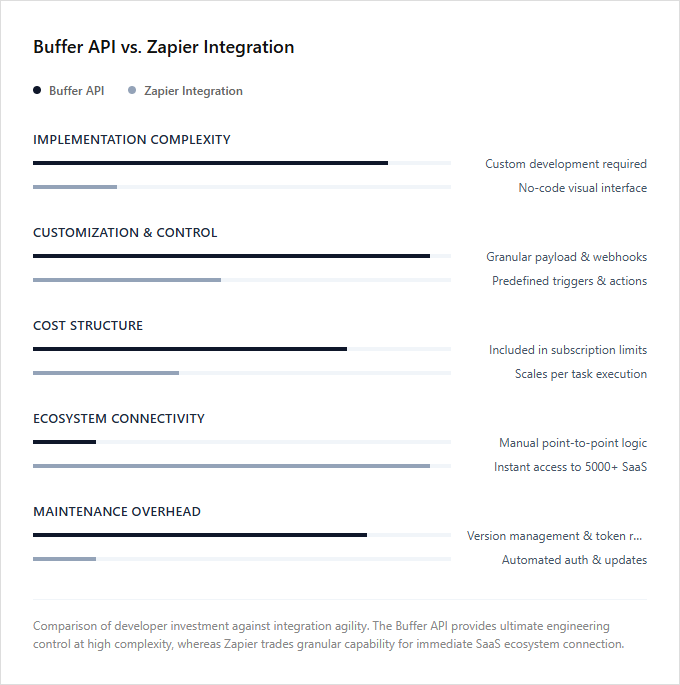
| Implementation Complexity | While the Buffer API requires custom software development and direct HTTP requests, Zapier Integration offers a no-code visual interface for rapid deployment. |
| Customization and Control | The Buffer API provides granular control over endpoint payloads and webhook listeners, whereas Zapier is constrained by predefined triggers and actions. |
| Cost Structure | Buffer API usage is typically governed by API rate limits within platform subscription tiers, while Zapier scales costs based on task volume and multi-step execution. |
| Ecosystem Connectivity | Zapier excels at connecting Buffer to thousands of third-party SaaS applications instantly, whereas the Buffer API requires manual integration logic for every external system. |
| Maintenance Overhead | Developers must actively manage API versioning and token rotation for the Buffer API, while Zapier automatically handles schema updates and OAuth authentication. |
Buffer API requires custom implementation of OAuth 2.0 authentication tokens.
When scaling social media management, choosing between the Buffer API and the Zapier integration depends heavily on your technical resources. The Buffer API offers granular control over publishing workflows but demands a custom implementation of OAuth 2.0 authentication tokens to secure user authorization. Developers must programmatically manage token generation, expiration, and refresh cycles to maintain stable, secure connections with Buffer's servers.
Zapier integration bypasses these complex security protocols with a pre-built, no-code connection that handles authentication automatically. This setup eliminates development overhead, though it reduces the deep customization options available through direct API endpoints. The native API suits enterprise developers requiring highly customized, bespoke software integrations, while the Zapier connector is ideal for non-technical marketing teams seeking rapid, plug-and-play workflow automation.
Zapier's GUI vs. Buffer's REST API
When scaling social media operations, organizations must choose between the Buffer API and Zapier integration based on their technical resources. Zapier automates workflows through an intuitive graphical user interface (GUI), enabling users to link Buffer with external applications without writing code. In contrast, the Buffer API requires direct interaction with REST API endpoints, which demands custom development to programmatically schedule content, manage queues, and extract performance analytics.
Each solution caters to distinct operational demands and technical capabilities. Zapier is ideal for marketers and business analysts who require rapid, code-free automation for everyday tasks, whereas the Buffer API is designed for software developers and enterprise engineering teams who need to build highly customized, deeply integrated social media workflows within proprietary platforms.
Real-Time Event Sync: Buffer Webhooks Replace Zapier Polling
When scaling social media operations with Buffer, choosing between the native Buffer API and a Zapier integration depends heavily on your data synchronization needs. The Buffer API utilizes webhooks to push instant notifications whenever events occur, ensuring real-time data updates across your internal systems. This eliminates latency, making it ideal for immediate response tracking and live dashboarding.
In contrast, Zapier relies on polling intervals, fetching data from Buffer at scheduled increments ranging from two to fifteen minutes. While this is highly efficient for automated multi-app workflows without custom code, it lacks the instantaneous precision of a webhook-driven architecture. Technical developers requiring instant data synchronization benefit most from the custom-built Buffer API, whereas marketing operations managers seeking rapid, code-free automation find Zapier best suited to their daily workflows.
Customize Social Metadata Formatting via Buffer API
Integrating Buffer into your marketing workflow offers two distinct paths: the native Buffer API and the turnkey Zapier integration. For sophisticated campaigns, the Buffer API provides unmatched, granular control over JSON payload formatting. This direct programmatic access allows teams to precisely construct social media metadata, fine-tuning how previews, thumbnails, and platform-specific fields render across different networks.
The Zapier integration offers a simplified, no-code alternative designed for rapid deployment without development overhead. While Zapier easily connects standard triggers to basic scheduling tasks, it lacks the deep customization required to manipulate complex metadata on the fly. Enterprise developers needing bespoke, data-driven publishing control are ideal candidates for the Buffer API, whereas marketing generalists seeking quick, automated cross-platform posting find Zapier more appropriate.
Manage Direct API Status Codes and Rate Limits
When scaling social media automation, choosing between the direct Buffer API and the Zapier integration depends on your team's technical resources. Leveraging the direct Buffer API grants developers granular control over data transmission, but it requires robust infrastructure management. Specifically, developers must programmatically manage HTTP status codes to address network anomalies and strictly monitor API rate limiting to prevent service disruptions.
The Zapier integration abstracts these development complexities by automatically handling error retries and API throttling limits within its pre-built ecosystem. The custom Buffer API is best suited for software engineers who require bespoke, high-volume application integration, whereas the Zapier connector is ideal for non-technical marketers needing fast, reliable automation without managing code.
Buffer API Supports Direct Media and Binary Uploads
When scaling social media automation, choosing between the Buffer API and the Zapier integration depends heavily on your technical requirements. The native Buffer API provides robust developer control, particularly regarding media management. It supports direct media ingestion and binary transfers using multipart/form-data payloads, allowing applications to upload image and video assets directly to Buffer's servers without relying on external hosting URLs.
The Zapier integration offers a no-code alternative that connects Buffer to third-party applications through a visual interface. While Zapier simplifies workflow creation, it lacks the deep, programmatic binary handling capabilities of the direct API. Enterprise developers requiring high-volume, custom media pipelines benefit most from the Buffer API, whereas marketing operations managers seeking quick, code-free workflow automations are better suited for the Zapier integration.
Direct Buffer API Eliminates Zapier Latency and Overhead
When scaling social media automation, choosing between the direct Buffer API and a Zapier integration is a critical architectural decision. Integrating directly with the Buffer API bypasses the middleware layer entirely, eliminating the task execution latency and polling overhead associated with third-party automation platforms. This direct connection ensures near-instantaneous post scheduling and real-time data synchronization, providing developers with maximum reliability and payload control.
Zapier offers a user-friendly, low-code alternative that simplifies setup but introduces external dependencies and per-task execution costs. Enterprise developers requiring high-volume, real-time publishing control are best suited for the direct Buffer API, whereas marketing managers seeking rapid, code-free workflow automation will find the Zapier integration highly effective.
Leave a comment