
As social media teams scale, keeping brand accounts secure while maintaining publishing agility becomes a high-stakes balancing act. Many managers struggle with the constant anxiety of accidental rogue posts, mismatched branding, or unauthorized configuration changes. Traditionally, organizations addressed these risks by relying on shared master passwords or basic platform-native admin invites-methods that offer very little operational security or oversight.
Fortunately, Buffer's workspace architecture grants administrators precise, tiered control over their entire digital footprint. While access to these advanced role-mapping features is stipulated by your specific Buffer subscription plan, leveraging them is key to protecting brand integrity. For example, a digital agency managing multi-channel clients like Apex Tech and Nova Retail can restrict junior copywriters to "Draft-Only" status on Facebook, while allowing senior strategists full publishing rights on LinkedIn.
In this article, we compare high-level Buffer Organization Settings with granular Channel Permissions, providing a clear roadmap on how to configure both to establish a secure, streamlined collaborative workflow.
| Factor | Summary |
|---|---|
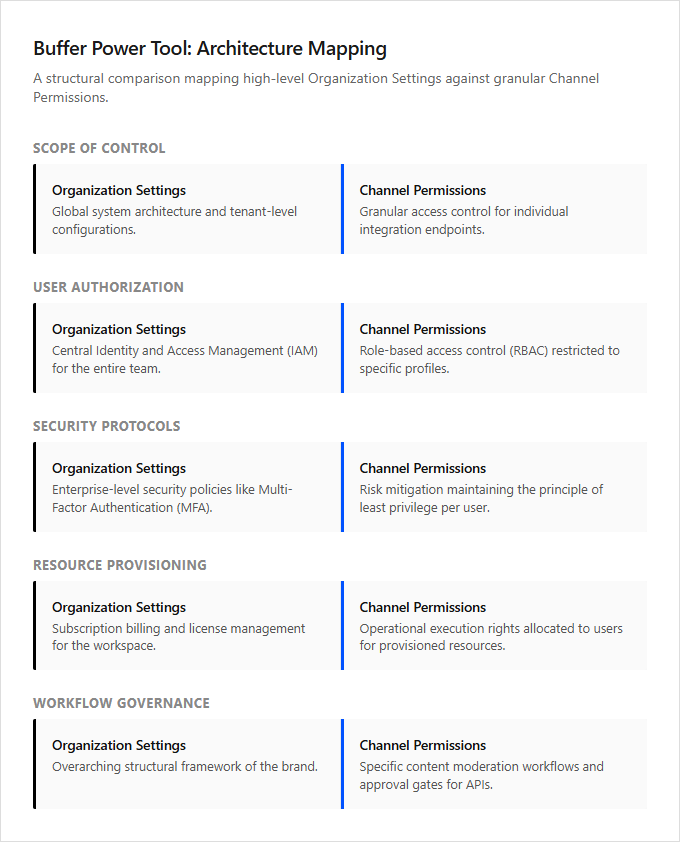
| Scope of Control | Organization Settings manage global system architecture and tenant-level configurations, whereas Channel Permissions define granular access control for individual integration endpoints. |
| User Authorization | Organization Settings handle central Identity and Access Management (IAM) for the entire team, while Channel Permissions apply role-based access control (RBAC) to restrict publishing capabilities on specific profiles. |
| Security Protocols | Organization Settings enforce enterprise-level security policies like Multi-Factor Authentication (MFA), whereas Channel Permissions mitigate risk by maintaining the principle of least privilege per user. |
| Resource Provisioning | Organization Settings control subscription billing and license management for the workspace, while Channel Permissions allocate operational execution rights to users for those provisioned resources. |
| Workflow Governance | Organization Settings establish the overarching structural framework of the brand, while Channel Permissions configure specific content moderation workflows and approval gates for social media APIs. |
Global Organization-Level RBAC and Admin Settings
Buffer distinguishes administrative control through two distinct layers: Organization Settings and Channel Permissions. Organization-level settings establish global Role-Based Access Control (RBAC) to govern workspace-wide billing, manage team invite lifecycles, and streamline member provisioning. This centralized governance ensures that high-level administrative tasks and security protocols remain securely restricted across the entire company profile.
Conversely, Channel Permissions delegate granular control over individual social media profiles, defining who can draft, approve, or publish content on specific networks. Organization Settings are designed for administrators and financial managers who oversee high-level team structures and billing, whereas Channel Permissions are tailored for content creators and social media managers who require day-to-day operational access to specific marketing streams.
Enforcing Least Privilege via Channel Permissions
Buffer Organization Settings and Channel Permissions serve distinct roles in securing a company's social media infrastructure. While Organization Settings manage high-level administrative tasks, billing, and overall workspace membership, Channel Permissions govern specific interactions with individual social profiles.
Channel permissions enforce the Principle of Least Privilege by restricting raw publishing access to designated social media API streams. This security measure ensures that team members only interact with the specific networks required for their roles, minimizing the risk of unauthorized or accidental broadcasts.
Organization Settings are tailored for agency administrators and IT managers who oversee the entire enterprise workspace, whereas Channel Permissions are designed for content creators, external clients, and specialists who require localized execution rights.
Channel-Level Publishing Permissions per User
Within the Buffer platform, administrators must navigate the structural differences between global Organization Settings and granular Channel Permissions. Organization Settings establish the foundational infrastructure, managing overarching billing profiles, team member invitations, and top-level administrative rights across the entire workspace. This centralized control ensures consistent security and high-level governance.
At a more granular level, Channel Permissions utilize Access Control Lists (ACLs) configured directly at the individual social channel level. These ACLs enable organizations to delegate customized draft, scheduling, and direct publishing privileges per individual user profile, ensuring precise operational control. Organization Settings are designed for corporate administrators and account owners overseeing workspace management, whereas Channel Permissions are best suited for content creators and external agency partners requiring specific execution-level access.
Organization Identity Federation and SSO Settings
In Buffer, Organization Settings serve as the administrative anchor, managing centralized identity federation independently from individual social media authentication. This foundational layer controls enterprise-grade security protocols, including Security Assertion Markup Language (SAML) and Single Sign-On (SSO) integrations, ensuring that user access aligns with corporate compliance policies before any social connections are accessed.
Conversely, Channel Permissions dictate operational access, governing which team members can draft, approve, or publish content to specific social media profiles. Organization Settings are utilized by IT administrators and security officers requiring strict control over account governance, while Channel Permissions are ideal for social media managers and content creators executing daily publishing workflows.
Gate Deployments via Channel Permission Approvals
Buffer's administrative architecture divides control between Organization Settings and Channel Permissions. Organization Settings govern high-level administrative tasks, such as billing management, team directories, and global security protocols. Channel Permissions operate at a granular level, managing how specific team members interact with individual social media channels.
Specifically, Channel Permissions facilitate customized Approval Workflows, ensuring draft content must pass strict verification states before triggering external webhook and API deployments. This granular control prevents unauthorized scheduling and ensures that only fully vetted social media posts are sent to downstream services.
Organization Settings are ideal for IT administrators and business owners managing overall account security, while Channel Permissions are designed for content managers and editors who require precise control over publishing workflows.
Hierarchical Inheritance Grants Admins Full Pipeline Ownership
In Buffer, distinguishing between Organization Settings and Channel Permissions is critical for effective workspace governance. Hierarchical Inheritance dictates that global Organization Admins automatically bypass localized channel-level restrictions and retain full ownership of all connected data pipelines. This structural flow ensures that high-level administrative rights always supersede granular, channel-specific rules, maintaining uninterrupted system integration.
Channel Permissions offer localized control, allowing teams to restrict publishing and approval access on a per-profile basis. In contrast, Organization Settings govern the entire ecosystem, including billing, team invitations, and global access. Organization Settings are ideal for executive administrators needing overarching system control, while Channel Permissions are tailored for day-to-day social media managers and external contributors requiring restricted access.
Audit Trail Logging: Org-Level Activity Scope
Buffer distinguishes between broad Organization Settings and granular Channel Permissions to maintain secure operational workflows. Within Organization Settings, the Audit Trail Logging system tracks high-level administrative events, such as changes to the workspace configuration and the removal of users. This logging provides a permanent record of structural modifications, keeping organizational governance separate from routine social media operations.
Channel Permissions manage day-to-day connectivity and output, focusing on channel-specific OAuth token re-authorizations and publishing activity. Organization Settings are designed for IT administrators and security compliance officers who govern workspace access, whereas Channel Permissions are suited for social media managers and content creators who execute daily marketing campaigns.
Leave a comment