
Managing social media consistency often feels like a relentless battle against the clock, leaving digital marketers struggling to maintain an active online presence without succumbing to creative burnout. While standard scheduling methods-such as manual spreadsheets or basic calendar tools-offer a baseline level of organization, they frequently fall short of true, hands-off automation.
Optimizing your workflow through Buffer's advanced queuing mechanics grants social media managers a powerful advantage: predictable consistency coupled with absolute scheduling flexibility. There is a stipulation, however; this efficiency is only realized when you match the right queue setting to your specific distribution strategy. For instance, a fast-paced news publisher requires a vastly different automated framework than a highly curated, once-a-day boutique brand.
Below, we will compare Buffer's Custom Posting Schedule against its Queue Autofill feature, analyzing how each mechanism operates so you can select the optimal automation model for your brand's unique publishing cadence.
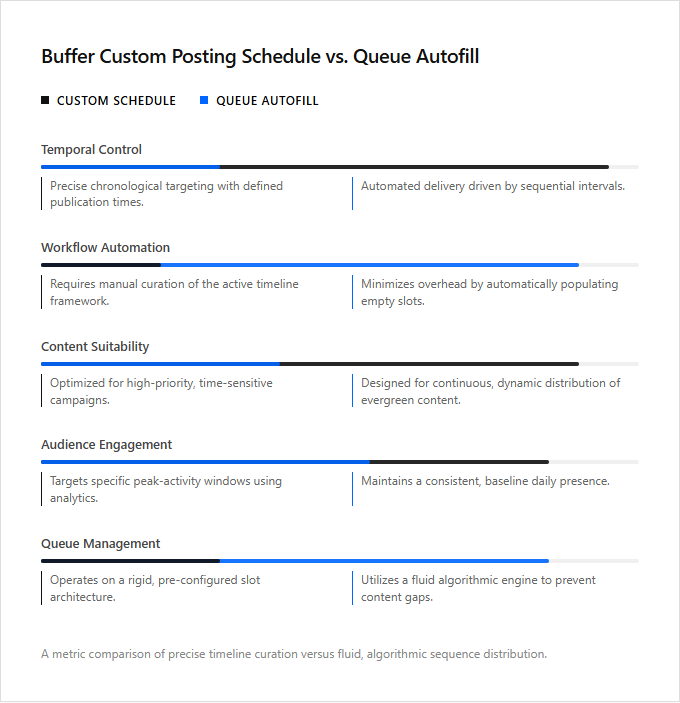
| Factor | Summary |
|---|---|
| Temporal Control | Custom Posting Schedule enables precise chronological targeting by defining exact publication times, whereas Queue Autofill automates delivery based on sequential intervals. |
| Workflow Automation | Queue Autofill minimizes administrative overhead by automatically populating empty time slots, unlike Custom Posting Schedule which requires manual curation of the publication timeline. |
| Content Suitability | Custom Posting Schedule is optimal for time-sensitive marketing campaigns, while Queue Autofill is designed for distributing evergreen content dynamically. |
| Audience Engagement | Custom Posting Schedule targets specific peak-activity windows based on user analytics, whereas Queue Autofill maintains a consistent baseline of social media presence. |
| Queue Management | Custom Posting Schedule relies on a rigid, pre-configured framework, whereas Queue Autofill utilizes a fluid algorithmic system to prevent empty content pipelines. |
Predefined time-slot allocation algorithms for frictionless Queue Autofill execution
Buffer's scheduling architecture offers two distinct approaches for content dissemination: the Custom Posting Schedule and the Queue Autofill engine. While the Custom Posting Schedule requires manual time input for each individual update, the Queue Autofill system relies on predefined time-slot allocation algorithms. These algorithms automatically map queued updates to pre-established publishing windows, eliminating the frictional decision-making process of selecting dates and times for every single piece of content.
By establishing a consistent queue structure, the allocation algorithm ensures a steady stream of distribution without manual intervention. This systematic approach stabilizes delivery frequency across multiple social channels. Manual custom schedules suit campaign-specific marketers needing precise, high-touch control over exact, time-sensitive release times, whereas Queue Autofill caters to high-volume content curators who prioritize frictionless, automated consistency.
Manual ISO 8601 Custom Post Scheduling
Buffer offers two distinct approaches for content scheduling: Custom Posting Schedules and Queue Autofill. The Custom Posting Schedule allows users to specify precise publishing times down to the minute, utilizing standardized ISO 8601 datetime timestamps. This granular control is essential for aligning posts with specific global events or highly coordinated marketing campaigns where exact timing is critical.
In contrast, Queue Autofill automates the distribution process by placing updates into pre-established, recurring time slots. While Queue Autofill streamlines daily operations by removing the need for individual timestamp configuration, the Custom Posting Schedule accommodates complex, time-sensitive campaigns. The Custom Posting Schedule is ideal for data-driven enterprise marketers managing international campaigns, whereas Queue Autofill suits consistent content creators seeking efficient, hands-off automation.
Integration of RSS feed syndication for automated Queue Autofill replenishment
Buffer offers two distinct methodologies for managing content distribution: the Custom Posting Schedule and the Queue Autofill system. The Custom Posting Schedule requires manual slot configuration, granting precise control over the exact days and times individual posts go live. In contrast, Queue Autofill automates this pipeline by continuously pulling fresh content into pre-determined slots, minimizing manual scheduling overhead.
Integrating RSS feed syndication elevates the Queue Autofill feature into a self-sustaining distribution engine. By linking external blogs or news sources directly to the Buffer queue, new articles are automatically ingested and staged for publication as soon as they are published online. This integration eliminates the need for daily curation, ensuring a highly consistent social media presence without manual intervention.
Precise Custom Posting is ideal for meticulous brand managers running highly targeted, time-sensitive campaigns, while RSS-driven Queue Autofill suits high-volume content curators and publishers who prioritize automated, consistent audience engagement.
Predictive Post Scheduling for Optimal Engagement
Buffer's Queue Autofill distributes social media content across pre-set, uniform intervals to maintain a consistent brand presence. The Custom Posting Schedule utilizes predictive audience engagement telemetry to pinpoint high-value publishing windows. By evaluating historical interaction data and real-time platform activity, this telemetry-driven approach ensures that individual updates launch precisely when target demographics are most active, significantly enhancing organic visibility.
While the automated queue simplifies workflow management, the customized alternative prioritizes data-backed precision for competitive algorithmic advantages. Queue Autofill suits brand generalists managing steady, high-volume content streams, whereas the Custom Posting Schedule serves analytical marketers who leverage engagement metrics to optimize specific campaign conversions.
FIFO Serialization in Queue Autofill Pipelines
Buffer offers two distinct methodologies for content distribution: Custom Posting Schedules and Queue Autofill. While Custom Posting Schedules require manual configuration for precise timing, the Queue Autofill pipeline utilizes First-In, First-Out (FIFO) queue serialization. Under this FIFO model, content is processed and published in the exact chronological order of its ingestion, ensuring systematic data flow without manual scheduling overhead. This serialization algorithm guarantees that older drafted items are prioritized, maintaining a predictable, linear stream of social media updates.
Custom Posting Schedules bypass this sequential processing, allowing users to pin specific assets to designated high-traffic calendar slots. Social media managers requiring strict, event-driven campaign control benefit from the Custom Posting Schedule, whereas high-volume content curators seeking automated, continuous stream maintenance are ideal candidates for the FIFO-driven Queue Autofill system.
Direct manipulation of API payload parameters for custom-scheduled ad-hoc posts
Buffer's Queue Autofill systematically distributes content across predefined, recurring time slots, ensuring consistent delivery with minimal manual intervention. In contrast, deploying custom-scheduled ad-hoc posts through direct manipulation of API payload parameters bypasses this automated queue entirely. By explicitly defining the scheduled_at timestamp parameter within the API request payload, developers override the default queue structure to execute precise, time-sensitive publications.
This direct API manipulation allows for the granular execution of dynamic, event-driven campaigns that require exact, non-standard delivery windows. While Queue Autofill is designed for marketers seeking hands-off, consistent content distribution, direct API parameter modification is utilized by developers and technical operators who require precise, programmatic control over custom-timed campaigns.
Mitigation of platform-specific API rate limiting through structured queuing protocols
Managing multi-platform social media distribution requires strict adherence to platform-specific API rate limits to prevent account throttling or service disruptions. Buffer mitigates these technical constraints through two distinct queuing protocols: the Custom Posting Schedule and Queue Autofill. The Custom Posting Schedule allows administrators to define precise, recurring distribution windows, dispersing API requests predictably across a designated timeline to avoid sudden spikes in transmission volume.
In contrast, the Queue Autofill protocol automatically sequences content into a continuous stream, spacing out posts programmatically to maintain a steady cadence without exceeding platform-specific daily API thresholds. The highly controlled Custom Posting Schedule is best suited for enterprise campaign managers requiring exact temporal alignment for sensitive product launches, whereas the automated Queue Autofill is ideal for high-volume content curators seeking to maintain consistent audience engagement with minimal manual oversight.
Leave a comment