
Proving the tangible ROI of social media campaigns remains a persistent challenge for digital marketers, who frequently struggle to connect top-of-funnel engagement with bottom-line website conversions. Typically, organizations rely on standard tracking practices-such as manually building UTM links in spreadsheet registries or navigating the complex attribution models of Google Analytics-to bridge this data gap. However, Buffer's native UTM functionality redefines this workflow, granting marketers automated, error-free tracking directly at the point of content scheduling.
To maximize this integration, it is important to note the stipulation that your team must maintain consistent campaign naming conventions; automated parameters are only as reliable as the structural hygiene you establish for platforms like LinkedIn and Instagram. In this comparison, we will evaluate the unique strengths of Buffer Analytics versus Google Analytics, demonstrate how to configure native UTM parameters, and outline a step-by-step framework for measuring true campaign ROI.
| Factor | Summary |
|---|---|
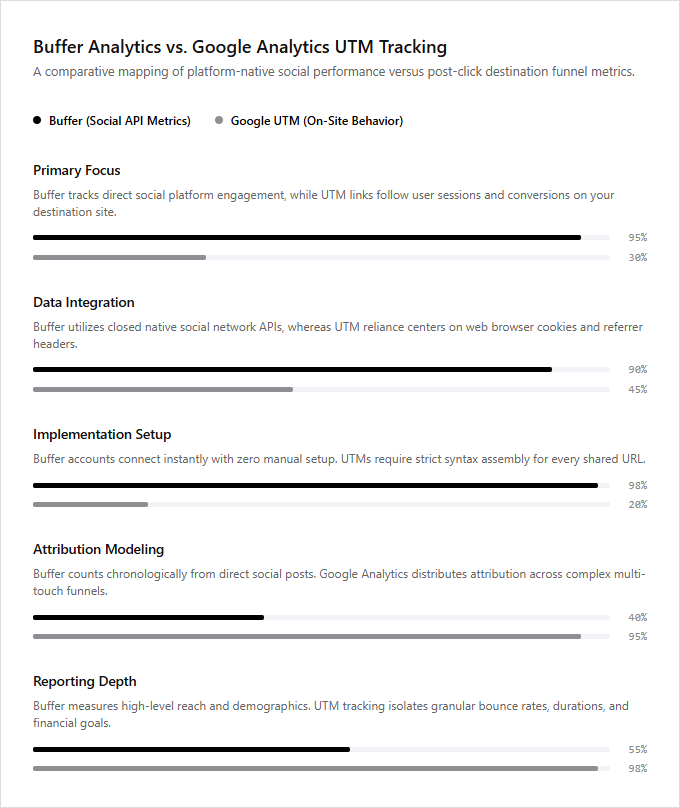
| Primary Focus | Buffer Analytics measures social media engagement metrics directly on social platforms, whereas Google Analytics UTM tracking monitors post-click user behavior and conversions on your destination website. |
| Data Integration | Buffer aggregates native API data from connected social networks, while UTM tracking relies on browser cookies and referrer headers processed by the Google Analytics tag. |
| Implementation Setup | Buffer Analytics requires no manual configuration beyond connecting accounts, whereas UTM tracking demands consistent URL parameter syntax construction for accurate campaign attribution. |
| Attribution Modeling | Buffer attributes interactions to specific social posts chronologically, while Google Analytics uses multi-touch attribution models to evaluate the role of UTM-tagged links in the conversion funnel. |
| Reporting Depth | Buffer provides high-level audience demographics and post-performance charts, whereas UTM-tagged URLs enable granular analysis of bounce rates, session duration, and goal completions. |
How Google Analytics Categorizes Buffer UTM Links
Buffer streamlines social media campaign tracking by automatically appending campaign-specific UTM parameters to all outbound links shared through the platform. This automated feature eliminates the manual task of generating tracking URLs, ensuring that every published link is consistently tagged with the correct source, medium, and campaign identifiers.
On the receiving end, Google Analytics processes these UTM-tagged links, categorizing the incoming referral traffic under its default channel groupings. While Buffer serves as the outbound engine that structures and tags your social links, Google Analytics acts as the destination repository, interpreting visitor behavior once users land on your website.
Buffer's automated tracking is ideal for social media managers seeking hands-free, consistent campaign tagging, whereas Google Analytics tracking is best suited for digital analysts who require in-depth, post-click behavioral reporting across multiple marketing channels.
Buffer's Social Metrics vs. Google Analytics' Post-Click Tracking
Buffer Analytics leverages direct integration with social media APIs to monitor native performance metrics. This platform tracks real-time engagement, impressions, and click-through rates directly from social networks, providing immediate visibility into how content performs within various platform feeds.
Google Analytics measures post-click behavior by utilizing UTM parameters. By employing event-based conversion tracking, it monitors user actions after they land on a website, mapping out the journey from the initial social referral to final actions like purchases or registrations.
Social media managers focused on optimizing immediate content reach benefit most from Buffer, while digital marketers analyzing long-term website ROI prefer Google Analytics.
Buffer Bypasses Tracking Blockers via Social Media APIs
When measuring social media performance, the primary technical distinction between Buffer Analytics and Google Analytics UTM tracking lies in how data is collected. Google Analytics relies on client-side JavaScript tags, which are increasingly blocked by privacy-focused browsers and ad-blocking extensions. In contrast, Buffer bypasses these browser-side blockers by using direct social media APIs to detect link clicks, ensuring more reliable top-of-funnel engagement metrics.
While Buffer captures server-to-server interaction data directly from social platforms, Google Analytics provides comprehensive post-click user behavior once a visitor arrives on your website. Buffer is ideal for social media managers who require accurate click data unaffected by ad-blockers, whereas Google Analytics is best suited for web analysts who need to track deep, multi-touch conversion journeys.
Google Analytics vs. Buffer: Comparing Attribution Models
Buffer's native UTM tracking offers a streamlined approach to social media measurement by isolating campaign performance through last-click attribution. This mechanism attributes conversions entirely to the final social media post a user clicked, providing immediate, uncomplicated data on specific promotional activities.
Google Analytics offers a broader perspective by analyzing complex, multi-channel user journeys. Utilizing sophisticated data-driven attribution models, it evaluates how different marketing touchpoints interact over time to drive conversions, rather than crediting a single source.
Buffer is best suited for tactical social media marketers focused on immediate post performance, whereas Google Analytics is designed for enterprise strategists who must analyze integrated, multi-touch customer journeys.
Google's User Tracking vs. Buffer's Link Tracking
Buffer Analytics and Google Analytics offer fundamentally different approaches to digital campaign measurement. Google Analytics utilizes advanced User-ID tracking to stitch user sessions together across multiple devices, providing a unified, holistic view of the entire customer journey. Buffer's native analytics, by comparison, are confined to individual, anonymous link-click events, capturing isolated interactions without linking them to broader user behaviors.
This technical distinction shapes how marketing teams analyze performance. While Google Analytics maps complex post-click conversions, Buffer provides immediate, post-level engagement data. Buffer is ideal for social media coordinators focusing on rapid content performance metrics, whereas Google Analytics is suited for advanced growth marketers requiring comprehensive, cross-device attribution mapping.
Buffer Reports Link Clicks Faster Than GA4
When tracking social media campaigns, data processing latency plays a critical role in campaign optimization. Buffer Analytics excels in real-time reporting, offering minimal data processing latency for link click performance. Marketers can monitor engagement and link clicks almost instantly, allowing for agile adjustments to active social media campaigns.
Google Analytics 4 requires a much longer processing window for its robust tracking capabilities. Custom dimension data and UTM parameters within the platform can take up to 48 hours to fully process and appear in reports. This latency can hinder fast-paced decision-making during time-sensitive events.
Buffer is ideal for social media managers needing immediate feedback on post performance, while Google Analytics 4 serves comprehensive data analysts who prioritize deep, multi-channel attribution over real-time updates.
Google Analytics vs. Buffer: Financial ROI vs. Traffic
Google Analytics and Buffer Analytics serve distinct roles in digital marketing measurement. Google Analytics calculates precise financial ROI by integrating directly with e-commerce purchase schemas, tracking the exact revenue generated from specific UTM-tagged campaigns. This deep integration allows organizations to map customer journeys from the initial click to the final transaction.
In contrast, Buffer Analytics evaluates campaign cost-efficiency by focusing on outbound traffic volume and social media engagement. Rather than tracking backend financial conversions, Buffer measures how effectively social content drives top-of-funnel interest and clicks. Google Analytics is ideal for e-commerce analysts needing to justify direct advertising spend, while Buffer is best suited for social media managers focused on optimizing content distribution and audience engagement.
Leave a comment