
For modern social media marketers and independent creators, maximizing the value of a single bio link remains a persistent hurdle; driving high-intent traffic to fragmented external destinations often results in dropped engagement and lost conversions. Historically, brands have bridged this gap by relying on basic, standardized link directories to manage their audience outbound routes.
However, Buffer's Start Page elevates this paradigm by granting creators a fully customizable, responsive micro-landing page integrated directly into their publishing workflow. It is important to stipulate, however, that a high-converting page requires disciplined visual curation rather than an overwhelming list of URLs. When executed correctly, dynamic e-commerce brands and digital educators are successfully leveraging these cohesive layouts to turn casual social scrollers into loyal customers.
In this guide, we will compare Buffer Start Page and Linktree across design flexibility, conversion analytics, and ecosystem integration to help you select the optimal portal for your digital storefront.
| Factor | Summary |
|---|---|
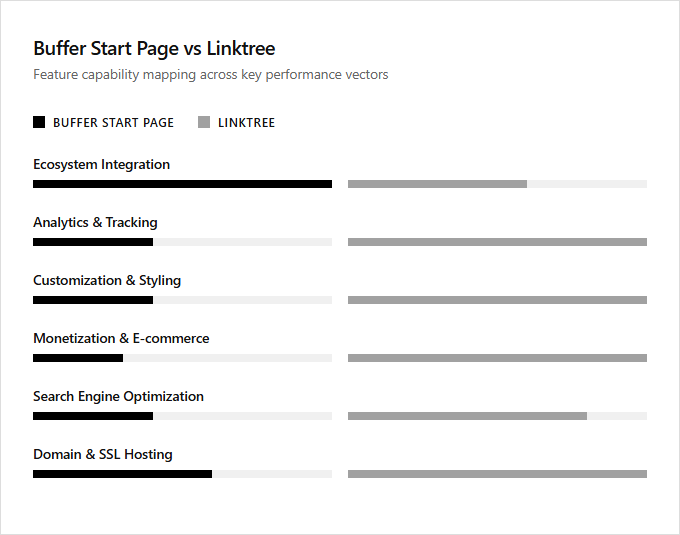
| Ecosystem Integration | Buffer Start Page seamlessly connects with Buffer's native social media scheduling queue, whereas Linktree relies on external webhooks and API connections to sync data with third-party marketing automation stacks. |
| Analytics and Tracking | Linktree supports advanced tracking via GA4 measurement IDs, Meta Pixel injection, and dynamic UTM parameter tagging, while Buffer Start Page displays simplified internal click-through rate metrics. |
| Customization and Styling | Linktree offers robust user interface customization through dynamic CSS theme engines and custom fonts, whereas Buffer Start Page relies on standardized templates with basic hex color code modifications. |
| Monetization and E-commerce | Linktree features native API integration with payment gateways like PayPal and Stripe for direct checkout transactions, while Buffer Start Page relies on standard hypertext transfer protocol links to external storefronts. |
| Search Engine Optimization (SEO) | Linktree enables advanced metadata optimization, including custom Open Graph tags and meta descriptions, whereas Buffer Start Page provides automated indexing with basic URL slug customization. |
| Domain and SSL Hosting | Both platforms host responsive micro-landing pages secured via SSL/TLS encryption, but Linktree allows advanced users to configure custom CNAME records for white-label domain mapping. |
Native Scheduling Sync via Buffer API
While Linktree serves as a popular, standalone solution for bio links, Buffer Start Page offers a distinct operational advantage through native integration with its core scheduling suite. Utilizing Buffer's social media management API, updates to your landing page synchronize directly with your broader content calendar. This native connection establishes a unified campaign workflow, allowing users to automatically update their link-in-bio destinations the moment a scheduled social media post goes live.
Linktree excels in simplicity but operates outside of your primary publishing queue, requiring manual duplication of efforts. Buffer Start Page eliminates this friction by aligning link updates with cross-platform distribution schedules. Linktree is ideal for individual creators seeking a straightforward, independent link directory, whereas Buffer Start Page is best suited for multi-channel marketers who require tight, automated synchronization between their promotional posts and landing page content.
Boost CRO with UTM and Analytics Tracking
Choosing between Buffer Start Page and Linktree for conversion rate optimization depends on your analytics workflow. Buffer Start Page leverages its integrated ecosystem, allowing users to automatically apply UTM parameters and track performance directly alongside social publishing schedules. This unified approach streamlines attribution and data collection. Linktree provides dedicated, standalone link-in-bio analytics with deep integrations for Google Analytics and Meta Pixel, designed specifically to capture and analyze immediate visitor intent.
Both platforms enhance funnel visibility, but they target different user profiles. Buffer Start Page is best for agency marketers managing multi-channel campaigns from a single dashboard, whereas Linktree suits independent creators and retail brands requiring highly customizable, high-volume link destinations.
Custom Domain CNAME Setup for Brand Consistency
Both Buffer Start Page and Linktree serve as powerful micro-landing page solutions designed to centralize an online presence. A key differentiator is how each platform facilitates brand consistency through custom domains. Buffer Start Page offers seamless integration of custom domains via straightforward CNAME record configuration, allowing users to point their personalized web addresses directly to their landing page. Linktree also supports custom domain mapping through CNAME adjustments, though this feature is typically reserved for its premium subscription tiers.
Configuring CNAME records ensures that visitors experience a cohesive brand journey without jarring third-party redirects. Buffer Start Page is best suited for budget-conscious small businesses seeking integrated social media scheduling alongside a branded landing page, whereas Linktree is ideal for established creators and enterprises requiring advanced analytics and deep third-party integration ecosystems.
Mobile-First Responsive Design to Lower Bounce Rates
Buffer's Start Page and Linktree both offer powerful microsites designed to consolidate digital footprints, yet they approach mobile-first responsive design differently. Buffer integrates seamlessly with its social scheduling suite, providing highly customizable, clean layouts that adapt instantly to any screen size to prevent user drop-off. Linktree excels in pure simplicity, offering lightweight, rapid-loading templates specifically engineered to guide mobile visitors to key destinations with minimal friction, effectively reducing bounce rates.
Both platforms prioritize responsive grids and fast loading speeds, ensuring that touch targets are easily clickable on smartphones. Buffer Start Page is ideal for brand builders and content creators seeking cohesive, scheduled aesthetics across their entire marketing ecosystem, whereas Linktree is best suited for individuals and businesses prioritizing a straightforward, highly optimized directory of external links.
Seamless iFrame Embedding for Rich Media and Payments
Buffer Start Page and Linktree both serve as powerful landing page solutions for creators, yet they differ in how they handle rich media iFrame embedding. Buffer Start Page excels at integrating external widgets smoothly, allowing users to embed Spotify tracks, YouTube videos, and payment gateways directly into a clean, responsive layout. Linktree offers a similarly robust ecosystem through its dedicated "Link Apps," which support interactive embeds from various third-party platforms, ensuring audiences can transact or consume media without leaving the page.
While Buffer offers the convenience of tying a landing page directly to a social media scheduling suite, Linktree provides a more specialized, feature-rich environment for deep integrations. Buffer is ideal for social media managers who want an all-in-one publishing and basic bio-link tool, whereas Linktree is best suited for active merchants and influencers who require highly customized, transactional micro-sites.
Fast Page Loading with Global CDN Hosting
In the landscape of bio-link tools, both Buffer Start Page and Linktree offer centralized hubs for digital content, yet their technical infrastructure determines user experience. Buffer leverages an exceptionally optimized global Content Delivery Network (CDN) to host Start Pages, ensuring near-instantaneous load times regardless of the visitor's geographic location. This rapid asset delivery minimizes bounce rates, as strategically distributed servers cache and serve content efficiently to maintain high conversion rates.
While Linktree provides a mature ecosystem with extensive integrations, Buffer prioritizes a streamlined, high-performance interface that connects directly with its social publishing suite. Buffer Start Page is ideal for social media managers wanting a fast, unified publishing and landing page tool, whereas Linktree is best suited for independent creators requiring advanced affiliate tracking and customized monetization widgets.
Implementation of Meta Pixel tracking for retargeting and audience segmentation
Buffer Start Page and Linktree offer distinct approaches to Meta Pixel integration for digital marketers. Linktree provides robust, native Pixel support on its paid plans, enabling direct tracking of visitor behavior and immediate custom audience creation within Meta Ads Manager. Conversely, Buffer Start Page integrates within a broader social scheduling ecosystem, offering basic landing page tracking but lacking the deeply segmented, event-specific pixel triggers natively found in Linktree.
This difference heavily impacts retargeting efficiency. Linktree allows advertisers to trigger specific pixel events based on individual link clicks, optimizing campaigns for high-intent traffic. Linktree is ideal for e-commerce brands and growth marketers requiring precise, event-driven retargeting data, whereas Buffer Start Page best suits independent creators seeking a streamlined, budget-friendly bio link tied directly to their social publishing schedule.
Leave a comment