
Managing a consistent Instagram presence often degenerates into a series of disruptive, manual interruptions. Social media managers frequently struggle to maintain workflow continuity when forced to drop high-priority tasks just to push scheduled content live via real-time mobile notifications.
While relying on native drafts or basic mobile reminders serves as a functional baseline strategy for entry-level campaigns, these manual intervention methods scale poorly for growing brands. Transitioning to Buffer's Direct Publishing functionality grants marketing teams the ultimate operational advantage: complete, hands-free automation that preserves creative focus and eliminates execution bottlenecks.
However, leveraging this automated delivery requires understanding certain platform stipulations, most notably the prerequisite of an Instagram Business profile rather than a personal account. For instance, while single-image posts publish seamlessly, certain complex formats-like multi-image carousels containing mixed media-may still require the mobile reminder workflow. Below, we compare Buffer Direct Publishing versus Mobile Reminders, analyzing setup requirements, feature limitations, and strategic workflows to optimize your Instagram delivery pipeline.
| Factor | Summary |
|---|---|
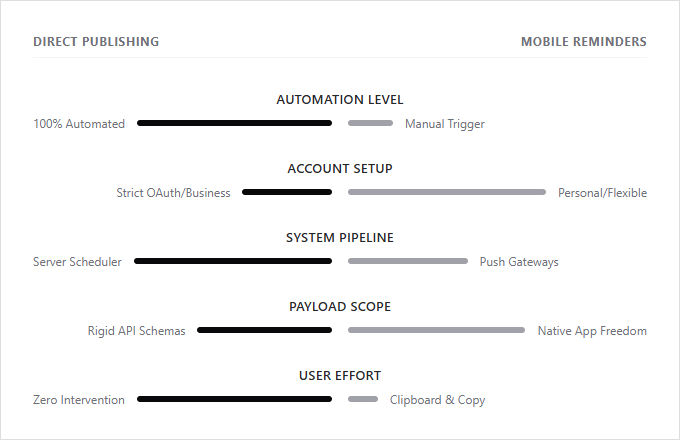
| Automation Level | Direct Publishing schedules and publishes posts automatically via social media API endpoints, whereas Mobile Reminders require manual user intervention triggered by push notifications. |
| Account Authentication | Direct Publishing requires strict OAuth authorization tokens and specific business account verifications, while Mobile Reminders support personal accounts without complex API permissions. |
| System Dependency | Mobile Reminders depend entirely on mobile push notification gateways like FCM or APNs, whereas Direct Publishing operates independently through server-side job schedulers. |
| Payload Constraints | Direct Publishing has rigid aspect ratio and file size limits dictated by platform API schemas, while Mobile Reminders bypass these limits by utilizing the native social media application's local interface. |
| User Intervention | Direct Publishing executes headless server-to-server delivery for fully automated scheduling, whereas Mobile Reminders rely on copying assets to the system clipboard for manual publication by the user. |
Meta Graph API Authentication for Direct Publishing
Buffer's Direct Publishing feature offers streamlined, automated content scheduling by communicating directly with social platforms. For Instagram and Facebook, this seamless delivery relies strictly on secure, authenticated access via the Meta Graph API endpoints, allowing Buffer to post your scheduled media automatically without manual intervention.
Mobile Reminders serve as an alternative workflow for account types or content formats that do not support direct API integration, such as personal profiles. Instead of automatic posting, Buffer sends a push notification to your mobile device, prompting you to open the platform and publish the post manually.
Direct Publishing is ideal for busy marketing teams managing established business pages that require hands-off automation, whereas Mobile Reminders suit individual creators and boutique brands seeking manual control and real-time aesthetic adjustments.
Automated Scheduled Publishing via Queue Workers
Buffer offers two distinct methods for dispatching scheduled social media content: Direct Publishing and Mobile Reminders. Direct Publishing utilizes asynchronous queue workers to post content automatically at scheduled times. Once a post is scheduled, these background workers handle the platform API requests independently, ensuring precise and reliable hands-off delivery without requiring any manual intervention.
In contrast, Mobile Reminders bypass direct API limitations for restricted formats, such as Instagram Stories or personal profiles. When the designated time arrives, Buffer sends a push notification to the user's mobile device, prompting them to easily copy the pre-prepared media and text into the native application to complete the post.
Direct Publishing is ideal for busy marketing teams seeking fully automated efficiency, while Mobile Reminders best suit individual creators who prefer manual control over interactive, native platform features.
Triggering Mobile Reminders via Push Notifications
Buffer offers two primary methods for scheduling social media content: Direct Publishing and Mobile Reminders. While Direct Publishing automatically shares content directly to supported platforms via official APIs, Mobile Reminders facilitate workflows for platforms with API limitations or posts requiring final manual adjustments.
The Mobile Reminder system relies on Apple Push Notification service (APNs) and Firebase Cloud Messaging (FCM). When a scheduled post is due, Buffer transmits push notification payloads through APNs and FCM to the user's mobile device, triggering a manual posting workflow that copies the media and text for seamless, manual sharing.
Direct Publishing is ideal for busy marketers seeking fully automated, hands-off scheduling, whereas Mobile Reminders suit hands-on creators who prioritize final aesthetic control or publish to restricted platforms.
Direct Publishing API Enforces Strict Aspect Ratios
Buffer offers two primary methods for scheduling content: Direct Publishing and Mobile Reminders. Direct Publishing automates the posting process by sending content straight to social networks. This method subjects media files to strict API payload validation constraints regarding aspect ratios and file sizes, meaning any non-compliant media will result in a failed post.
Alternatively, Mobile Reminders bypass these strict API limitations by sending a push notification to your mobile device, allowing you to finalize and publish the post manually through the native platform. Direct Publishing is ideal for busy social media managers who prioritize automation and standardized media, while Mobile Reminders suit creators who use custom, non-standard aspect ratios or prefer manual, last-minute adjustments.
Direct Publishing Requires OAuth 2.0 Tokens
Buffer provides two distinct methods for scheduling social media content: Direct Publishing and Mobile Reminders. Direct Publishing enables fully automated posting by establishing a secure, continuous connection with destination platforms. This automated workflow requires persistent access tokens managed through the OAuth 2.0 authorization protocol, which securely grants Buffer the necessary permissions to publish on your behalf without requiring manual intervention for every post.
Mobile Reminders bypass this direct API integration, instead sending a push notification to a registered mobile device so users can manually finalize the post. Direct Publishing is ideal for busy marketing professionals seeking a fully automated, hands-off workflow, while Mobile Reminders are best suited for boutique creators who prefer a final, manual review of their layout before going live.
Direct Carousel Publishing via Meta Container IDs
Buffer's Direct Publishing offers a fully automated scheduling experience for modern social media professionals. Specifically, this feature utilizes Meta's secure media container ID generation to compile, validate, and publish complex carousel posts directly to business profiles without manual intervention at the scheduled time. This integration ensures seamless and reliable delivery for multi-image campaigns.
In contrast, Mobile Reminders provide a flexible workflow for restricted account types or unique formats, sending a push notification to your mobile device to complete the publishing process manually within the native app. Direct Publishing is best suited for busy marketing agencies managing established business profiles that require high-volume automation, whereas Mobile Reminders are ideal for individual creators who manage personal accounts or prefer a final hands-on review before going live.
Real-Time Direct Publishing Monitoring via Webhooks
Buffer offers two primary deployment workflows: Direct Publishing and Mobile Reminders. Direct Publishing operates as a fully automated solution, pushing scheduled posts directly to connected social media networks. A critical technical advantage of this method is the integration of webhook callbacks, which provide real-time monitoring of delivery success. This capability allows systems to receive immediate, programmatic confirmation of successful posts or detailed error reports if a transmission failure occurs.
Mobile Reminders send a notification to a registered device at the scheduled time, requiring manual intervention to finalize and publish the post. Direct Publishing is best suited for enterprise teams requiring scalable, hands-off automation and instant tracking, whereas Mobile Reminders are ideal for individual creators who prioritize final manual oversight and creative adjustments before their content goes live.
Leave a comment