
Managing modern social media campaigns often presents a frustrating technical challenge: long, cluttered URLs that dilute brand authority and actively depress click-through rates. To solve this attribution puzzle, organizations typically rely on standard software funding allocations to procure high-cost, standalone enterprise link management platforms. However, leveraging Buffer's integrated ecosystem grants teams immediate, centralized control over their analytics and vanity URLs without additional budget overhead.
As a necessary educational stipulation, while custom domains require a minor, one-time DNS configuration setup, the long-term data clarity and security payoff are substantial. Industry leaders like Shopify regularly employ these customized, branded short links to maximize audience trust and secure higher engagement.
In this article, we compare the performance of Buffer's default buff.ly shortener against custom domains, evaluating setup complexity, tracking accuracy, and brand impact to help you optimize your social sharing strategy.
| Factor | Summary |
|---|---|
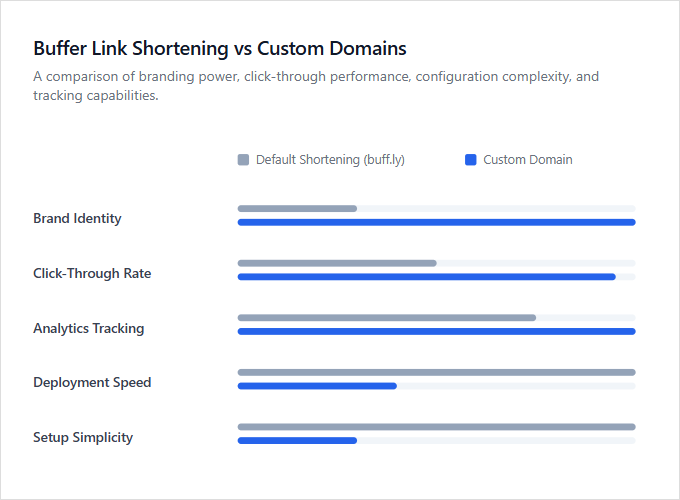
| Brand Identity | Custom domains allow organizations to maintain consistent brand authority using branded vanity URLs, whereas default shortening relies on the shared buff.ly domain. |
| Click-Through Rate | Branded custom domains significantly improve the click-through rate (CTR) because target audiences perceive them as more secure than generic short links. |
| DNS Configuration | Implementing a custom domain in Buffer necessitates configuring your domain registrar settings by adding a CNAME record pointing to Buffer's host. |
| Analytics Tracking | Both methods support UTM parameters for campaign tracking, but custom domains provide cleaner referral data in analytics platforms. |
| Setup Complexity | Buffer link shortening offers immediate out-of-the-box deployment, while custom domains require validation latency during SSL certificate generation. |
Configuring CNAME Records for Custom Domains
Buffer offers two primary paths for link management: default Buffer link shortening and custom domains. While the default "buff.ly" option requires zero configuration, establishing a custom domain elevates brand authority. To implement a custom domain, users must configure their Domain Name System (DNS) settings. This process involves creating a CNAME record pointing your desired subdomain to Buffer's destination servers, which allows Buffer to securely host and redirect your branded links.
This technical DNS alignment ensures that every shared link retains your unique brand identity rather than a generic shortener. Default shortening is ideal for casual creators seeking immediate utility, whereas custom domains are suited for established businesses and marketing professionals aiming to maximize brand trust and click-through rates.
UTM Integration for Granular Campaign Tracking
Buffer's default link shortener, buff.ly, provides an automated solution for appending UTM parameters to shared links. This integration simplifies campaign tracking by injecting source, medium, and campaign tags directly into shortened URLs, allowing analytics platforms to capture precise traffic data. It eliminates manual tagging errors, making it highly efficient for standard social media distribution and straightforward reporting.
Custom domains elevate this capability by replacing the generic shortener with a branded URL while preserving full UTM integration. Combining branded links with UTM tracking enhances user trust and click-through rates, all while maintaining granular attribution in downstream analytics. Default shortening is best for budget-conscious creators focused on quick implementation, while custom domains suit scaling businesses and agencies requiring both brand consistency and advanced analytics tracking.
Execution of 301 redirects to preserve destination URL link equity
Buffer's default link shortening and custom domains both streamline social sharing, but they handle search engine optimization differently. When using a custom domain, Buffer executes seamless 301 permanent redirects to the destination URL. This technical process ensures that search engines pass the maximum amount of link equity from the shared social link to the target website, preventing loss in organic authority.
Default shorteners redirect through Buffer's domain, which is efficient but does not reinforce individual brand recognition. Custom domains preserve brand consistency while maximizing domain authority through these permanent redirects. Standard Buffer shortening suits casual content curators seeking quick metrics, whereas custom domains are ideal for enterprise brands and SEO specialists prioritizing search ranking and brand equity.
Securing Custom Short Links with SSL/TLS
Buffer offers default link shortening alongside support for custom short domains to maintain brand consistency. While default Buffer links are automatically secured, utilizing a custom domain requires the deployment of SSL/TLS certificates to ensure all redirected links resolve over HTTPS. Buffer manages this security layer by automatically provisioning and renewing free SSL certificates once the custom domain's DNS settings are correctly configured.
This automated security deployment eliminates the technical complexity of manual certificate management, safeguarding user data and maintaining search engine trust. Default shortening suits casual creators seeking quick, zero-configuration sharing, whereas custom domains with HTTPS are ideal for established brands and marketing professionals who prioritize brand authority and secure, recognizable user experiences.
Optimization of Click-Through Rate (CTR) through branded domain trust factors
Buffer's default link shortener offers a streamlined way to share content, yet it lacks brand identity. Upgrading to a custom branded domain replaces generic URLs with a recognizable brand name, directly influencing audience psychology. This visual consistency fosters trust, signaling security and professionalism to users who might otherwise hesitate to click unfamiliar links.
Optimizing for a custom domain significantly improves click-through rates by assuring audiences of the content's legitimacy. By eliminating the anonymity of standard shorteners, brands establish consistent touchpoints that reinforce domain authority. Standard Buffer shortening is ideal for casual creators seeking operational simplicity, while custom domains are best suited for scaling businesses focused on maximizing conversion rates and brand trust.
Protection of domain reputation by avoiding shared public shortener blacklists
When sharing content on social media, choosing between Buffer's default link shortener and a custom domain significantly impacts your brand's digital standing. Standard shorteners like buff.ly offer immediate convenience, yet they carry the risk of shared public shortener blacklists. If bad actors abuse the same generic domain, your links may suffer from reduced deliverability and flagging by security filters. A custom domain isolates your brand from these collective risks, ensuring your domain reputation remains pristine and entirely under your control.
By utilizing a custom domain, businesses establish a direct, trusted connection with their audience while maximizing click-through rates. Buffer's default shortener is ideal for casual creators seeking quick, hassle-free sharing, whereas custom domains are suited for established brands and security-conscious marketers who must safeguard their online authority.
Real-Time Click Tracking Sync via Buffer API
Buffer offers two distinct paths for link management: the default Buffer link shortener and custom branded domains. Both options integrate with Buffer's reporting API, enabling seamless data synchronization for real-time click tracking analytics. This API connection ensures that engagement metrics are instantly fed into your analytics dashboard, allowing for immediate performance evaluation and agile campaign adjustments.
While the standard Buffer shortener provides hassle-free tracking setup, custom domains elevate brand recognition by keeping your identity consistent across shared URLs. Regardless of the choice, the underlying API maintains precise, real-time synchronization of visitor data and click counts. The default shortener suits individual creators seeking quick, maintenance-free analytics, whereas custom domains are ideal for established brands prioritizing trust and cohesive visual marketing.
Leave a comment