
Developers tasked with synchronizing external applications with Buffer queues often struggle with data latency and synchronization lag, frequently running up against restrictive API rate limits. Traditionally, engineering teams rely on recurrent polling schedules, treating their daily API request quotas as the primary "funding sources" to constantly query Buffer's servers for queue updates.
However, shifting to an event-driven architecture grants immediate, real-time synchronization the exact moment a social post is scheduled, sent, or updated. Stipulation: leveraging webhooks requires maintaining an active, highly available server endpoint capable of securely parsing incoming POST payloads. Industry leaders like Zapier utilize this push-based model to ensure seamless, instantaneous updates across platforms.
Below, we examine the technical trade-offs between Buffer Webhooks and the Polling API, comparing latency, resource consumption, and implementation complexity to help you choose the optimal integration method for your system.
| Factor | Summary |
|---|---|
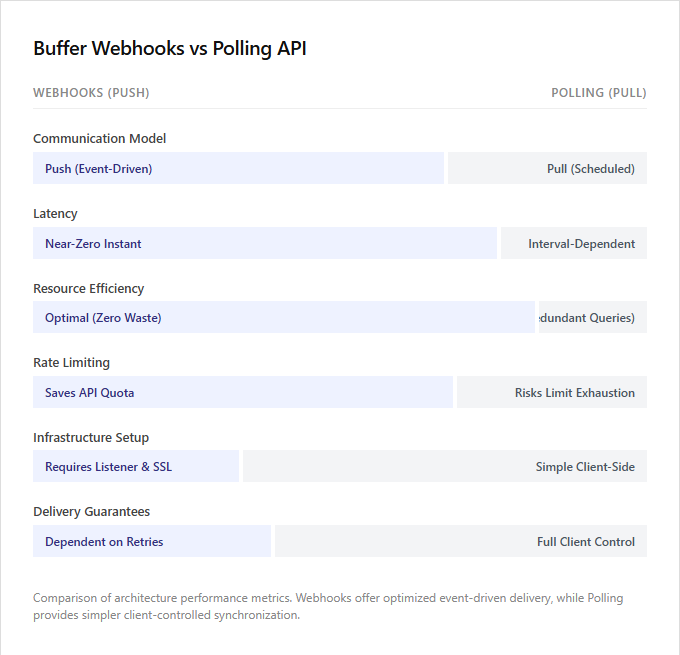
| Communication Model | Webhooks utilize an event-driven push mechanism to deliver data instantly, whereas Polling relies on scheduled HTTP GET requests to pull data from the Buffer API. |
| Latency | Webhooks offer near-zero latency by transmitting JSON payloads immediately upon state changes, while Polling introduces a delay dependent on the configured interval. |
| Resource Efficiency | Webhooks minimize server overhead by eliminating redundant requests, whereas constant Polling consumes unnecessary bandwidth and CPU cycles on empty responses. |
| Rate Limiting | Webhooks help developers avoid exhausting API rate limits by sending data only when events occur, whereas Polling frequently risks hitting API thresholds due to repetitive queries. |
| Infrastructure Setup | Implementing Webhooks requires a publicly accessible listener endpoint with SSL/TLS encryption to receive data, whereas Polling only requires a basic client-side scheduler or cron job. |
| Delivery Guarantees | Webhooks rely on the provider's retry policy to handle failed deliveries, whereas Polling gives the client application full control over state synchronization and error handling. |
Webhooks vs. Polling: Achieving Near-Zero Latency
Buffer's developer platform offers two primary methods for retrieving social media updates: Webhooks and the Polling API. Buffer Webhooks utilize an event-driven architecture that pushes data instantly as activities occur, achieving near-zero synchronization latency. In contrast, the Polling API relies on clients making periodic HTTP GET requests to check for updates, which consumes more bandwidth and introduces a natural delay between actual events and data retrieval.
Choosing the right integration method depends heavily on infrastructure requirements and real-time demands. Webhooks are ideal for developers building live dashboards or instant notification systems requiring immediate data propagation, whereas the Polling API is best suited for analysts performing scheduled batch processing or teams with restricted inbound network access.
Prevent API Rate Limit Exhaustion with Webhooks
When integrating with the Buffer API, choosing the right data retrieval method is critical for system performance. Traditional polling relies on scheduled, repetitive requests to check for updates, which frequently return empty payloads and rapidly exhaust API rate limits. Buffer Webhooks solve this inefficiency by pushing data in real time only when specific events occur, eliminating redundant network traffic and preserving valuable rate limit quotas.
By shifting from a pull to a push model, developers drastically reduce server overhead and maintain consistent data synchronization without hitting platform thresholds. Scheduled polling is best suited for developers maintaining legacy architectures that require simple, interval-based batch processing, whereas webhooks are the ideal choice for high-volume enterprise developers who need immediate, event-driven updates and optimized resource consumption.
Webhook HMAC vs. Polling TLS Security
Buffer offers two primary integration methods for developers: Webhooks and the Polling API. Webhooks operate on an active push model, delivering real-time event notifications directly to your application. Because this architecture requires exposing an ingress endpoint to receive external data, security relies on implementing HMAC signature verification to validate that all incoming payloads originate strictly from Buffer.
The Polling API operates on a pull model, retrieving data at scheduled intervals. This method leverages standard outbound TLS client authentication, securing the connection through client-initiated HTTPS requests. Webhooks are ideal for real-time developers who require instant, event-driven automation, whereas the polling API suits system administrators managing legacy infrastructures with strict inbound firewall policies.
Preventing Webhook Data Loss via Exponential Backoff
Buffer offers two primary mechanisms for data retrieval: Webhooks and the Polling API. While polling requires continuous, resource-intensive requests to check for updates, webhooks push real-time event notifications directly to your server. To ensure reliability, Buffer's webhook architecture incorporates robust exponential backoff retry policies. This mechanism systematically retries failed deliveries during listener downtime, safeguarding critical social media data from loss.
The Polling API operates on a scheduled request cycle, placing the responsibility of data retrieval entirely on the client side without automatic retry fail-safes. Webhooks are ideal for developers requiring real-time, event-driven automation with guaranteed delivery, whereas polling is best suited for analysts managing scheduled batch-processing workflows where immediate synchronization is unnecessary.
Real-Time Webhooks Reduce Queue Bandwidth
Buffer offers two distinct pathways for managing social media queue data: Webhooks and the Polling API. The Polling API requires systems to repeatedly request the entire queue state, fetching large JSON arrays at set intervals regardless of whether the data has changed. In contrast, Buffer Webhooks operate on an event-driven architecture, transmitting immediate delta updates only when specific queue state changes occur.
By transmitting only the modified data, Webhooks drastically reduce bandwidth usage and eliminate the unnecessary processing overhead associated with redundant API calls. Polling is best suited for administrators managing legacy systems that prefer simple, scheduled synchronization, while Webhooks are ideal for developers building highly responsive, real-time applications that demand optimal data efficiency.
Webhooks Require Daemons, Polling Can Be Stateless
Buffer offers two primary integration methods for retrieving social media updates: Webhooks and the Polling API. Implementing Buffer Webhooks requires a persistent, publicly accessible HTTP listener daemon that remains constantly active to receive real-time event payloads. This architecture demands dedicated server maintenance and continuous uptime management to ensure no data packets are missed.
The Polling API operates on a pull-based model, making it compatible with stateless serverless functions or simple scheduled cron-jobs. This approach eliminates the need for ongoing server hosting, as the system only executes resources during active API requests. Webhooks are ideal for enterprise developers requiring instant, real-time data syncs, while polling is best suited for resource-conscious teams managing scheduled, low-frequency updates.
How Polling Solves Webhook Out-of-Order Delivery
Buffer offers two primary integration methods: Webhooks and the Polling API. While Webhooks deliver real-time event notifications, they are highly susceptible to out-of-order delivery. This asynchronous nature requires developers to implement complex sequence ID reconciliation on their servers to accurately reconstruct the true timeline of social media updates.
The Polling API avoids these sequence discrepancies by querying the absolute source of truth directly on demand. By retrieving data states straight from Buffer's database, integration systems bypass the network delivery jitter that disrupts webhook sequences, ensuring absolute data consistency without local sorting logic.
Webhooks are ideal for event-driven developers needing real-time updates who possess the engineering capacity for complex state reconciliation, whereas the Polling API is best suited for teams prioritizing data integrity and simpler architecture over instant execution.
Leave a comment