
Managing a high-volume social media pipeline often degenerates into a tedious bottleneck of manual scheduling and constant queue replenishment. While standard Buffer queues offer a reliable baseline for daily posts, scaling your enterprise output typically forces content managers to rely on standard, manual CSV imports to keep channels active.
Utilizing a dedicated Buffer Bulk Uploader, however, grants marketing teams an immediate competitive advantage: error-free, automated scheduling of hundreds of posts simultaneously. Naturally, maximizing this efficiency requires adhering to specific data stipulations, such as precise date-time formatting and platform-specific character limits. For example, top-tier agencies scheduling 500+ weekly multi-channel updates use these exact structured frameworks to bypass manual entry entirely.
In this article, we will compare the traditional CSV import method against specialized bulk uploading tools, analyzing their features, setup speed, and workflow integration to help you choose the ultimate scheduling solution.
| Factor | Summary |
|---|---|
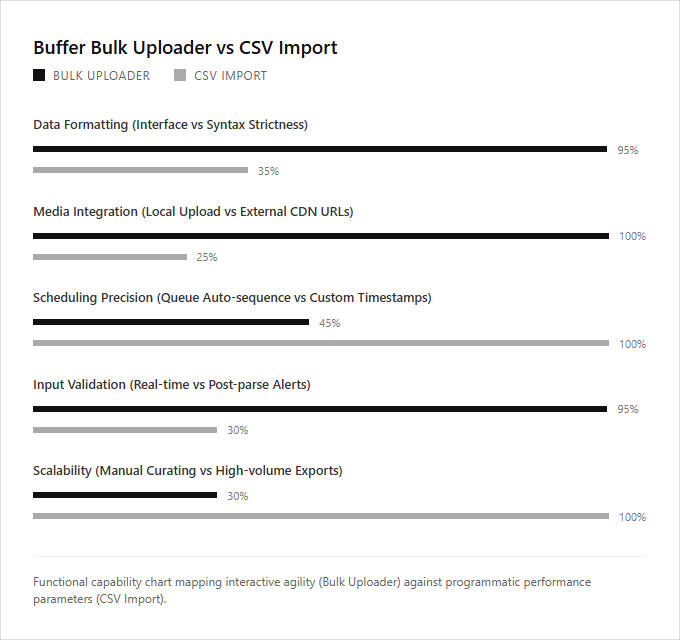
| Data Formatting | Buffer Bulk Uploader utilizes a streamlined web interface for manual text entry, whereas CSV Import requires adherence to strict syntax protocols like specific comma-separated values and date-time formats to prevent parsing errors. |
| Media Integration | While the Bulk Uploader allows direct drag-and-drop of local media files, the CSV Import method relies on publicly accessible image URLs hosted on external CDN servers to attach media to social posts. |
| Scheduling Precision | The Bulk Uploader automatically sequences updates into the default Buffer Queue, while CSV Import allows users to programmatically define exact publication timestamps within designated spreadsheet columns. |
| Input Validation | The interactive Bulk Uploader provides real-time character count and API limit validation, whereas CSV Import only flags formatting errors and metadata violations after the document has been fully parsed. |
| Scalability | CSV Import is highly efficient for high-volume database exports and bulk scheduling of hundreds of updates, whereas the Bulk Uploader is optimized for manual curation of smaller content batches. |
Strict CSV Schema Compliance Prevents Import Errors
Buffer's power tools offer efficient paths to schedule social media content at scale, primarily through the Bulk Uploader and CSV Import features. While both methods accelerate the scheduling workflow, the CSV Import tool requires strict adherence to a predefined CSV schema. Any variation in column headers, date formatting, or text delimiters will trigger data parsing errors, halting the upload process entirely.
The native Bulk Uploader offers a more visual, interactive interface that allows users to drag, drop, and edit posts directly within the platform. Analytical professionals comfortable with database structures and spreadsheet validation thrive using the CSV Import, whereas visual content creators managing dynamic, media-rich campaigns find the Bulk Uploader ideal.
Automatic Bulk Upload vs. Manual CSV Scheduling
Buffer offers distinct methodologies for managing high-volume social media scheduling, primarily through its Bulk Uploader and standard CSV Import features. The Bulk Uploader streamlines the scheduling pipeline by aligning uploaded content directly with pre-established Buffer queue slots. This automated approach utilizes Buffer's internal slot algorithm to distribute posts sequentially across designated time slots, eliminating the need for manual scheduling calculations.
The CSV Import method offers precise chronological control by requiring users to configure specific epoch timestamps for each entry. This manual timestamp configuration ensures exact publication times but demands greater initial preparation and technical precision. The automated Bulk Uploader is ideal for content curators seeking rapid, hands-off queue replenishment, while the CSV Import is best suited for data-driven marketers requiring strict, time-sensitive campaign coordination.
Bulk Post Injection via Buffer OAuth API
Buffer's native CSV import tool allows users to upload structured text files to schedule multiple social media posts, but it often requires manual adjustments within the dashboard interface. In contrast, advanced third-party bulk uploaders leverage the Buffer API OAuth 2.0 protocol to directly inject scheduled posts into the queue payload. This secure protocol bypasses traditional file-parsing limitations, enabling seamless, programmatic scheduling and richer metadata handling directly from external databases.
While standard CSV imports rely on static, manually prepared spreadsheets, these API-driven tools dynamically sync complex content streams with minimal friction. Manual CSV uploads are best suited for solo creators managing simple weekly campaigns, whereas API-based bulk uploaders are ideal for technical teams and agencies requiring high-volume, automated workflows.
Preventing Silent CSV Import Failures
When managing social media campaigns at scale, Buffer users often choose between the standard CSV Import feature and specialized Bulk Uploader power tools. Standard CSV imports frequently present operational hurdles because they lack real-time syntax validation. Without immediate checks for delimiter consistency and UTF-8 character encoding, users regularly experience silent upload failures, where corrupted data or unsupported special characters halt the scheduling process without clear error reporting.
Dedicated Bulk Uploader tools mitigate these risks by providing instant pre-upload validation, flagging formatting errors before data transmission to preserve campaign integrity. Standard CSV imports suit occasional users with simple, plain-text schedules, while advanced Bulk Uploaders are indispensable for agency managers and enterprise marketers handling high-volume, multi-language content.
Buffer Bulk Uploader vs. CSV: Dynamic Image Importing
Buffer's scheduling efficiency depends heavily on how media is ingested. Standard CSV imports allow for bulk text scheduling, but they frequently limit automated media attachment generation, requiring users to manually upload images. In contrast, the Buffer Bulk Uploader dynamically processes image URLs via CDN hotlinking. This capability allows the system to instantly retrieve, cache, and attach images directly to social posts from hosted links, eliminating manual uploads.
This technical distinction alters workflow speed for high-volume campaigns. Standard CSV imports are best suited for small businesses managing straightforward, text-based schedules, whereas the Bulk Uploader is ideal for enterprise teams executing dynamic, media-heavy campaigns.
Managing API Rate Limits for Bulk Uploads
When managing large-scale social media campaigns, choosing between the Buffer Bulk Uploader and standard CSV Import requires a clear understanding of system constraints. High-volume bulk uploaders must actively manage API rate limiting to prevent payload rejection and server throttling during large-batch imports. While standard CSV imports often process data in a single, vulnerable request that can trigger rate limits, dedicated bulk uploading tools queue and pace posts to align with Buffer's API thresholds, ensuring seamless delivery without data loss.
The choice between these two methods depends heavily on operational scale and workflow complexity. Standard CSV imports suit individual social media managers seeking quick, manual scheduling for weekly content, whereas the advanced Buffer Bulk Uploader is ideal for enterprise marketing agencies requiring automated, programmatic syndication of hundreds of multi-channel posts simultaneously.
Transforming Bulk Uploads into Structured JSON
While standard CSV imports offer a basic method to schedule text and single-image posts, they often fall short for complex campaigns. Advanced Buffer Bulk Uploaders solve this limitation by converting raw input data into structured JSON payloads. This sophisticated backend processing enables the system to support multi-image carousels and highly customized, platform-specific metadata that traditional flat CSV files cannot accommodate.
Selecting the right tool depends entirely on your campaign complexity and technical workflow. The standard CSV import is ideal for individual creators scheduling straightforward text updates, while the advanced Bulk Uploader is best suited for agency teams executing dynamic, visually rich campaigns across multiple social networks.
Leave a comment