
Managing multi-platform publishing has become increasingly fragmented, especially as Twitter's restrictive API shifts clash with Mastodon's decentralized architecture. Developers and marketers struggle to maintain cross-posting efficiency without doubling their development overhead. Traditionally, teams address this bottleneck by reallocating internal engineering budgets or securing external funding sources to build custom API wrappers for each platform.
Fortunately, leveraging a unified solution like Buffer's API grants development teams seamless, single-point access to both ecosystems. As a practical stipulation, however, users must note that while Buffer harmonizes the connection, platform-specific metadata rules and rate limits still apply. Enterprise organizations like Shopify have successfully utilized unified API strategies to bypass these API hurdles and maintain continuous syndication. Below, we examine the structural differences between the Mastodon and Twitter APIs, evaluate how Buffer bridges the gap, and outline a streamlined implementation roadmap.
| Factor | Summary |
|---|---|
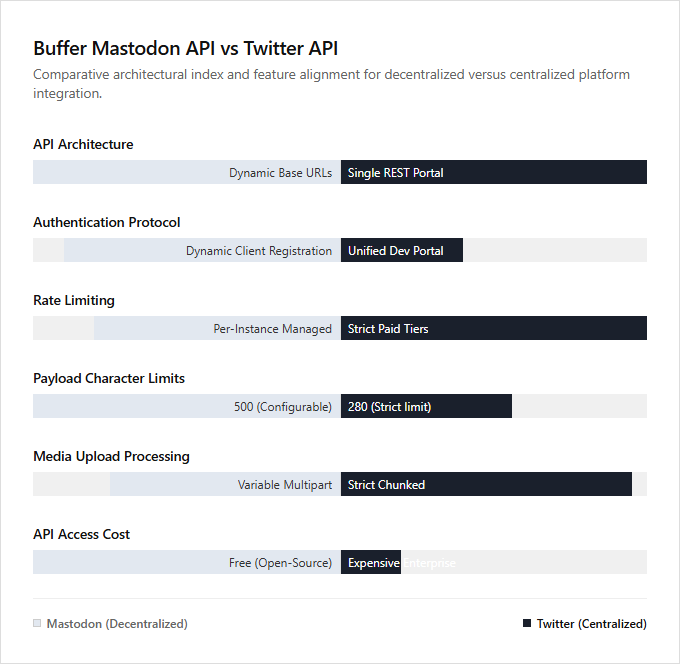
| API Architecture | Mastodon utilizes a decentralized ActivityPub model requiring Buffer to handle dynamic base URLs per instance, whereas the Twitter API relies on a single, centralized REST architecture. |
| Authentication Protocol | Buffer authenticates users via OAuth 2.0 for both platforms, but Mastodon requires dynamic client registration on each specific instance domain, unlike Twitter's unified developer portal registration. |
| Rate Limiting | Mastodon API rate limits are enforced independently by individual self-hosted instances, whereas Twitter enforces strict, multi-tiered global rate limiting based on developer tier pricing. |
| Payload Character Limits | The Mastodon API payload supports a default of 500 characters with custom instance configurations, while the Twitter API v2 strictly enforces a 280-character limit for standard accounts. |
| Media Upload Processing | Buffer manages media attachments via multipart/form-data for Mastodon's variable instance limits, compared to using Twitter's strict chunked upload protocol for large files. |
| API Access Cost | Mastodon provides open-source, rate-limited access to its REST and Streaming APIs for free, while Twitter requires subscription to expensive enterprise pricing tiers for automated POST endpoints. |
Mastodon's Decentralized OAuth vs. Twitter's Centralized Authentication
Buffer's social management tool navigates fundamentally different authentication architectures when connecting to Mastodon versus Twitter. For Twitter, Buffer utilizes a centralized developer portal model, where a single, static set of API keys and OAuth 2.0 credentials authenticates the application across all user accounts. This centralized structure ensures a predictable, uniform integration managed entirely through Twitter's portal.
By comparison, Mastodon's decentralized ecosystem requires Buffer to employ dynamic client registration. Because every Mastodon instance operates independently, Buffer must programmatically register a unique OAuth 2.0 client on the fly for each user's specific server. Twitter's centralized API suits mainstream brand managers prioritizing standardized, high-volume reach, whereas Mastodon's dynamic system caters to decentralized web enthusiasts and localized communities seeking sovereign data ownership.
Federated REST Routing vs. Twitter's Unified Gateway
Integrating Mastodon into Buffer's publishing suite highlights a key architectural shift from traditional social networks. Because Mastodon is federated, Buffer must dynamically route REST API requests across a multitude of independent server domains, adapting to different instance-specific configurations and security protocols.
Twitter relies on a single, unified API gateway. This centralized infrastructure processes all requests through a standardized base URL, ensuring consistent rate limits and simplified authentication pathways across the entire platform.
Enterprise social media managers requiring highly centralized, predictable campaigns favor the structured Twitter API, whereas community coordinators seeking decentralized engagement within niche, sovereign networks are ideal candidates for the Mastodon API.
Custom HTTP Rate Limits vs. Twitter's Rigid Tiers
Buffer's integration with Mastodon and Twitter highlights a fundamental architectural divergence in API rate limiting. Mastodon operates on a decentralized model where each individual instance defines its own custom rate-limiting HTTP headers, dynamically returned in response payloads. This allows developers to monitor real-time capacity on a per-server basis. In contrast, Twitter employs a highly rigid, centralized tier-based pricing model that imposes strict, predetermined caps across standard, pro, and enterprise levels, regardless of individual usage context.
Navigating these distinct environments requires different strategies for social media management. Buffer abstracts these technical complexities, but the underlying API structures still dictate overall application behavior. Mastodon is ideal for community-driven developers seeking highly customized, server-specific engagement, while Twitter remains suited for enterprise brands requiring predictable, high-volume reach within a standardized framework.
ActivityPub JSON vs. Twitter v2 Schema Compatibility
Buffer's integration tools navigate vastly different API architectures to streamline multi-platform scheduling. The technical divergence is most apparent in data serialization: Mastodon relies on the open-standard ActivityPub protocol, utilizing a decentralized, extensible JSON-LD payload schema designed for cross-platform interoperability. In contrast, the Twitter v2 API enforces a highly structured, proprietary Tweet object model that relies on centralized data schemas, strict field expansions, and rigid media upload workflows.
While ActivityPub prioritizes flexible vocabulary and actor-to-object relationships across the fediverse, Twitter's v2 schema focuses on granular, closed-loop metadata such as precise metrics and poll objects. Developers and community advocates prioritizing open-source, sovereign digital spaces thrive within the ActivityPub ecosystem, whereas mainstream enterprise brand managers requiring standardized, high-volume analytical feedback loops are best suited for the Twitter v2 infrastructure.
Synchronous vs. Twitter's Chunked Media Uploads
Buffer's integration with Mastodon relies on synchronous media attachment endpoints, where media files are uploaded in a single, direct request. This simplified workflow ensures immediate feedback and rapid processing for standard image and video sizes. In contrast, the Twitter API utilizes an asynchronous, chunked media uploading protocol. This multi-step process requires initiating, uploading segments, and finalizing the upload, which is highly efficient for handling larger, high-resolution files and resilient to network interruptions.
The direct synchronous approach minimizes development overhead and latency for straightforward publishing schedules. Meanwhile, the robust asynchronous pipeline accommodates complex media workflows requiring high-bandwidth transfers and strict validation. Independent creators prioritizing rapid, uncomplicated cross-posting thrive under the Mastodon API model, while enterprise social media managers demanding high-fidelity video campaigns depend on the Twitter API infrastructure.
Mastodon vs. Twitter: WebSockets vs. Webhooks
Buffer leverages distinct architectures for Mastodon and Twitter integrations. Mastodon utilizes a native WebSocket streaming API, establishing a persistent, bi-directional connection that pushes real-time updates instantly. The Twitter API relies on the Account Activity API, a webhook-based model where Twitter delivers user events via HTTP POST requests to registered server endpoints.
These structural differences impact data delivery and infrastructure requirements. WebSockets demand continuous connection maintenance, while webhooks require secure, listener-enabled endpoints to process incoming payloads. Mastodon's streaming model is ideal for developers seeking immediate, zero-latency feed updates, while Twitter's webhook system suits enterprise teams requiring structured, event-driven integration for high-volume corporate accounts.
Free Open-Source APIs vs. Twitter's Costly Tiers
Buffer's integration landscape highlights a stark contrast between modern API ecosystems. Twitter's transition to highly restrictive, paid API monetization tiers has significantly raised barriers for social media management, forcing organizations to allocate substantial budgets merely to maintain basic publishing functionalities on the platform.
Mastodon's open-source framework offers zero-cost API access, allowing Buffer to seamlessly connect users to the decentralized fediverse. Without the burden of prohibitive licensing fees, this open architecture supports sustainable, cost-effective broadcasting and fosters continuous developer innovation.
Twitter integration remains essential for corporate brands requiring massive, mainstream public relations reach despite the high overhead, whereas Mastodon is ideal for tech-savvy communities, developers, and independent creators seeking decentralized, community-oriented engagement.
Leave a comment