
Managing high-volume fastening operations often introduces severe production bottlenecks, characterized by operator fatigue and inconsistent depth-of-drive. Traditionally, facilities attempt to resolve these inefficiencies by relying on standard manual tackers or consumer-grade corded models to bridge the gap. However, upgrading to industrial-grade actuation systems grants operations a massive competitive advantage in cycle times, significantly lowering labor costs while ensuring flawless joint integrity.
To maximize this investment, we must stipulate that the optimal tool selection depends heavily on your existing facility infrastructure-specifically, your compressed air capacity. In demanding applications like high-volume furniture upholstery and subfloor installation, choosing the wrong actuation mechanism can quickly derail assembly line throughput.
This article provides an analytical comparison of electric versus pneumatic staplers, evaluating their mechanical durability, utility requirements, and actuation speeds to help you select the optimal tool for your specific manufacturing workflow.
| Factor | Summary |
|---|---|
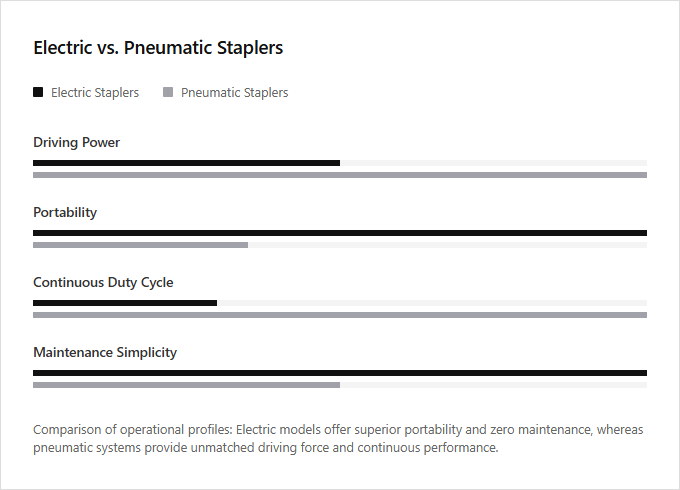
| Power Source | Electric staplers run on standard AC electricity or lithium-ion batteries, whereas pneumatic staplers require a constant feed of compressed air from an external air compressor. |
| Driving Power | Pneumatic staplers generate a significantly higher pounds per square inch (PSI) of driving force than electric models, allowing them to easily penetrate dense hardwoods. |
| Portability | Battery-powered cordless electric staplers offer superior maneuverability and freedom of movement because they are not restricted by an air hose tether. |
| Duty Cycle | Pneumatic staplers are designed for continuous duty cycle operations without the risk of thermal overload, unlike electric solenoids which can overheat during rapid-fire use. |
| Maintenance | Pneumatic staplers require routine pneumatic tool oil lubrication to preserve their internal O-rings, while electric models are generally maintenance-free. |
The Speed and Power of Pneumatic Staplers
When selecting fastening tools for industrial or construction applications, the choice between electric and pneumatic staplers depends on the required performance. Electric staplers provide convenient portability and consistent operation for light-to-medium tasks, running directly on standard electrical outlets or battery power.
In contrast, pneumatic staplers deliver superior performance for heavy-duty applications. By utilizing compressed air regulated by pounds per square inch (PSI) and standard cubic feet per minute (SCFM), these tools offer faster cycle times and significantly greater driving force. This pneumatic system ensures rapid, repetitive fastening through dense materials without tool fatigue.
Electric models are ideal for DIY enthusiasts and mobile technicians needing lightweight versatility, whereas pneumatic staplers are best suited for high-volume production workshops and professional contractors requiring relentless speed and maximum penetration power.
Thermal and Duty Cycle Limits of Electric Models
Electric staplers offer excellent portability and convenience, utilizing electromagnetic solenoids or advanced brushless motors to drive fasteners. However, these electric drive systems are bound by specific duty cycles and thermal limits, requiring periods of cooling during high-volume applications to prevent system degradation.
In contrast, pneumatic staplers rely on compressed air to deliver consistent, rapid-fire force without the risk of overheating. While they require an air compressor and hose, their robust mechanical design allows for continuous, high-speed fastening in demanding construction and industrial environments.
Electric models are ideal for mobile installers and DIY enthusiasts who value quick setup for moderate tasks, whereas pneumatic staplers are suited for high-production manufacturing professionals who demand nonstop, heavy-duty performance.
Pneumatic Tools: Superior Power-to-Weight Ratio
When selecting between electric and pneumatic staplers, power and maneuverability are key considerations. Pneumatic staplers utilize compressed air, allowing them to deliver a significantly higher power-to-weight ratio than their electric counterparts. Because pneumatic tools lack heavy onboard electric motors or battery packs, they remain exceptionally lightweight and highly ergonomic during extended periods of operation.
Electric staplers offer the convenience of instant plug-and-play power or battery mobility, though these onboard components add physical weight and can limit driving force. Cordless electric models are ideal for DIY enthusiasts and mobile technicians requiring quick portability, whereas pneumatic staplers are best suited for high-volume manufacturing professionals and dedicated upholstery workshop operators.
Cordless Electric Staplers Offer Hose-Free Maneuverability
When selecting professional fastening equipment, the choice between electric and pneumatic staplers depends heavily on your workspace requirements. Cordless electric staplers provide superior volumetric maneuverability without tethering to an air compressor hose, allowing operators to easily navigate complex assemblies, tight corners, and remote job sites. This independence from pneumatic infrastructure eliminates trip hazards and simplifies tool transport.
Conversely, pneumatic staplers offer unmatched driving power and rapid cycle times by leveraging continuous compressed air. Because they lack heavy internal batteries, these tools remain lightweight and highly durable for repetitive, stationary assembly line work. High-volume manufacturing facilities and roofers benefit most from the relentless speed of pneumatic systems, while mobile finish carpenters and cabinet installers find cordless electric models ideal for precise, on-the-go applications.
Pneumatic Actuation Infrastructure Requirements
Electric staplers offer immediate plug-and-play convenience, drawing power directly from standard electrical outlets or onboard batteries. In contrast, pneumatic staplers deliver superior, consistent driving power but necessitate a dedicated compressed air system. Operating pneumatic actuation tools requires essential auxiliary infrastructure, including high-pressure air hoses, inline lubricators to protect internal valves, and moisture separators to prevent condensation damage.
While electric models provide portability and zero maintenance, pneumatic systems require a stationary setup and regular infrastructure upkeep. Electric staplers are ideal for mobile installers and DIY enthusiasts prioritizing portability, whereas pneumatic staplers are best suited for high-volume workshop manufacturers and professional contractors requiring rapid, repetitive fastening.
Why Electric Staplers Lose Penetration Depth
Selecting between electric and pneumatic staplers depends on power delivery and consistency. Electric staplers offer portability, but they rely on spring-tensioned flywheels or battery voltage to drive fasteners. This mechanism can cause a decay in penetration depth as the charge depletes or the spring fatigues, leading to incomplete drives in denser woods.
Pneumatic staplers utilize compressed air, ensuring constant pressure and uniform depth regardless of operation time. This system avoids the power degradation seen in electric models, making it highly reliable for continuous assembly. Cordless electric models are ideal for mobile contractors and hobbyists seeking portability, whereas pneumatic systems are suited for high-production cabinetmakers and upholsterers requiring rapid, repetitive fastening.
Why Pneumatics Excel in High-Volume Fastening
Electric staplers offer convenient, plug-and-play operation powered by electrical outlets or batteries. These tools are highly portable and require minimal setup, making them ideal for light-to-medium utility work. Their internal electric motors can experience heat buildup during prolonged use, which naturally limits their duty cycle.
In contrast, pneumatic staplers utilize compressed air to deliver superior power and speed. Pneumatic systems excel in continuous high-volume fastener actuation due to low mechanical wear and rapid exhaust valve cycling. Without an internal motor to overheat, these tools easily sustain demanding production paces with remarkable durability.
Electric models suit DIY enthusiasts and mobile installers needing quick setup, whereas pneumatic staplers are designed for industrial manufacturers and high-volume woodworkers requiring relentless, day-long productivity.
Leave a comment