
Selecting the wrong instrument for intricate detailing can ruin hours of meticulous craftsmanship, leaving makers frustrated by bulky tools that lack finesse. When equipping a professional workshop or makerspace, standard funding sources-such as departmental equipment grants or capital budgets-frequently prioritize large-scale, heavy-duty machinery.
However, integrating a high-speed rotary tool into your arsenal grants operators the surgical control and micro-torque necessary to elevate standard projects. To manage expectations, we must stipulate that while these high-RPM devices excel at micro-craftsmanship, they are not designed for rapid, bulk material extraction. For instance, tasks like engraving custom glass patterns or restoring delicate brass hardware demonstrate their highly specialized utility.
This article evaluates high-speed rotary tools against oscillating multi-tools, analyzing their mechanics, accessory ecosystems, and detailing capabilities to help you invest in the optimal device for your precise workflow.
| Factor | Summary |
|---|---|
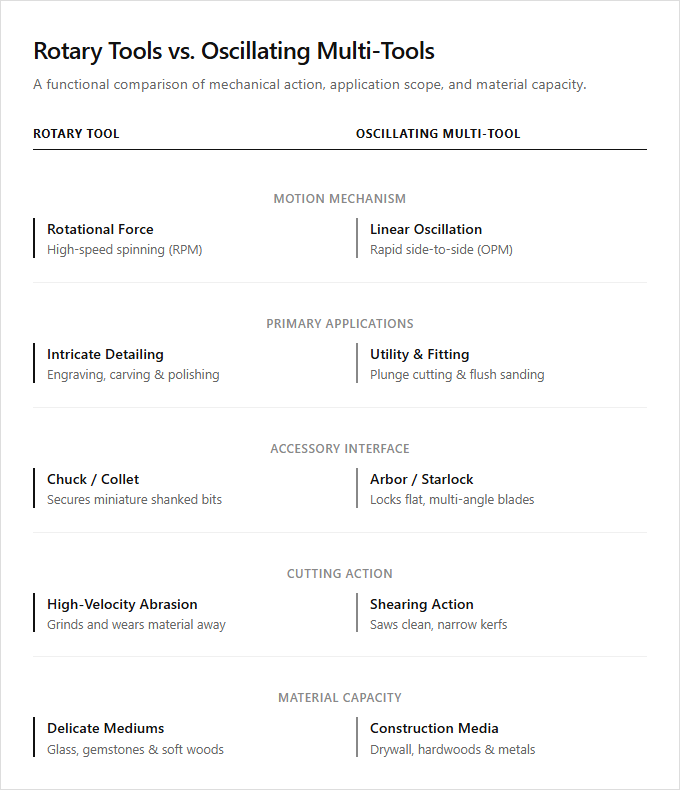
| Motion Mechanism | Rotary tools utilize high-speed rotational force measured in RPM, whereas oscillating multi-tools employ rapid, low-amplitude side-to-side movement measured in OPM. |
| Primary Applications | Rotary tools excel at intricate tasks like engraving, polishing, and routing, while oscillating multi-tools are optimized for plunge cutting, flush sanding, and grout removal. |
| Accessory Interface | Rotary tools secure miniature accessories using a chuck or collet system, whereas oscillating multi-tools utilize a specialized arbor or Starlock mounting system to lock flat blades in place. |
| Cutting Action | The high-velocity spinning action of rotary tools removes material through abrasion, while the linear oscillation of multi-tools creates a precise kerf using a shearing action. |
| Material Capacity | Rotary tools are designed for micro-machining delicate materials like glass and gemstones, whereas oscillating multi-tools handle heavy-duty construction media such as drywall, hardwood, and non-ferrous metals. |
Rotary vs. Oscillating Tools: RPM vs. OPM
Rotary tools and oscillating multi-tools utilize distinct mechanical principles to achieve precise results. A rotary tool operates at high Revolutions Per Minute (RPM), often exceeding 30,000 RPM, to deliver continuous, high-speed cutting, grinding, and carving. This immense rotational velocity allows the accessory to shear material away smoothly through constant circular contact, making it highly efficient for detail work.
In contrast, oscillating multi-tools rely on Oscillations Per Minute (OPM) rather than rotation. These tools move a blade or sanding pad back and forth at a very narrow, low-angle arc, typically under four degrees, at high frequencies. This rapid, side-to-side motion provides superior control, making them ideal for flush cuts and scraping in confined areas where rotational force might cause slippage.
Detailed crafters and hobbyists requiring intricate engraving or material removal favor the high-speed precision of rotary tools, while contractors and home renovators performing plunge cuts and surface preparation benefit most from the stability of oscillating multi-tools.
Rotary Precision vs. Oscillating Arc for Micro-Detailing
Rotary tools operate via high-speed concentric rotation, a mechanism that minimizes spindle runout to deliver exceptional stability for micro-detailing and intricate engraving. In contrast, oscillating multi-tools utilize a rapid, broad side-to-side pivotal arc. While this oscillating motion excels at aggressive material removal, flush cutting, and scraping, it lacks the axial precision required for ultra-fine, pinpoint tasks.
The continuous circular path of the rotary spindle allows for seamless grinding, etching, and polishing on delicate surfaces. Conversely, the pivoting blade of the multi-tool provides superior control during linear plunge cuts and surface preparation. Detailed crafters and jewelers benefit most from the precision of a rotary tool, whereas general contractors and renovators require the heavy-duty versatility of an oscillating multi-tool.
Collet Chucks vs. Multi-Tools for Precision Detailing
Rotary tools and oscillating multi-tools serve distinct roles in workshop environments due to their mechanical designs. High-precision detailing requires a collet chuck system to secure micro-diameter shanks, which minimizes runout during high-speed rotation. Oscillating multi-tools utilize bulky blade-clamping flanges designed to withstand heavy lateral force. This larger mounting interface lacks the capability to hold miniature accessories, making it unsuitable for intricate engraving or detailed carving.
The high-speed rotational action of a rotary tool excels at material removal on a microscopic scale, whereas the flat profile of the oscillating multi-tool dominates in flush-cutting and scraping. Jewelers and model makers require the surgical precision of the rotary tool, while drywall installers and flooring contractors are best suited to the aggressive cutting capabilities of the oscillating multi-tool.
Rotary vs. Multi-Tools: Fine Detail vs. Large Cuts
Rotary tools and oscillating multi-tools serve distinct roles in workshop environments, differentiated primarily by their accessory compatibility and movement. Rotary tools accommodate miniature carbide burrs and diamond engraving bits for subsurface carving, intricate engraving, and micro-machining. This high-RPM rotation allows for exceptional control on delicate materials like glass, metal, and hardwoods.
In contrast, oscillating multi-tools rely on a rapid, small-angle back-and-forth motion. They are limited to larger plunge-cut blades and delta sanding pads, making them highly effective for flush cutting, grout removal, and surface preparation. Fine-scale crafters and jewelers benefit most from the surgical precision of a rotary tool, whereas general contractors and home remodelers require the robust material-removal capabilities of an oscillating multi-tool.
Flexible Shafts Enable Superior Pencil-Grip Ergonomics
When comparing rotary tools to oscillating multi-tools, the primary distinction lies in their operational mechanics and ergonomic adaptability. A rotary tool equipped with a flexible shaft attachment offers a distinct advantage by transferring the heavy motor weight away from the user's hand. This configuration eliminates the gyroscopic resistance inherent in spinning motors, allowing for a highly precise, pencil-grip technique. Oscillating multi-tools, which rely on the rapid side-to-side movement of the entire tool body, cannot replicate this lightweight dexterity.
While oscillating tools excel at high-torque cutting and flush-sanding over larger surface areas, they remain bulky and require a firm grip. Detail-oriented craftspeople and model makers benefit most from the surgical precision of a rotary tool, whereas general contractors and home renovators require the robust, heavy-duty cutting and scraping capabilities of an oscillating multi-tool.
Why Rotary Tools Cut Cleaner Than Oscillating Blades
Rotary tools operate at exceptionally high peripheral speeds, facilitating clean and precise material removal through a process of micro-chipping. This high-RPM method minimizes work-piece deflection and delivers smooth finishes on intricate surfaces. By contrast, oscillating multi-tools rely on a high-torque, back-and-forth shearing action. While highly effective for flush cuts and scraping, this oscillating motion exerts significant shear force that can splinter delicate materials.
The choice between these power tools depends on the scale and precision of the task. Rotary tools excel in detailed engraving, carving, and fine grinding where control is paramount, while oscillating multi-tools are designed for broader construction and remodeling jobs. Precision crafters and hobbyists will benefit most from the delicate control of a rotary tool, whereas general contractors and DIY remodelers require the robust cutting capacity of an oscillating multi-tool.
Rotary vs. Oscillating Tools: Omnidirectional vs. Linear
Rotary tools and oscillating multi-tools serve distinct functions in a workshop based on their unique movement profiles. Rotary tools operate at exceptionally high speeds, providing precise omnidirectional axial control that is ideal for delicate, intricate tasks like detailed engraving, carving, and fine polishing. In contrast, oscillating multi-tools utilize a rapid, low-angle side-to-side motion, restricting their utility primarily to linear plunge-cutting, flush-cutting, and flat surface scraping.
Selecting between these devices depends entirely on the scale and nature of the project. Rotary tools are ideal for detail-oriented artisans, jewelers, and hobbyists requiring micro-precision on small workpieces, while oscillating multi-tools are best suited for contractors and remodelers undertaking demolition, flush cuts, and surface preparation.
Leave a comment