
Achieving perfectly flat faces and square edges on rough lumber is a constant struggle for woodworkers, often thwarted by a jointer table that has sagged out of coplanar alignment over time.
While upgrading machinery is typically financed through standard equipment funding sources or shop capital budgets, securing the investment is only the first step; selecting the correct physical asset requires deep technical scrutiny.
Choosing the right table adjustment design is critical, as the optimal mechanism grants operators permanent alignment stability and eliminates the frustration of frequent, tedious recalibrations.
As an educational stipulation, however, buyers must realize that even the most robust table design cannot compensate for poorly set cutterhead knives or improper operator feed techniques.
Industry-leading models like the Powermatic 60HH and the Grizzly G0858 highlight how different manufacturers address this engineering challenge.
This article provides an in-depth comparison of dovetail ways versus parallelogram links, analyzing their structural differences, maintenance needs, and long-term accuracy to help you choose the best machine for your shop.
| Factor | Summary |
|---|---|
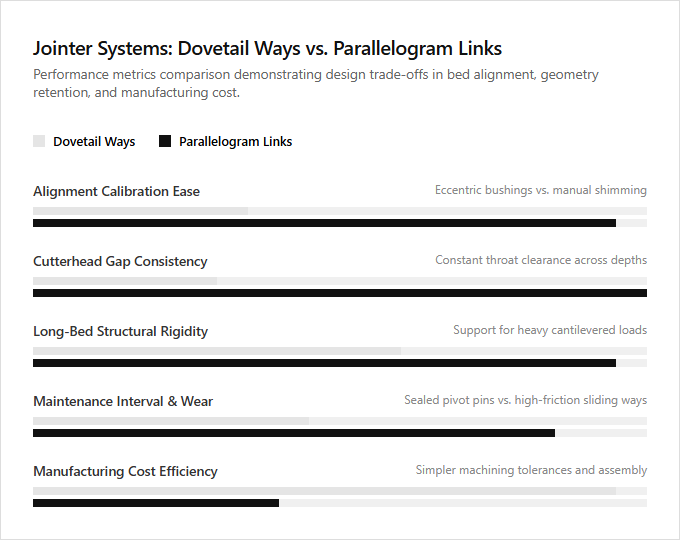
| Movement Geometry | Dovetail ways move the bed along a straight diagonal path, whereas parallelogram links guide the table in a tight arc of movement to maintain a constant distance from the cutterhead. |
| Coplanar Alignment | Parallelogram jointers utilize adjustable eccentric bushings for precise calibration, while dovetail jointers require manual shimming of the ways to correct sag. |
| Throat Clearance | The parallelogram design maintains a constant throat clearance regardless of depth, whereas dovetail ways increase the gap at deeper cuts, which can affect chip extraction. |
| Wear and Maintenance | Dovetail ways require periodic gib adjustment to compensate for friction wear along the sliding cast iron surfaces, while parallelogram mechanisms rely on sealed pivot pins. |
| Structural Rigidity | Parallelogram linkages offer superior support for extra-long tables, distributing the cantilevered load more effectively than traditional sliding dovetail joints. |
| Manufacturing Cost | Dovetail ways are less complex to manufacture but demand highly precise machining tolerances, making them the standard for entry-level to mid-range machinery. |
Constant throat clearance maintenance during depth-of-cut adjustment in parallelogram systems
When selecting a jointer, the table adjustment mechanism dictates both safety and cut quality. Traditional dovetail ways move tables along a straight diagonal path, which widens the throat clearance-the gap between the table edge and the cutterhead-as the depth of cut increases. Parallelogram systems adjust using four pivoting links that guide the tables in a precise arc. This motion maintains a constant, minimal throat clearance at any depth setting, significantly reducing wood tear-out and improving chip collection efficiency.
While dovetail units offer robust simplicity, parallelogram designs allow for easier coplanar adjustments and greater long-term alignment stability. Dovetail jointers are highly suitable for budget-conscious hobbyists prioritizing mechanical simplicity, whereas parallelogram models are ideal for professional woodworkers requiring maximum precision, safety, and frequent depth adjustments.
Adjusting Gibs on Cast-Iron Dovetail Ways
Dovetail ways utilize angled, cast-iron sliding interfaces to guide jointer table height adjustments. Because these mating metal surfaces wear over time, they require periodic calibration. Operators must manually adjust the integrated gib screws to tighten the tolerance, preventing unwanted table play and sagging while ensuring smooth travel. This traditional design offers exceptional structural rigidity when properly maintained.
Parallelogram jointers instead use a pivoting four-point linkage system to adjust table height, eliminating sliding wear and keeping the tables coplanar. Dovetail ways are best suited for traditional woodworkers who value mechanical simplicity and are comfortable performing regular machine maintenance, while parallelogram links suit high-production professionals requiring rapid, frequent adjustments and minimal downtime.
Coplanar Alignment of Parallelogram Linkages via Eccentric Bushings
Jointer tables require absolute flatness to function accurately. Traditional dovetail ways move the tables along a straight, diagonal plane, requiring physical shimming to correct any misalignment over time. In contrast, parallelogram linkages support the tables on pivoting arms, maintaining a constant tight clearance with the cutterhead throughout depth adjustments.
The primary advantage of the parallelogram design lies in its superior calibration system. Four-point coplanar alignment is achieved through adjustable eccentric bushings located at the pivot points of the linkages. These bushings allow independent, precise height adjustment of each table corner, simplifying the correction of twist or droop without the tedious trial-and-error of traditional shimming.
Dovetail jointers are highly suitable for budget-conscious hobbyists seeking simple, robust machinery, whereas parallelogram models are best for high-production woodworkers who demand effortless, micro-adjustable precision.
Fixed Dovetail Way Gaps During Deep Cuts
Dovetail ways guide jointer beds along a straight, angled linear vector during height adjustments. As the infeed table is lowered for deeper cuts, this fixed linear movement inherently moves the table bed further away from the cutterhead, creating a wider gap. This increased opening reduces critical workpiece support near the rotating knives, which can compromise cut quality and safety during heavy stock removal.
In contrast, parallelogram linkages move the tables along a pivoting arc, maintaining a constant, tight clearance to the cutterhead regardless of depth settings. Dovetail jointers are highly suited for budget-conscious hobbyists who prioritize straightforward mechanical calibration and traditional maintenance, whereas parallelogram models are ideal for high-volume professionals requiring maximum surface support during frequent, deep depth adjustments.
Arc-of-Travel Table Movement for Constant Cutterhead Gap
When evaluating jointer design, the mechanism regulating table movement directly impacts safety and cut quality. Traditional dovetail ways slide the infeed table along a straight diagonal path, which inherently widens the gap between the table lip and the cutterhead as the depth of cut increases. In contrast, parallelogram link systems pivot the table along an arc-of-travel that closely mirrors the radius of the cutterhead. This critical design feature maintains a constant, minimal clearance between the table lip and the spinning knives, which optimizes chip extraction and significantly reduces the risk of dangerous kickback.
While parallelogram jointers offer easier coplanar adjustments and superior alignment retention over time, dovetail models remain popular for their simpler mechanical design and lower cost. Dovetail jointers are highly suitable for budget-conscious hobbyists who prioritize rugged simplicity, whereas parallelogram jointers are ideal for professional woodworkers who require precise calibration and maximum operational safety during heavy daily use.
Manual Shimming Requirements for Dovetail Joint Alignment
Dovetail ways on traditional jointers rely on angled cast-iron tracks for table elevation adjustments. Over time, physical wear and gravity can cause these tables to sag, disrupting the essential coplanarity between the infeed and outfeed beds. Correcting this out-of-parallel condition requires manual shimming, a meticulous, time-consuming process of inserting thin metal strips into the ways to restore alignment.
Parallelogram link jointers address this alignment challenge by supporting the tables on four pivoting points. This design maintains parallel alignment throughout the height adjustment range, allowing users to make precise calibrations via adjustable eccentric bushings rather than physical shims.
Dovetail models are well-suited for budget-conscious hobbyists comfortable with hands-on machine maintenance, while parallelogram models cater to high-output professionals requiring rapid, precise adjustments.
Load-Distributing Pivot Pins for Long-Term Bed Calibration
When selecting a professional jointer, the choice between traditional dovetail ways and parallelogram linkages dictates long-term accuracy. Parallelogram jointers utilize parallel linkage pivot pins to secure the infeed and outfeed tables. This multi-point design distributes operational loads across several heavy-duty steel pins rather than relying on a single sliding surface. By dispersing force evenly, these pivot assemblies virtually eliminate table sag and maintain precise, coplanar calibration over years of heavy use.
Dovetail ways adjust along a linear diagonal path, which can develop play as friction wears down the mating cast-iron surfaces over time. Parallelogram systems pivot in a tight arc close to the cutterhead, allowing simple eccentric bushing adjustments to restore perfect alignment. Dovetail jointers suit hobbyists seeking straightforward, budget-friendly maintenance, while parallelogram machines are designed for high-production shops demanding permanent calibration and maximum jointing precision.
Leave a comment