
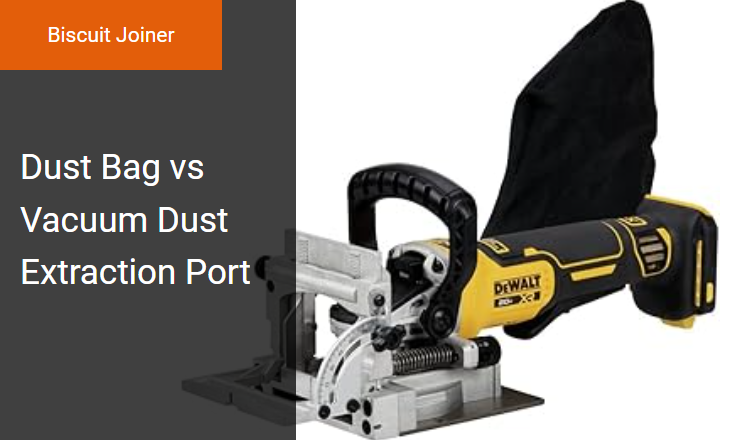
Operating a biscuit joiner is notoriously messy, producing a rapid volume of fine wood chips that quickly obscure your cut line and compromise joint alignment. For many woodworkers, managing this airborne debris represents a constant operational struggle.
While craftsmen often look to standard shop funding sources-allocating their capital budget primarily to the acquisition of the plate joiner itself-dust mitigation is frequently treated as an afterthought. Yet, investing in the right extraction setup is a critical value-add that grants operators immaculate workpiece visibility and a toxin-free breathing zone.
The primary stipulation, however, is that even top-tier machinery underperforms when choked by its own waste. For example, routing dense hardwoods with a Makita PJ7000 or DeWalt DW682 requires specific CFM parameters to prevent internal clogging.
This article examines the critical differences between passive dust bags and active vacuum extraction ports, evaluating both options based on workspace mobility, collection efficiency, and overall respiratory safety.
| Factor | Summary |
|---|---|
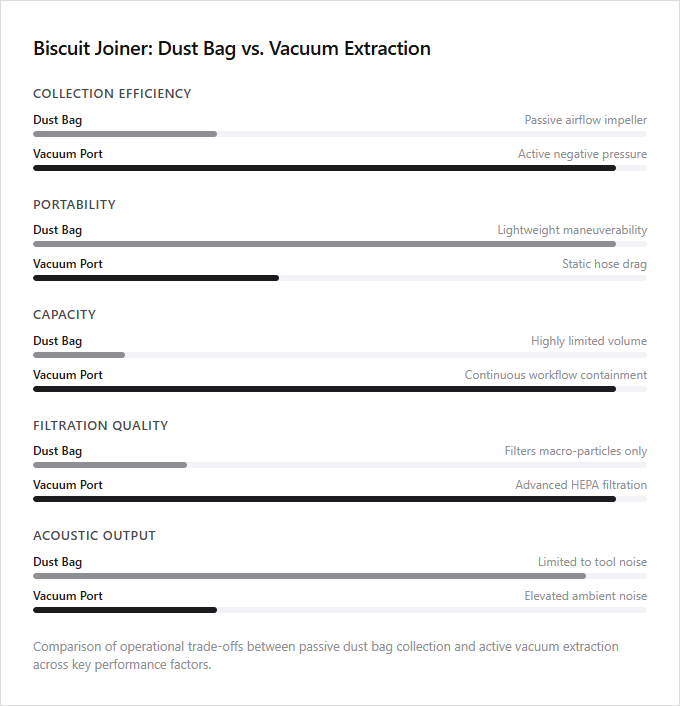
| Collection Efficiency | Dust bags rely on passive airflow generated by the tool's internal impeller, whereas vacuum dust extraction ports utilize active negative pressure to maximize particulate capture. |
| Portability | Dust bags preserve the tool's lightweight maneuverability, while vacuum hoses introduce static hose drag that can restrict the operator's range of motion. |
| Capacity | Dust bags have a highly limited volume requiring frequent emptying, whereas vacuum extractors provide continuous containment volume suitable for high-production workflows. |
| Filtration Quality | Vacuum extractors utilize advanced HEPA filtration to capture microscopic respirable dust, while standard cloth dust bags only filter larger macro-particles. |
| Acoustic Output | Using a dust bag keeps the decibel level limited to the tool itself, whereas active vacuum extraction significantly increases the overall ambient noise level of the workspace. |
Active Vacuum vs. Passive Expansion CFM Rates
When managing wood debris with a biscuit joiner, the choice between a dust bag and a vacuum extraction port hinges on airflow mechanics. A standard dust bag relies on passive expansion, where the tool's internal impeller generates a low Cubic Feet per Minute (CFM) rate-typically under 15 CFM-to push chips into the collector. This method offers excellent portability but is prone to clogging during rapid, sequential cuts.
Connecting a shop vacuum to the extraction port introduces active suction, pulling debris at rates exceeding 100 CFM. This high-velocity airflow ensures the blade chamber remains completely clear, maintaining tool efficiency and cut precision. Passive dust bags are ideal for mobile woodworkers performing quick, on-site installations, while active vacuum extraction is best suited for high-volume workshop artisans requiring continuous operation and a pristine environment.
HEPA filtration efficiency versus standard dust bag micron ratings
Biscuit joiners generate a high volume of wood shavings and fine dust during operation. Standard fabric dust bags, while portable, typically filter particles down to only 5 or 10 microns, allowing hazardous, invisible micro-dust to escape back into the workshop air. This passive collection method relies solely on the tool's internal impeller to push debris into the bag.
In contrast, connecting the tool's dust port to a vacuum extraction system with HEPA filtration provides superior workplace safety. HEPA filters capture 99.97% of airborne particulates down to 0.3 microns, utilizing active suction to clear the cutting channel instantly. Standard dust bags are suitable for hobbyists performing quick, occasional outdoor cuts, whereas HEPA vacuum extraction is essential for professional cabinetmakers working daily in enclosed communal shops.
Negative static pressure requirement for heavy wood chip evacuation
Biscuit joiners generate large, dense wood chips rather than fine dust, posing a unique challenge for waste management. Passive dust bags rely entirely on the tool's internal impeller to push these heavy shavings out, a method that often fails and leads to rapid clogging. Because the chips lack the buoyancy of fine dust, they require active assistance to clear the cutting chamber effectively.
Connecting a vacuum to the dust extraction port solves this by introducing high negative static pressure. This continuous suction forcibly pulls the heavy debris away from the blade, maintaining optimal tool performance and preventing buildup. Standard dust bags are suitable for mobile DIYers performing quick, occasional joints, while external vacuum extraction is the definitive choice for professional woodworkers seeking a clean, uninterrupted workflow in a production shop.
Hose drag torque affecting tool maneuverability and joint alignment precision
A standard dust bag offers maximum tool maneuverability because it eliminates hose drag torque. Without a stiff vacuum hose pulling on the biscuit joiner, woodworkers can easily maintain perfect, flat alignment against the workpiece. This option keeps the tool lightweight and balanced, ensuring consistent slot depth and precise joint alignment.
Connecting a vacuum hose to the dust extraction port provides superior debris clearance but introduces physical resistance. The weight and stiffness of the hose generate lateral torque that can subtly tilt the joiner during plunge cuts, potentially misaligning the mating boards. Users must actively manage the hose path to counteract this drag and maintain accuracy.
On-site installers prioritizing quick, agile setups benefit most from the mobility of a dust bag, while high-volume workshop professionals requiring continuous, dust-free operations are better suited for vacuum extraction setups despite the added hose management.
Port diameter compatibility and step-down hose adapter airflow restrictions
Biscuit joiners generate a high volume of rapid debris, making effective dust management essential for visibility and safety. While standard fabric dust bags offer immediate portability, active vacuum extraction provides vastly superior debris collection. Integrating a vacuum often introduces port diameter compatibility challenges, as most biscuit joiners feature small, proprietary ports ranging from 1 to 1.25 inches, which do not directly accept standard 2.5-inch workshop vacuum hoses.
Utilizing step-down hose adapters resolves this physical connection issue but introduces critical airflow restrictions. Narrowing the extraction pathway reduces the system's cubic feet per minute (CFM) capacity, which can cause larger wood shavings to clog the narrow port during heavy use. On-site finish carpenters requiring rapid setup and maximum mobility are best suited for dust bags, whereas stationary cabinetmakers prioritizing a pristine workshop environment will benefit most from dedicated vacuum extraction systems.
Anti-static hose grounding to eliminate electrostatic discharge
When managing debris from a biscuit joiner, woodworkers choose between a passive fabric dust bag and an active vacuum extraction port. While a dust bag offers maximum tool portability, a vacuum system utilizing a grounded, anti-static hose provides superior safety and dust collection. High-velocity wood chips generate significant friction as they pass through plastic ports, creating a buildup of static electricity. Connecting an anti-static hose to the vacuum port safely grounds this charge, eliminating the risk of painful electrostatic shocks and preventing potential dust ignition in the workshop.
Passive dust bags are prone to clogging and require frequent manual emptying, whereas a grounded vacuum extraction setup ensures continuous clearing of the cutting channel and maintains a cleaner workspace. Mobile installers performing quick, on-site joinery benefit most from the simplicity of the dust bag, while cabinetmakers and workshop professionals requiring continuous, high-volume production and static-free air filtration are best suited for the vacuum extraction system.
Chip deflector accumulation causing tool throat obstruction and clogging
When operating a biscuit joiner, rapid wood chip generation often leads to accumulation around the internal chip deflector. Standard dust bags rely entirely on the tool's passive centrifugal force to expel debris. This limited airflow frequently fails to clear the tight throat area, causing rapid clogging that disrupts tool operation and requires frequent manual clearing.
Utilizing an active vacuum dust extraction port resolves this issue by applying continuous negative pressure directly to the exhaust path. The strong, steady suction forcibly pulls wood chips past the deflector before they can nest, maintaining a clear cutter head and preventing throat obstruction.
Passive dust bags are suited for hobbyists performing quick, intermittent joints in mobile environments, while active vacuum extraction is the standard choice for professional woodworkers requiring continuous, high-volume production with minimal downtime.
Leave a comment