
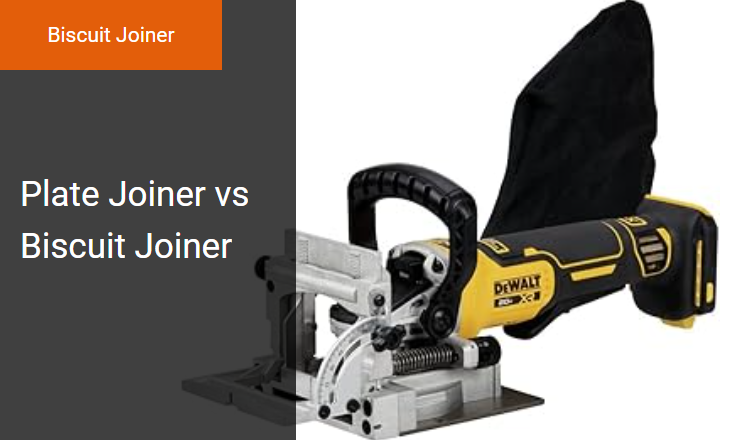
Woodworkers often struggle to achieve perfectly flush faces when edge-gluing panels, frequently battling the frustrating misalignment that standard clamping pressure alone cannot correct. While traditional mechanical fasteners like pocket screws or standard wooden dowels are common workshop solutions, they often lack the lateral play required for micro-adjustments during assembly.
This is where the biscuit joiner excels, as it grants woodworkers a crucial margin of error-allowing lateral shifting while maintaining perfect vertical alignment. However, as an educational stipulation, it is important to note that these compressed wooden splines are engineered primarily for alignment and shear strength in cabinetry, rather than heavy structural load-bearing. Proven in high-end credenzas and seamless tabletop glue-ups, this tool is a modern workshop essential.
Below, we will clarify the technical distinctions between the terms "plate joiner" and "biscuit joiner," analyze their mechanical wood-jointing applications, and guide you in mastering this precise alignment technique.
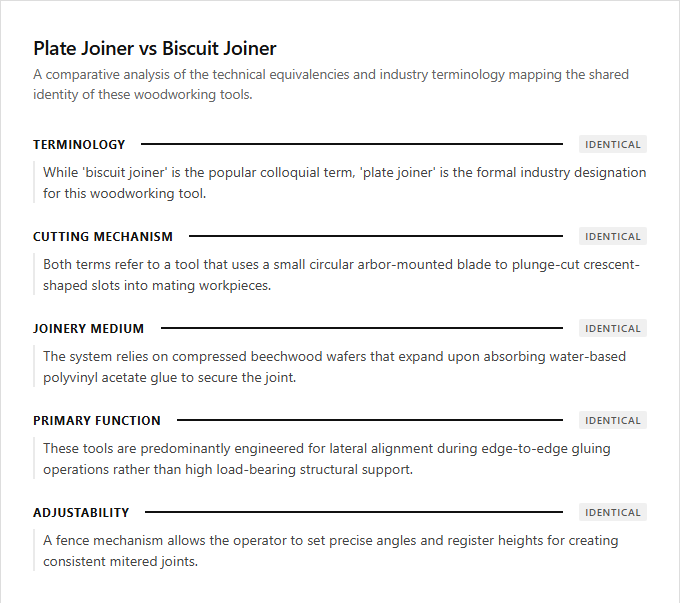
| Factor | Summary |
|---|---|
| Terminology | While "biscuit joiner" is the popular colloquial term, "plate joiner" is the formal industry designation for this woodworking tool. |
| Cutting Mechanism | Both terms refer to a tool that uses a small circular arbor-mounted blade to plunge-cut crescent-shaped slots into mating workpieces. |
| Joinery Medium | The system relies on compressed beechwood wafers that expand upon absorbing water-based polyvinyl acetate glue to secure the joint. |
| Primary Function | These tools are predominantly engineered for lateral alignment during edge-to-edge gluing operations rather than high load-bearing structural support. |
| Adjustability | A fence mechanism allows the operator to set precise angles and register heights for creating consistent mitered joints. |
Plate vs. Biscuit Joiner: Two Names, One Tool
In the woodworking industry, the terms "plate joiner" and "biscuit joiner" are frequently used interchangeably, yet they refer to the exact same plunge-cutting power tool. "Plate joiner" represents the formal engineering and technical designation, emphasizing the tool's mechanical function of cutting crescent-shaped slots into mating workpieces. Conversely, "biscuit joiner" is the widely accepted commercial and colloquial name, derived from the football-shaped compressed wooden splines, or biscuits, used to align and secure the joint.
Engineered for precision, this specialized tool utilizes a small circular saw blade to plunge into the wood face, creating a precise recess for adhesive-anchored connectors. Formal engineering specifications typically attract industrial designers and architects specifying "plate joiners" for technical contract documents, whereas hands-on cabinetmakers and hobbyists universally seek "biscuit joiners" for practical workshop applications.
Precision Crescent Wood Slotting Tool
The terms "plate joiner" and "biscuit joiner" refer to the same highly efficient woodworking power tool. This specialized tool utilizes a circular carbide-tipped blade to machine a precise crescent-shaped kerf into mating wooden workpieces. Once the slots are cut, a compressed wooden biscuit is inserted with adhesive, swelling to create a strong, hidden, and perfectly aligned joint.
While industry manufacturers often use "plate joiner" to denote heavy-duty, high-precision machinery, consumers and hobbyists typically refer to portable, light-duty units as "biscuit joiners." Versatile biscuit joiners are ideal for weekend DIYers seeking straightforward alignment for tabletop glue-ups, whereas robust plate joiners are suited for professional cabinetmakers requiring microscopic depth adjustments and continuous shop production.
PVA Glue Expands Beechwood Biscuits for Secure Joints
While the terms are often used interchangeably, plate joiners and biscuit joiners both utilize a highly effective chemical-mechanical connection. The structural integrity of this system relies on a precise reaction: a water-based polyvinyl acetate adhesive triggers the volumetric expansion of compressed beechwood biscuits to secure the connection. As the moisture is absorbed, the wood fibers swell within the crescent-shaped slots, creating a tight, permanent physical lock that reinforces the joint as the adhesive cures.
In practice, the term "plate joiner" often designates heavy-duty, highly adjustable machinery designed for commercial applications, whereas "biscuit joiner" typically refers to standard, highly portable handheld units. Industrial furniture manufacturers requiring high-precision alignment across various sheet goods favor the robust plate joiner, while DIY enthusiasts and finish carpenters seeking quick, reliable alignment on solid wood projects benefit most from the compact biscuit joiner.
Adjustable Fence for Precise Miter and T-Joints
While the terms "plate joiner" and "biscuit joiner" refer to the same fundamental woodworking tool, their operation relies on high-precision components to ensure strong, seamless wood mating. A critical feature of this tool is the adjustable fence, which allows for the precise angular registration required to execute complex miter joints and T-joints. By securing the fence at exact angles, operators can consistently plunge the crescent-shaped blade to create perfectly aligned slots in mating workpieces.
The distinction between the two names often aligns with the tool's build quality and target market. Heavy-duty plate joiners are preferred by professional cabinetmakers who require extreme tolerance control and continuous workshop use, whereas standard biscuit joiners are ideal for DIY hobbyists seeking a reliable, portable solution for occasional furniture assembly.
Adjustable Depth Turret for Standard Biscuit Sizes
While "plate joiner" and "biscuit joiner" refer to the same essential woodworking tool, industry nomenclature often distinguishes them by application scale. At the core of both tools is an adjustable depth turret that controls the plunge mechanism. This turret features preset detents matching standardized biscuit sizes designated as number zero, ten, and twenty, ensuring precise slot depths for corresponding compressed beechwood splines.
Selecting the correct setting prevents the carbide-tipped blade from cutting too deep, preserving workpiece integrity during alignment. Dedicated plate joiners often accommodate larger, specialty connectors for heavy-duty millwork, whereas standard biscuit joiners excel at rapid, everyday cabinetry alignment. Production woodworkers and timber framers typically require the robust versatility of heavy-duty plate joiners, while hobbyist furniture makers and cabinet installers benefit from the agility of compact biscuit joiners.
Slot Clearance for Clamping Micro-Adjustments
The terms "biscuit joiner" and "plate joiner" refer to the same highly efficient woodworking tool designed for rapid, reliable joint alignment. A key engineering advantage of this system is the deliberate relationship between the crescent-shaped blade and the compressed wood biscuit. The machine cuts a slot that is slightly longer than the insert itself. This longitudinal clearance within the machined slot provides lateral play for micro-adjustments during the clamping phase, ensuring perfectly flush faces.
While "biscuit joiner" is the common residential term, "plate joiner" is often preferred in industrial settings to denote heavy-duty machinery capable of cutting slots for specialized metal or plastic connectors. Dedicated hobbyists and furniture makers favor the classic biscuit joiner for seamless hardwood panel gluing, whereas commercial fabricators and onsite installers utilize versatile plate joiners for rapid, adaptable joining of diverse composite materials.
High-Alignment Jointing with Low Shear Strength
The terms "biscuit joiner" and "plate joiner" refer to the same essential woodworking power tool, which utilizes a small circular blade to cut crescent-shaped slots into mating workpieces. This jointing method excels at face-alignment in edge-to-edge gluing but offers lower shear strength than traditional mortise and tenon joinery. It serves as a rapid, highly efficient solution for maintaining flush surfaces during the clamping process.
While the terminology is largely interchangeable, high-end manufacturers often use "plate joiner" to denote heavy-duty machinery capable of cutting diverse connector slots, whereas "biscuit joiner" typically describes standard-duty tools. Plate joiners are ideal for commercial cabinetmakers requiring high-precision, multi-functional hardware integration, while standard biscuit joiners are best suited for DIY enthusiasts and custom furniture makers prioritizing straightforward tabletop alignment.
Leave a comment