
For many woodworkers, few things are more frustrating than a carefully planed panel joint slipping out of alignment during a critical glue-up, or worse, having a mismatched fastener telegraph through a finished surface.
While traditional alignment methods like dowel jigs or pocket screws serve as standard workshop solutions, they often lack the forgiving lateral play required for flawless micro-adjustments. A professional biscuit joiner resolves this issue, as it grants woodworkers a unique combination of rapid alignment, invisible joint reinforcement, and lateral tolerance. However, maximizing this tool requires a clear understanding of its limitations: biscuits are engineered primarily for alignment and shear stability, rather than high-tensile load-bearing strength.
Whether you are assembling delicate picture frames or laminating a thick oak tabletop, selecting the correct biscuit dimension is critical to joint integrity. This article provides a comprehensive comparison between Size 10 and Size 20 biscuits, examining their structural capacities, depth requirements, and ideal applications to help you choose the right joint for your next project.
| Factor | Summary |
|---|---|
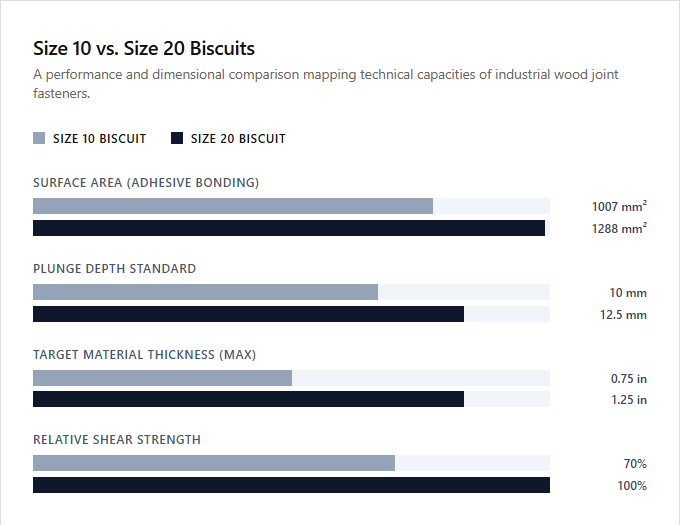
| Physical Dimensions | Size 20 biscuits measure 56 by 23 millimeters, providing a larger surface area than the 53 by 19 millimeter Size 10 biscuits to facilitate greater adhesive bonding. |
| Plunge Depth | The biscuit joiner's depth adjustment knob must be set specifically to the corresponding numerical dial to prevent the carbide-tipped blade from blowing through the workpiece. |
| Stock Thickness | Size 10 is optimized for material thicknesses of 1/2 to 3/4 inches, whereas Size 20 is the standard choice for thicker hardwood lumber to ensure structural integrity. |
| Joint Strength | Size 20 biscuits offer significantly higher shear strength and lateral stability within the mating mortises due to their increased penetration depth. |
| Common Applications | Size 10 is commonly utilized for delicate cabinet face frames, while Size 20 is preferred for heavy-duty edge-to-edge glue joints in large tabletops. |
Size 10 vs. Size 20 Biscuit Dimensions
When selecting wood joining splines, understanding the dimensional differences between Size 10 and Size 20 biscuits is essential for structural integrity. Size 20 biscuits measure 56x23mm, providing a larger surface area for adhesive bonding, whereas Size 10 biscuits measure 53x19mm for more compact joints. Despite these differences in length and width, both sizes share a standard 4mm thickness, meaning they are cut using the same standard 4mm blade kerf on a biscuit joiner.
The choice between these two sizes depends entirely on the scale and load requirements of your workpiece. Delicate woodworkers crafting picture frames or narrow trim will benefit most from the compact Size 10, whereas professional furniture makers assembling large tabletops and heavy cabinetry should opt for the robust Size 20.
Adjusting Plate Joiner Turret Depth Stop
When utilizing a plate joiner for wood joinery, selecting between Size 10 and Size 20 biscuits requires precise calibration of the tool. The turret depth stop on the biscuit joiner must be manually adjusted between the "10" and "20" settings to align the plunge depth of the blade with the corresponding biscuit dimensions. This adjustment ensures that the slot cut into the workpiece accommodates the specific length and width of the chosen connector without compromising the structural integrity of the wood.
Size 10 biscuits measure approximately 53mm by 19mm, making them ideal for medium-duty applications and thinner stock. In contrast, Size 20 biscuits measure 56mm by 23mm, offering a larger surface area for maximum joint strength in thicker materials. Size 10 is preferred by detail-oriented furniture makers working with delicate frames, while Size 20 is the standard choice for professional cabinet makers and carpenters constructing robust tabletops.
Size 10 vs. 20: Stock Thickness Guide
Selecting the correct biscuit size is crucial for maintaining structural integrity and surface quality in woodworking. Size 10 biscuits are engineered for nominal stock thicknesses ranging from 1/2 to 3/4 inch. This mid-range option provides sufficient gluing surface area for medium-duty joints without compromising the structural walls of thinner materials.
Size 20 biscuits offer maximum joint strength but demand a minimum stock thickness of 3/4 inch. Utilizing these larger splines in thinner material risks telegraphing, a defect where the outline of the internal biscuit shows through the finished wood surface after the glue cures.
Size 10 serves furniture makers crafting delicate cabinets or drawer boxes, while Size 20 is suited for carpenters constructing heavy-duty tabletop assemblies or structural panels.
Size 20 PVA Bonds Offer Higher Shear Strength
Selecting the appropriate biscuit size is critical for optimizing joint integrity in woodworking. Size 20 biscuits feature a larger physical footprint than Size 10, which significantly increases the surface area available for polyvinyl acetate (PVA) glue bonding. This expanded contact zone allows the adhesive to form a more extensive network, yielding substantially higher shear strength and superior joint stability.
For thinner workpieces and narrower frames, Size 10 biscuits offer adequate support without the risk of exposing the slot. Size 20 biscuits are preferred for heavy-duty applications like tabletop assembly and large cabinetry where maximum load capacity is required. Size 10 biscuits are ideal for detailed finish carpenters working with delicate trim, whereas Size 20 biscuits are best suited for structural furniture makers building robust, load-bearing projects.
Choosing Between Size 10 and Size 20 Joints
In professional woodworking, selecting the correct biscuit size is critical for maintaining structural integrity and joint alignment. Size 10 biscuits, measuring approximately 53mm by 19mm, are ideal for applications with limited surface area. Woodworkers prefer Size 10 for reinforcing narrow miter joints, delicate picture frames, and slender cabinet stiles, as the smaller footprint prevents the slot from breaking through the finished edges of the workpiece.
Size 20 biscuits, measuring 56mm by 23mm, serve as the industry standard for heavy-duty applications. This larger size offers maximum surface area for glue adhesion, which is essential for large-scale carcass butt joints, cabinet construction, and solid wood tabletop alignments. Detail-oriented trim carpenters working on delicate moldings benefit from the compact Size 10, while professional cabinetmakers assembling heavy structural furniture require the robust holding power of Size 20.
Water-Activated Self-Locking Beechwood Joints
In professional woodworking, selecting the appropriate biscuit size is crucial for ensuring joint integrity and structural alignment. Both Size 10 and Size 20 biscuits utilize compressed beechwood that undergoes hygroscopic expansion to lock the joint securely when contact is made with water-based adhesive. This moisture-triggered swelling action creates a permanent, high-friction bond within the routed slots.
While Size 10 biscuits measure 53mm by 19mm for medium-duty applications, Size 20 biscuits measure 56mm by 23mm to provide a larger surface area for maximum holding power. Detailed cabinetmakers working with thin materials typically utilize Size 10, whereas structural furniture builders managing heavy hardwoods require the robust reinforcement of Size 20.
Size 10 Prevents Edge Blowout on Narrow Frames
Selecting the correct biscuit size is crucial for maintaining structural integrity in woodworking joinery. While both Size 10 and Size 20 biscuits offer excellent alignment, their dimensions dictate their application. When working with narrow frame members, utilizing Size 10 biscuits instead of Size 20 is essential to prevent edge blowout. The shorter cut of the Size 10 ensures the slot remains entirely concealed, whereas the deeper plunge required for a Size 20 biscuit would exit through the sides of narrow stock and ruin the workpiece.
Choosing the right size depends on the scale of your project and material width. Size 10 biscuits are best suited for detail-oriented artisans working on delicate frames and narrow trim, while Size 20 biscuits are ideal for general furniture makers constructing large cabinetry and heavy-duty tabletop panels.
Leave a comment