
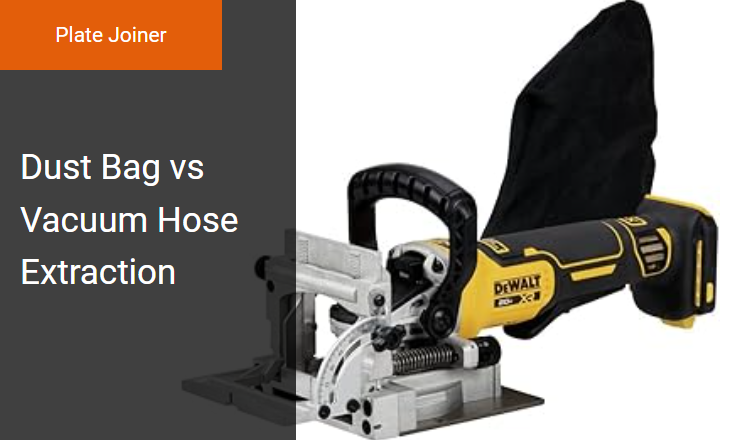
For professional woodworkers and cabinetry specialists, the rapid plunge of a plate joiner is unmatched for quick joint alignment, yet it notoriously unleashes a concentrated, high-velocity blast of fine dust that quickly clogs workpieces and compromises respiratory health. Traditionally, craftsmen rely on the standard, passive cloth dust bags packaged as default factory accessories to manage this waste stream.
However, transitioning to an active vacuum hose system grants operators near-total particulate containment and uninterrupted cut-line visibility. Under the stipulation that hose extraction inevitably introduces slight physical drag and requires precise adapter matching, the health and efficiency gains remain undeniable. For example, cabinetry shops pairing a DeWalt plate joiner with a dedicated HEPA dust extractor during high-volume MDF shelving builds report pristine biscuit slots and virtually zero airborne cleanup.
Below, we will compare passive bags versus active vacuum extraction, analyze critical CFM airflow requirements, and outline how to optimize your dust collection setup for maximum workshop efficiency.
| Factor | Summary |
|---|---|
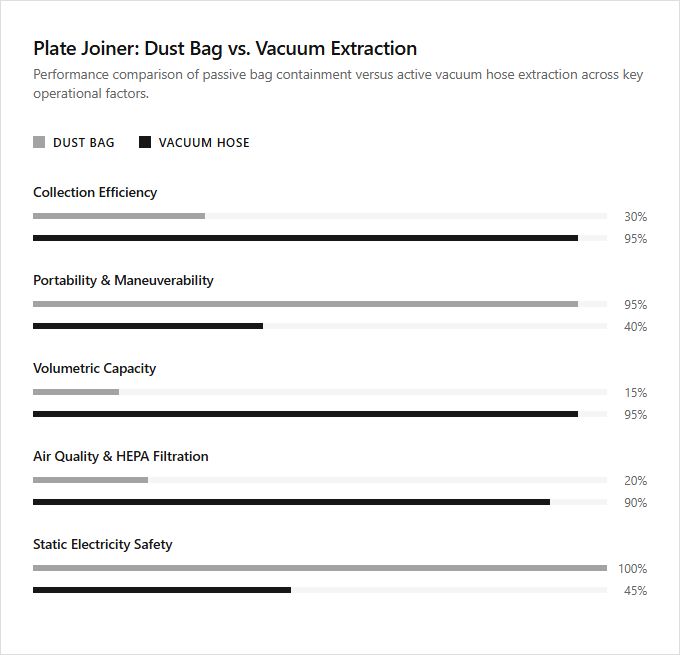
| Collection Efficiency | Vacuum hose extraction utilizes high negative pressure to capture a significantly higher percentage of wood chips than a passive dust bag. |
| Portability | While a dust bag maintains the plate joiner's maximum ergonomic maneuverability, a vacuum hose introduces physical drag and resistance during plunge cuts. |
| Volumetric Capacity | Vacuum extraction systems eliminate the frequent downtime associated with emptying a low-capacity dust bag by routing waste directly to a high-volume cyclonic separator. |
| Air Quality | Active vacuum extraction paired with HEPA filtration captures hazardous respirable dust that easily escapes through the porous fabric of a standard dust bag. |
| Static Electricity | Vacuum hose extraction can generate significant triboelectric charging unless a specialized anti-static hose is utilized, whereas dust bags carry no electrical risk. |
CFM Disparity: Passive Impeller Ejection vs. Active Suction
A plate joiner generates coarse wood chips that must be rapidly cleared from the cutting chamber to maintain precision. Standard dust bags rely on the tool's internal, passive impeller to eject waste. This configuration operates at a low Cubic Feet per Minute (CFM) rate, depending entirely on the airflow generated by the spinning blade. While highly portable, this passive system often fails to evacuate debris quickly enough during rapid, successive cuts, resulting in chamber clogging and reduced visibility.
Connecting an external vacuum hose introduces active suction, which vastly increases the CFM pulling power at the ejection port. High-CFM dust extractors create a continuous negative pressure zone, instantly drawing chips away from the cutter head to prevent thermal buildup and tool wear. Dust bags are ideal for mobile installers performing quick, on-site adjustments where portability is paramount, while vacuum hose extraction is suited for workshop joiners executing high-volume production runs that demand flawless dust containment.
Static Pressure Threshold to Prevent Biscuit Chip Clogging
Plate joiners generate large, dense wood chips that rapidly clog the tool's narrow discharge port. While standard fabric dust bags rely solely on the tool's internal fan impeller, they often fail to clear these heavy shavings, leading to frequent blockages. Efficient chip evacuation requires active vacuum hose extraction. To reliably prevent accumulation inside the chamber, an external dust extractor must maintain a minimum static pressure threshold of approximately 4.0 to 5.0 inches of water lift (about 1,000 to 1,200 Pa) at the tool connection. This continuous suction pulls the debris through before it can pack together and stall the cutter.
Maintaining this pressure threshold ensures clean biscuit slots and prevents thermal buildup on the blade. Passive dust bags are ideal for hobbyists performing occasional, quick joints where maximum portability is required, whereas active vacuum hose extraction is essential for high-volume workshop professionals who demand continuous, clog-free production.
Airflow Restriction from Step-Down Exhaust Adapters
When managing sawdust from a plate joiner, operators choose between a standard dust bag and an active vacuum hose extraction system. While vacuum systems generally offer superior collection, connecting a standard shop vacuum often requires step-down hose adapters to match the tool's small exhaust port. This reduction in diameter restricts airflow velocity, creating static pressure bottlenecks that can cause debris to clog the port rather than escape efficiently.
A dedicated dust bag relies on the tool's internal impeller, avoiding adapter-induced restrictions but filling quickly. Dust bags are ideal for mobile tradespeople requiring maximum tool portability on busy jobsites, whereas vacuum extraction systems are best suited for stationary workshop woodworkers prioritizing a pristine, dust-free environment.
HEPA Filtration for Respirable Wood Dust Capture
Standard cloth dust bags on plate joiners offer basic containment but fail to capture hazardous, respirable wood dust. These microscopic particulates easily bypass porous fabric membranes, remaining suspended in the workshop air and posing long-term respiratory risks.
Integrating a vacuum hose connected to a HEPA-certified extractor provides superior particulate control. This system utilizes advanced filtration to capture 99.97% of airborne dust down to 0.3 microns, maintaining a safer work environment. Standard dust bags suit mobile carpenters performing quick, on-site joints outdoors, while HEPA vacuum extraction is essential for professional cabinetmakers and shop-based woodworkers prioritizing strict indoor air quality.
Electrostatic discharge (ESD) mitigation using grounded anti-static vacuum hoses
When operating a plate joiner, effective dust management is critical for both safety and woodshop cleanliness. While standard fabric dust bags offer basic, passive containment, they often restrict airflow and fail to mitigate the static electricity generated by high-velocity wood shavings. Utilizing a vacuum hose extraction system vastly improves debris collection, but the friction of wood particles moving through plastic hoses can generate significant static. To address this, implementing a grounded anti-static vacuum hose is essential to prevent electrostatic discharge (ESD), safeguarding sensitive tool electronics and protecting the operator from uncomfortable shocks.
Standard dust bags are highly suitable for mobile contractors prioritizing portability and quick setups on-site, whereas grounded vacuum extraction systems are the ideal choice for dedicated workshop professionals performing high-volume fabrication where dust-free, ESD-safe environments are required.
Tool Maneuverability: Vacuum Hose Drag vs. Passive Collectors
When selecting a dust management system for a plate joiner, operators must balance extraction efficiency against tool handling. Standard vacuum hose extraction offers superior particulate capture but introduces significant hose drag, which resists the natural pivoting and plunging motions required for precise biscuit slotting. This extra weight and stiffness can fatigue the user and compromise joint alignment during repetitive tasks.
Passive dust bags preserve the tool's native ergonomics and balance, allowing unrestricted maneuverability in tight spaces or at awkward angles. While passive bags require frequent emptying and leave more fine airborne dust, they eliminate the tethering effect of a heavy vacuum line. Portable onsite carpenters prioritizing agility find passive bags ideal, whereas high-volume workshop woodworkers requiring pristine air quality are better suited for vacuum hose systems.
Negative pressure capture efficiency versus blade-generated kinetic energy chip projection
A plate joiner's high-speed blade projects dense wooden chips with substantial kinetic energy. Standard dust bags rely entirely on this directional velocity to self-eject debris into the fabric chamber, a passive method prone to clogging as chip momentum dissipates. Vacuum hose extraction introduces continuous negative pressure directly at the ejection port, immediately capturing high-speed chips and preventing debris buildup regardless of tool orientation.
Active vacuum extraction is highly suited for cabinetmakers in stationary workshops demanding pristine air quality and uninterrupted production, while passive dust bags are preferred by finish carpenters performing rapid, mobile installations on job sites where portability is paramount.
Leave a comment