
Achieving flawless alignment and structural integrity in woodworking can be highly frustrating when biscuit joints slip or fail, a common pain point often traced back to using an incorrect cutter size. Before upgrading to expensive machinery, woodworkers typically rely on standard tooling investments, such as the default manufacturer-packaged blades that came with their plate joiner, to solve these stability issues.
However, mastering the distinction between blade diameters grants craftsmen the ability to achieve maximum joint strength and pristine alignment. As a crucial educational stipulation, note that a larger cutter is not universally superior; blade selection must strictly align with your workpiece's material thickness and load requirements.
For example, while a standard four-inch blade is the benchmark for heavy-duty cabinet carcasses, a specialized two-inch blade is indispensable for tight, delicate projects like picture frames and narrow face frames. Below, we provide an executive comparison of four-inch and two-inch cutters, detailing their specifications, depth capacities, and how to select the perfect blade for your shop.
| Factor | Summary |
|---|---|
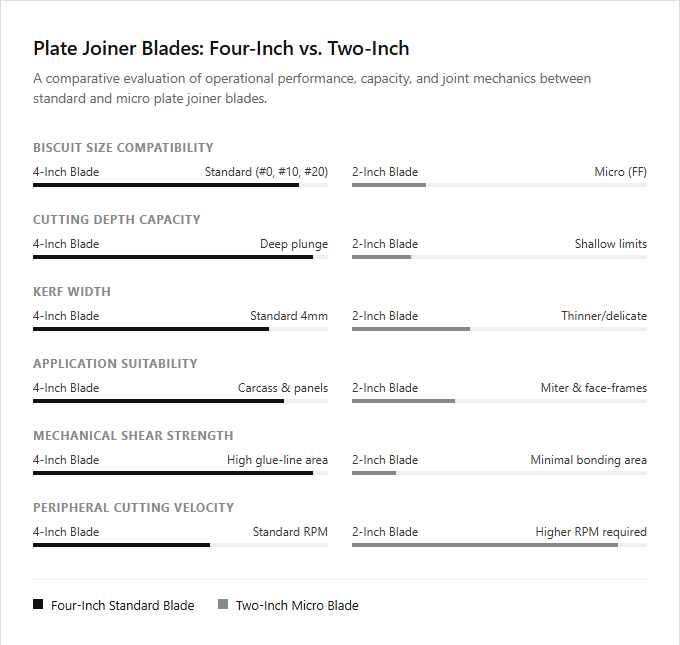
| Biscuit Size Compatibility | The four-inch blade is designed for standard biscuit sizes like #0, #10, and #20, whereas the two-inch blade is engineered specifically for micro-sized FF (Face Frame) biscuits. |
| Cutting Depth Capacity | A four-inch blade provides a significantly deeper maximum plunge depth, while the two-inch blade is limited to shallow cuts suitable for narrow or thin workpieces. |
| Kerf Width | Standard four-inch blades typically feature a 4mm kerf width to match industry-standard biscuits, whereas two-inch blades often utilize a thinner kerf to prevent structural compromise in delicate stock. |
| Application Suitability | Four-inch blades are ideal for heavy-duty carcass construction and panel-to-panel alignment, while two-inch blades excel at delicate miter joints and narrow face-frame joinery. |
| Mechanical Shear Strength | Joints made with a four-inch blade offer superior shear strength due to the larger glue-line surface area of standard biscuits compared to the minimal bonding area produced by a two-inch blade. |
| Peripheral Cutting Velocity | While both blades operate on similar arbor configurations, the smaller diameter of the two-inch blade requires a higher rotational speed to maintain optimal peripheral velocity. |
Blade Sizes for Standard and Mini Biscuits
When selecting a plate joiner, the blade diameter directly dictates the range of woodworking projects you can undertake. A standard four-inch blade is the industry norm, engineered specifically to cut slots for standard biscuit designations, including #0, #10, and #20. These larger biscuits provide the substantial surface area and strength necessary for robust wood joining tasks, such as tabletop alignments and large cabinet construction.
Specialized woodworking applications require a smaller two-inch blade. This compact size is designed specifically for mini or FF (Face Frame) biscuits, which are essential for delicate trim work and narrow frames where standard biscuits would protrude or weaken the wood. Professional cabinetmakers and furniture restorers typically benefit from the precision of the two-inch blade, while general carpenters and DIY enthusiasts find the versatility of the four-inch blade indispensable for structural panel alignment.
Plunge Depth: 4-Inch vs. 2-Inch Blades
When selecting a plate joiner, the blade diameter directly dictates the tool's cutting capabilities. A standard four-inch blade provides a significantly deeper maximum plunge depth, typically reaching up to three-quarters of an inch to accommodate standard biscuit sizes for robust wood joints. A two-inch blade delivers a much shallower cut, limiting its penetration but allowing for precise work on thinner stock.
This variance in depth capacity determines the overall strength and application of the joint. Professional furniture makers and carpenters requiring deep, structural joints will benefit most from the versatile four-inch blade, while delicate crafters and musical instrument makers working with thin materials are best suited for the precision of the two-inch blade.
Arbor Hole Compatibility: 4-Inch vs. 2-Inch Blades
Plate joiners rely on precise blade dimensions to ensure safe operation and accurate cuts. The standard four-inch blade features a 22mm arbor hole diameter, which matches the spindle design of most conventional woodworking joiners. This widespread standard simplifies blade replacement and provides robust stability during heavy-duty cutting operations.
Smaller two-inch blades utilize downsized arbor mounts designed specifically for compact or detail joiners. These smaller mounting configurations are incompatible with standard 22mm spindles, requiring dedicated specialty tools. The reduced diameter allows for shallower, more precise slots in narrow or thin workpieces.
Standard four-inch blades are ideal for general furniture makers assembling cabinet carcasses, whereas two-inch blades are best suited for fine luthiers or picture framers working with delicate, thin-profile wood.
Standard vs. Detail Blade Kerf Widths
Standard plate joiners typically utilize a four-inch blade, which is the industry standard for most woodworking applications. This blade cuts a consistent 4mm kerf width, perfectly matching standard biscuit sizes such as #0, #10, and #20. It provides the necessary depth and width for robust structural joints in cabinetry and furniture.
In contrast, specialized two-inch detail blades cut a much narrower slot designed for smaller, delicate workpieces. These smaller blades prevent the risk of blowing through thin materials while still providing adequate alignment strength for intricate assemblies.
Cabinetmakers requiring maximum joint strength on heavy-duty shelving benefit most from the robust four-inch blade, whereas detail woodworkers and picture frame makers require the precision of the two-inch blade.
Two-Inch Blades Prevent Face Frame Jointing Blowouts
Selecting the appropriate blade size for a plate joiner depends on the scale of your woodworking. While the standard four-inch blade is highly effective for large carcass construction, it presents risks on delicate components. A two-inch blade is specifically engineered to prevent blowout on narrow rails and stiles during face frame jointing. By utilizing smaller biscuits, this compact blade ensures the plunge cut remains entirely within the boundaries of thin wood segments, preserving structural integrity.
Standard four-inch blades excel in heavy-duty panel alignment, providing deep, robust mortises for maximum strength. Cabinetmakers and detailed finish carpenters benefit most from the precision of the two-inch blade for intricate trim, while general furniture builders find the larger four-inch blade ideal for broad-surface cabinet construction.
How Blade Diameter Affects Safe RPM
In plate joiners, the choice between a four-inch and a two-inch blade dictates the tool's rotational dynamics. Because blade diameter directly affects peripheral cutting speed-the velocity of the teeth at the outer edge-each size requires a specific RPM setting for safe operation. A larger four-inch blade covers more linear distance per rotation, requiring lower motor RPMs to prevent timber burning. Conversely, a smaller two-inch blade must spin at much higher RPMs to achieve the necessary peripheral velocity for clean, splinter-free cuts.
Matching the tool's spindle speed to the designated blade diameter is crucial for maintaining operator control and preventing kickback. Standard four-inch joiners are ideal for professional cabinetmakers working on robust, load-bearing furniture joints, while compact two-inch models are best suited for detail-oriented hobbyists crafting delicate, narrow frames.
Comparing Cutter Tooth Designs for Chip Clearance
Plate joiners rely on specific blade diameters to achieve precise biscuit slots, with the four-inch and two-inch options serving as the industry standards. Both cutters utilize carbide-tipped teeth, but the hook angle and tooth count differ to manage chip clearance effectively. The larger four-inch blade typically features a higher tooth count and a steeper hook angle, which facilitates rapid material removal and efficient waste evacuation during deep plunges.
The two-inch blade is engineered with fewer teeth and a shallower hook angle to prevent clogging within smaller slots. This variation ensures clean cuts without burning the wood, even when operating at high rotational speeds in confined areas. Standard four-inch blades are ideal for cabinetmakers assembling large-scale furniture, while compact two-inch blades are best suited for detail-oriented artisans crafting delicate frames and narrow jewelry boxes.
Leave a comment