
Achieving perfectly flush face frames and seamless panel alignments is a constant struggle for woodworkers, where even a fractional misalignment can ruin hours of precision prep work. While craftsmen traditionally rely on labor-intensive mortises or complex doweling jigs-the standard capital investments of joint integrity-the plate joiner offers a highly efficient alternative.
This specialized tool grants woodworkers rapid, micro-adjustable lateral play during glue-ups, saving critical assembly time. However, we must stipulate that biscuits are engineered primarily for alignment and shear-force resistance rather than massive tensile load-bearing. Selecting between traditional compressed beechwood biscuits and modern plastic alternatives, such as Lamello Clamex slip-join splines, depends heavily on your project's moisture exposure and knockdown requirements.
In this article, we will analyze the structural performance, material compatibility, and shear strength of both wood and plastic biscuits, helping you choose the optimal alignment spline for your next woodworking project.
| Factor | Summary |
|---|---|
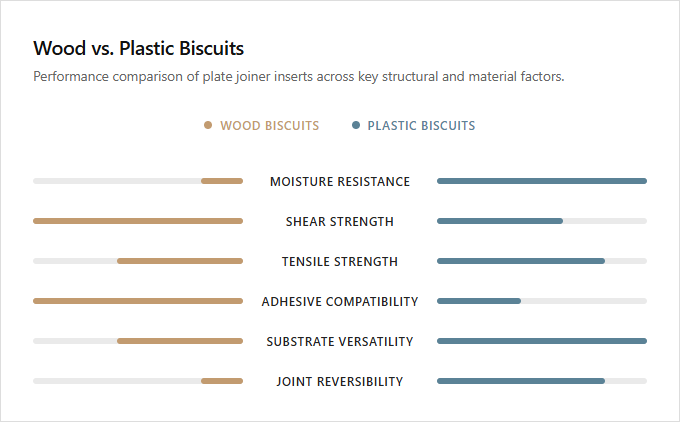
| Material Composition | Wood biscuits are manufactured from highly compressed beechwood, whereas plastic biscuits are molded from non-porous polymers such as polystyrene or polycarbonate. |
| Adhesive Compatibility | Water-based PVA glues trigger hygroscopic expansion in wooden biscuits for a locked joint, whereas plastic biscuits require specialized adhesives like epoxy or cyanoacrylate to bond. |
| Moisture Resistance | Plastic biscuits are completely waterproof and resist rot in outdoor applications, unlike wood biscuits which suffer from dimensional instability and degradation when exposed to moisture. |
| Substrate Compatibility | Wood biscuits are optimized for porous timber and medium-density fiberboard, while plastic biscuits are ideal for non-porous substrates like solid surface materials and acrylics. |
| Tensile and Shear Strength | Wooden biscuits offer superior lateral shear strength once the fibers swell inside the mortise, whereas plastic biscuits provide high tensile strength but may exhibit more flex under load. |
| Joint Reversibility | Certain plastic biscuits feature interlocking designs that function as knockdown fasteners for temporary dry-fitting, whereas wood biscuits are strictly designed for permanent joinery. |
Expanding Beechwood Biscuits Lock Wood Joints Securely
When utilizing a plate joiner for wood joinery, the choice between wood and plastic biscuits significantly impacts joint integrity. Standard wood biscuits, typically crafted from highly compressed beechwood, rely on a unique physical reaction to secure the connection. Upon absorbing water-based adhesives, the compressed wood fibers undergo hygroscopic expansion, swelling tightly within the routed mortise to ensure a permanent, high-strength mechanical lock.
In contrast, plastic biscuits do not expand and rely solely on surface friction or specialized adhesives. These waterproof alternatives excel in damp environments and do not degrade when exposed to moisture. Traditional wood biscuits are ideal for traditional furniture makers who require maximum structural strength in hardwood, whereas plastic biscuits are best suited for outdoor installers or those working with non-porous synthetic materials.
Reactive Adhesives for Thermoplastic Polymer Biscuits
In professional woodworking, selecting the correct plate joiner insertion material is crucial for structural integrity. Traditional wood biscuits expand when exposed to water-based glues, creating a tight mechanical bond within the joint. In contrast, plastic biscuits made from thermoplastic polymers feature a non-porous surface that cannot absorb standard wood glue. These polymer components require reactive adhesives, such as polyurethane or epoxy, to establish a secure chemical bond.
The choice between these two materials depends on the project environment and the adhesive systems at your disposal. Wood biscuits are ideal for traditional furniture makers seeking rapid alignment with standard PVA glues, whereas plastic biscuits are best suited for industrial fabricators and outdoor builders who require waterproof joints and possess the technical setup for working with specialized reactive resins.
45-Degree Grain Wood Biscuits Maximize Shear Resistance
Plate joinery relies on the material composition of the insert to determine the structural integrity of a joint. Traditional wood biscuits feature anisotropic grain orientation set at a forty-five-degree angle to maximize shear resistance across the joint line. Upon absorbing water-based glue, these compressed beechwood components expand within the slot to create a highly secure, permanent bond.
Non-porous plastic biscuits offer distinct advantages, including total moisture resistance and the ability to serve as dry-fit alignment clips. They do not swell, which makes them highly reusable during project mockups. Wood biscuits are the standard choice for traditional furniture makers requiring maximum adhesive-based strength, whereas plastic alternatives are excellent for outdoor builders and installers seeking waterproof alignment solutions.
Self-Clamping Barbed Plastic Biscuits for Dry-Fitting
Traditional plate joining relies on compressed beechwood biscuits that expand upon contact with water-based wood glues to create a permanent, tight joint. While highly effective for standard furniture building, these wood biscuits require wet gluing and clamping time to achieve full structural integrity, which limits immediate adjustments during the assembly process.
In contrast, plastic biscuits utilize molded barbed ribs for immediate mechanical interlocking, allowing for dry-fitting and lateral adjustment without glue clamping. This engineered design provides instant alignment stability and permits woodworkers to test-assemble or modify joints before committing to a final, permanent installation.
Traditional wood biscuits are ideal for workshop-based cabinetmakers seeking permanent, adhesive-bonded joinery, whereas plastic interlocking biscuits are best suited for on-site installers and exhibition builders who require rapid, clamp-free alignment.
Plastic Splines Prevent Veneer Joint Telegraphing
When joining manufactured panels with a plate joiner, the choice between wood and plastic biscuits significantly impacts the finished surface quality. Standard compressed beechwood biscuits rely on moisture absorption to swell and lock the joint, but this volumetric fluctuation often causes joint telegraphing, leaving visible telegraph lines through thin hardwood veneers as the wood shrinks and expands over time. Solid plastic splines resolve this issue through superior dimensional stability, remaining completely inert to environmental humidity changes and ensuring a perfectly flat face.
The physical characteristics of each connector determine their ideal application and user base. Traditional furniture makers assembling solid timber projects find organic wood biscuits ideal for natural fiber bonding, while precision cabinetmakers fabricating premium veneered paneling require plastic biscuits to guarantee stable, telegraph-free surfaces.
Kerf Precision for Wood and Plastic Biscuits
When utilizing a plate joiner, the choice between wood and plastic biscuits dictates the exact tolerance requirements of the machined slot. Wood biscuits are compressed during manufacturing and rely on the moisture from water-based adhesives to swell inside the joint. This swelling action compensates for minor discrepancies in the kerf, establishing a secure, permanent chemical and physical bond.
Plastic biscuits do not expand and require an exceptionally precise friction-fit tolerance. The plate joiner's cutter kerf must match the plastic fastener's thickness exactly to ensure a reliable mechanical interlock without relying on adhesive expansion. Wood biscuits are ideal for traditional woodworkers seeking forgiving, permanent alignments, while plastic alternatives best suit modern production specialists requiring dry-fit disassembly or the joining of non-porous materials.
Plastic Biscuits: Superior Rot Resistance Over Beechwood
When utilizing a plate joiner for woodworking joinery, the choice between traditional wood biscuits and modern plastic alternatives significantly impacts the longevity of the joint. Traditional biscuits crafted from organic beechwood excel in interior environments where they absorb water-based glues to swell and lock the joint. However, when exposed to the elements in exterior applications, beechwood is highly susceptible to biodegradation, wood rot, and structural failure due to moisture absorption.
In contrast, plastic biscuits offer superior resistance to biodegradation and moisture-induced rot, ensuring long-term structural integrity in outdoor environments. These non-porous fasteners do not expand, warp, or decay when exposed to wet conditions. Standard beechwood biscuits are ideal for indoor furniture makers and hobbyists working on dry cabinetry, whereas weather-resistant plastic biscuits are best suited for professional contractors and outdoor builders constructing decks, gates, and marine installations.
Leave a comment