
Woodworkers and metalworkers frequently face the frustration of bottoming out mid-bore, realizing too late that their current machinery lacks the necessary spindle travel for deep drilling operations. This limitation halts production and compromises workpiece accuracy.
While workshops typically look to standard capital equipment budgets or tooling grants to fund machinery upgrades, selecting the wrong form factor can waste these vital resources. Securing the right machine, however, grants operators the critical capacity to execute deep mortises and heavy-gauge boring effortlessly.
As a key stipulation, maximizing this utility requires balancing spindle travel with motor horsepower and column rigidity. For example, while a compact 12-inch benchtop model offers convenience, a 17-inch heavy-duty floor-standing unit is required for deep-bore stability.
In this guide, we will analyze the critical differences in spindle travel capacity between benchtop and floor-standing drill presses, helping you select the ideal machine configuration for your shop's needs.
| Factor | Summary |
|---|---|
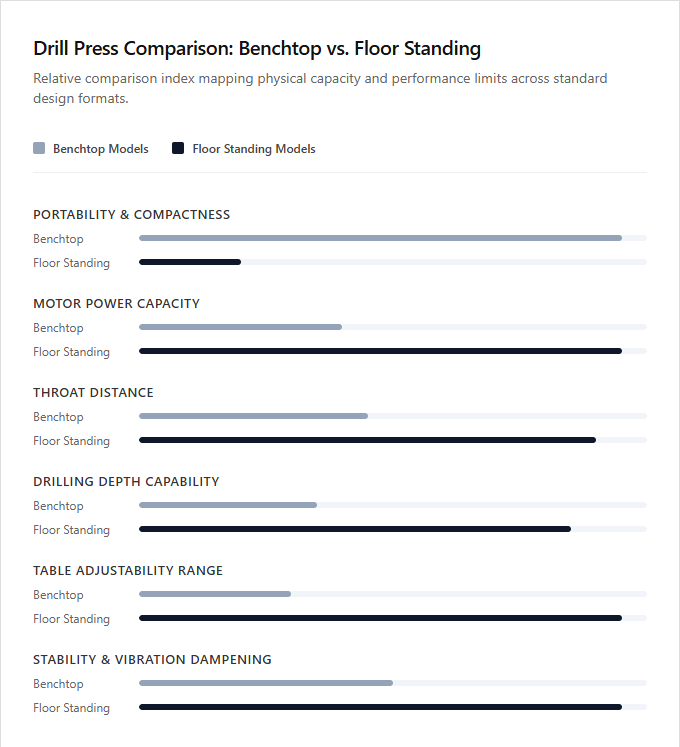
| Footprint and Portability | Benchtop models offer a compact spatial footprint suitable for limited workshop spaces, whereas floor-standing models require dedicated, permanent floor space due to their heavy stationary design. |
| Motor Power | Floor-standing drill presses typically feature higher horsepower ratings and larger induction motors to handle continuous, heavy-duty drilling tasks. |
| Throat Capacity | Floor-standing models provide a larger swing distance, which dictates the maximum width of material that can be drilled to its center point. |
| Drilling Depth | Floor-standing units offer greater spindle travel depth for boring through thicker workpieces, whereas benchtop models have a shorter quill stroke that limits depth capacity. |
| Table Adjustment | Floor-standing presses utilize robust rack-and-pinion elevation mechanisms on tall steel columns to easily accommodate tall workpieces. |
| Stability and Vibration | Floor-standing models rely on heavy cast-iron construction to minimize vibrations during high-torque operations, whereas lighter benchtop units may require being bolted to a workbench to ensure stability. |
Floor-standing units deliver maximum quill stroke for deep-hole drilling applications
When selecting a drill press, the choice between benchtop and floor-standing models depends on your workshop space and project requirements. Benchtop units offer compact, space-saving designs ideal for smaller workpieces, whereas floor-standing models provide the stability and power needed for heavy-duty operations.
Floor-standing units deliver maximum quill stroke for deep-hole drilling applications, allowing operators to plunge deeper into thick materials without adjusting the table height. This extended spindle travel, paired with larger capacities and more powerful motors, ensures high precision and efficiency during demanding tasks.
Benchtop models are best suited for hobbyists and DIY enthusiasts working on light-to-medium projects, while floor-standing units are essential for professional woodworkers and metal fabricators who require continuous, heavy-duty production.
Floor Models Feature Larger Morse Taper Spindles
When selecting a drill press, workshops must evaluate the distinct capabilities of benchtop versus floor-standing units. Floor models offer significantly greater power and capacity, utilizing larger Morse Taper spindles to accommodate longer, heavy-duty drill bits. This robust spindle design ensures secure tool seating and high-torque power transfer, preventing slippage during demanding drilling operations in thick steel or dense hardwoods.
Benchtop models provide excellent precision for smaller workpieces while maintaining a compact footprint. These units typically feature standard chucks suitable for everyday drilling tasks. Benchtop models are ideal for DIY hobbyists and light-duty woodworkers with limited workshop space, while floor-standing units are suited for industrial fabricators and professional machinists requiring maximum material capacity and continuous heavy-duty output.
Benchtop Capacity Limits Spindle Travel Utility
When selecting a drill press, the choice between a benchtop and a floor-standing model depends heavily on workshop space and capacity requirements. Benchtop models offer a compact footprint but present a distinct limitation in chuck-to-table capacity. This restricted vertical clearance directly limits the utility of long spindle travel, as there is often insufficient physical space to accommodate both long drill bits and thick workpieces simultaneously.
Floor-standing models address these limitations by offering expansive vertical clearance and longer quill strokes, allowing for deep-hole drilling in large-scale materials. The robust construction of floor models also provides superior stability for heavy-duty operations. Benchtop units are ideal for hobbyists and light woodworkers with limited workshop space, whereas floor-standing models are suited for professional fabricators and industrial woodworkers requiring maximum capacity and precision.
Floor-Standing Frames Minimize Column Deflection
When selecting between a benchtop and a floor-standing drill press, column rigidity is a critical factor for precision machining. Floor-standing models feature robust, heavy-duty frames engineered to minimize column deflection at the maximum extension of spindle travel. This superior structural stability prevents the drill bit from deviation under heavy loads, ensuring perpendicular accuracy that lighter benchtop alternatives struggle to maintain during deep boring operations.
Benchtop drill presses offer space-saving convenience and portability, making them highly efficient for smaller workshops. While they lack the massive cast-iron support of their larger counterparts, they provide adequate torque for standard, shallow-depth drilling tasks. Benchtop models are ideal for hobbyists and DIY enthusiasts with limited shop space, whereas floor-standing units are suited for industrial fabricators and professional woodworkers requiring maximum capacity and uncompromising accuracy.
Heavy-Duty Springs for Long Spindle Retraction
When evaluating drill presses, the distinction between benchtop and floor-standing configurations extends beyond footprint to critical internal engineering. Benchtop models accommodate standard workshop projects with moderate spindle travel. Floor-standing units support much longer spindles designed for deep-boring applications. To retract these heavier, extended assemblies safely, floor-standing models require heavy-duty torsion spring return mechanisms. These high-tension springs ensure the spindle retracts smoothly, preventing mechanical fatigue and maintaining operational accuracy during demanding operations.
Benchtop units are best suited for DIY enthusiasts and small-scale craftspeople prioritizing workspace efficiency, while floor-standing models are essential for industrial fabricators and professional woodworkers demanding maximum depth capacity and daily, high-volume production.
Precision Threaded Depth Stops for Accurate Plunge Control
Selecting between a benchtop and a floor-standing drill press depends on your workspace capacity and workpiece size. Regardless of the frame scale, both configurations rely on precision threaded depth stop systems to manage the accuracy of extended plunge depths. These mechanical stops eliminate variance during repetitive drilling operations, ensuring consistent spindle travel and uniform hole depths even under heavy resistance.
Floor-standing units provide the rigidity and motor torque required for deep, large-diameter bores in heavy stock, whereas benchtop models offer compact efficiency for standard workshop tasks. Benchtop models best suit hobbyists and light-duty crafters requiring space-saving precision, while floor-standing machines are ideal for industrial fabricators and professional woodworkers handling oversized, heavy-duty materials.
Floor Models with Superior Rack and Pinion Elevation
When selecting a drill press, workshop operators must evaluate the spatial and functional differences between benchtop and floor-standing configurations. While benchtop units offer space-saving convenience for smaller workspaces, floor-standing models deliver superior capacity and stability. Floor models feature superior rack and pinion elevation to adjust the table relative to spindle travel, allowing operators to easily crank the heavy worktable up or down to accommodate varying workpiece heights while maintaining precise alignment.
The decision between these configurations depends heavily on the scale of your projects and available workshop space. Benchtop models are best suited for hobbyists and light-duty crafters with limited space, whereas robust floor-standing models are the ideal choice for professional fabricators and industrial woodworkers who require maximum spindle capacity and daily operational power.
Leave a comment