
Selecting an air compressor that delivers consistent pneumatic performance under heavy loads remains a persistent challenge for workshop managers. Too often, critical projects stall due to unexpected pressure drops and inadequate airflow during continuous tool operation.
While buyers traditionally rely on standard metrics like horsepower ratings or tank capacity to guide their purchases, these specifications alone do not guarantee sustained output. True performance optimization lies in the pump configuration, which directly dictates Cubic Feet per Minute (CFM) delivery. We must stipulate, however, that selecting the right configuration is highly application-dependent and requires matching mechanical design to your specific duty cycle.
For instance, operating high-demand tools like 1-inch pneumatic impact wrenches or continuous paint sprayers demands a highly efficient pump setup to prevent premature system fatigue. This article compares axial and radial pump configurations, examining their internal mechanics, thermal efficiency, and CFM delivery rates to help you choose the optimal system for your operational needs.
| Factor | Summary |
|---|---|
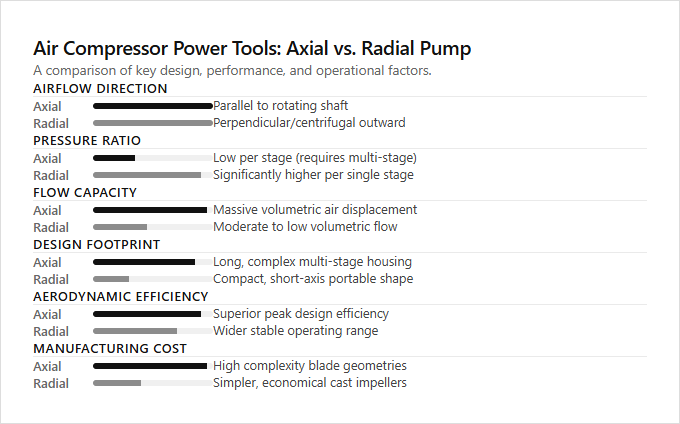
| Airflow Direction | Axial pumps direct air parallel to the rotating shaft, whereas radial pumps utilize centrifugal force to push air outward perpendicular to the impeller axis. |
| Pressure Ratio | Radial pumps achieve a significantly higher pressure ratio per stage, whereas axial compressors require multiple stages to reach high discharge pressures. |
| Flow Capacity | Axial compressors deliver a much larger volumetric flow rate than radial compressors, making them suitable for massive air displacement. |
| Design Footprint | Radial pumps offer a compact, short-axis design ideal for portable pneumatic tools, while axial pumps require a long, multi-stage housing. |
| Aerodynamic Efficiency | Axial compressors provide superior peak polytropic efficiency at design capacity, whereas radial compressors offer a wider operating range before surging. |
| Manufacturing Cost | The intricate geometry of axial stator and rotor blades increases manufacturing complexity compared to the simpler cast impellers of radial pumps. |
Axial Configurations: Ideal for High Flow, Low Pressure
In air compressor technology, selecting between axial and radial pump configurations depends on the specific flow and pressure requirements of the application. Axial configurations are optimal for high specific speed applications requiring massive CFM output at low pressure ratios. These systems accelerate air parallel to the drive shaft, moving vast volumes of air continuously without generating excessive pressure.
Radial pumps displace air outwardly, making them highly effective for generating high pressure at lower volumes. Matching the correct pump design to the task ensures optimal efficiency and tool lifespan. Industrial operators requiring continuous high-volume ventilation benefit most from axial systems, while workshop mechanics needing high-pressure pneumatic tools are best served by radial compressors.
Radial Designs Offer Higher Pressure Ratios Than Axial
In industrial air compressors, the choice between axial and radial pump configurations dictates core performance characteristics. Axial compressors guide airflow parallel to the shaft, prioritizing high-volume delivery. Conversely, radial designs utilize a high-velocity impeller to achieve greater pressure ratios per stage than axial configurations, optimizing compression efficiency within a more compact footprint.
While axial systems excel at maintaining steady, continuous flow, radial pumps are engineered for high-intensity discharge pressures. Large-scale industrial operators requiring massive, uninterrupted airflow are best suited for axial compressors, whereas automotive mechanics and workshop technicians needing targeted, high-pressure power are the ideal users for radial systems.
Axial Compressor Mechanics: Achieving Continuous High Flow
Air compressor pump designs dictate how air is pressurized and delivered, with axial and radial configurations serving distinct operational needs. Axial compressors are engineered for heavy-duty applications, maintaining a continuous, high-CFM flow by directing air parallel to the shaft through alternating rows of rotating rotor blades and stationary stators. This progressive acceleration and diffusion of air yields a constant, high-volume output that is highly efficient for large-scale operations.
Radial compressors, by comparison, displace air outwardly from the center using centrifugal force to achieve higher pressures, though at lower flow rates. Industrial operators requiring uninterrupted, massive-volume airflow for gas turbines or large plants are best suited for axial compressors, whereas automotive technicians and workshop professionals benefit most from the high-pressure, intermittent delivery of radial pumps.
How Radial Pump Diffusers Influence CFM
In air compressor technology, selecting between axial and radial pumps determines tool performance and efficiency. Radial pumps draw air in axially and accelerate it outward. These systems convert kinetic energy to static pressure using a diffuser, directly influencing the final CFM delivery. This design provides high pressure and steady airflow, making them highly efficient for heavy-duty pneumatic demands.
Conversely, axial pumps move air parallel to the shaft, offering high flow rates but at lower pressures. While radial pumps excel in high-pressure applications by maximizing CFM output through velocity conversion, axial designs favor continuous, high-volume fluid movement. Radial compressors are ideal for industrial professionals requiring consistent high-pressure tool operation, whereas axial systems suit large-scale facility ventilation specialists.
Radial Configurations Expand Stable Operating Envelopes
In industrial air compressors, the choice between axial and radial pumps determines how the system responds to fluctuating workloads. Radial configurations excel in environments with variable airflow requirements due to their distinct aerodynamic properties. The surge limit characteristics of radial configurations allow for a wider stable operating envelope under varying CFM demands, preventing stalling and maintaining system pressure even as consumption fluctuates unpredictably.
Axial pumps deliver high-volume, continuous airflow at a constant rate but operate within a narrower margin before experiencing aerodynamic instability. Because of these distinct performance profiles, axial models are best suited for large-scale industrial facility operators requiring constant, high-volume output, while radial pumps are ideal for workshop technicians who operate various pneumatic tools with intermittent air demands.
Optimizing High-Volume CFM with Multi-Stage Axial Systems
In industrial air compression, the choice between axial and radial pump configurations dictates system efficiency and flow dynamics. Axial pumps excel in high-flow applications by directing air parallel to the drive shaft. Specifically, multi-stage axial configurations minimize aerodynamic drag to optimize efficiency during high-volume CFM transport, ensuring a continuous and streamlined flow with minimal energy loss.
In contrast, radial pumps utilize centrifugal force to push air outward, generating significantly higher pressures at lower volumetric flow rates. This fundamental difference in design makes axial compressors ideal for large-scale industrial facility engineers requiring massive, uninterrupted airflow, while radial models are best suited for automotive technicians and contractors who need high-pressure power for individual pneumatic tools.
Axial vs. Radial Selection for Optimal Polytropic Efficiency
In aerodynamic design, selecting the optimal compressor configuration relies heavily on fundamental thermodynamic principles. Polytropic efficiency optimization dictates selecting axial pumps for applications requiring high flow-to-pressure ratios. The axial design allows air to flow parallel to the rotating shaft, facilitating continuous, high-volume displacement with minimal kinetic energy loss per compression stage.
In contrast, radial pumps excel when optimizing for high pressure-to-flow ratios. By redirecting airflow radially outward, these compressors leverage centrifugal force to generate substantial pressure increases within a compact physical footprint. Heavy-duty industrial contractors requiring high-pressure pneumatic tools typically opt for radial systems, whereas plant engineers overseeing large-scale, continuous ventilation operations are best served by axial machinery.
Leave a comment