
Managing microscopic airborne dust remains a persistent, frustrating struggle for professional woodworkers and shop managers alike, often compromising both respiratory health and final finish quality. While operators typically look to standard capital equipment budgets to fund high-capacity point-of-source extractors, achieving pristine air quality requires a more comprehensive financial and operational strategy. Integrating a dedicated ambient air cleaner into your workshop layout grants an invaluable secondary line of defense, capturing the elusive, suspended particulates that source collectors miss.
To establish realistic expectations, we must introduce a critical stipulation: ambient filtration is not a standalone replacement for source collection, but rather a symbiotic partner. For example, while a primary collector handles heavy shavings from a planer, a ceiling-mounted HEPA ambient unit is required to mitigate the highly respirable MDF and walnut dust that lingers in the breathing zone.
In this article, we will compare ambient air cleaners against source dust collectors, evaluating their distinct mechanics, filtration efficiencies, and how to position both to achieve optimal woodshop air quality.
| Factor | Summary |
|---|---|
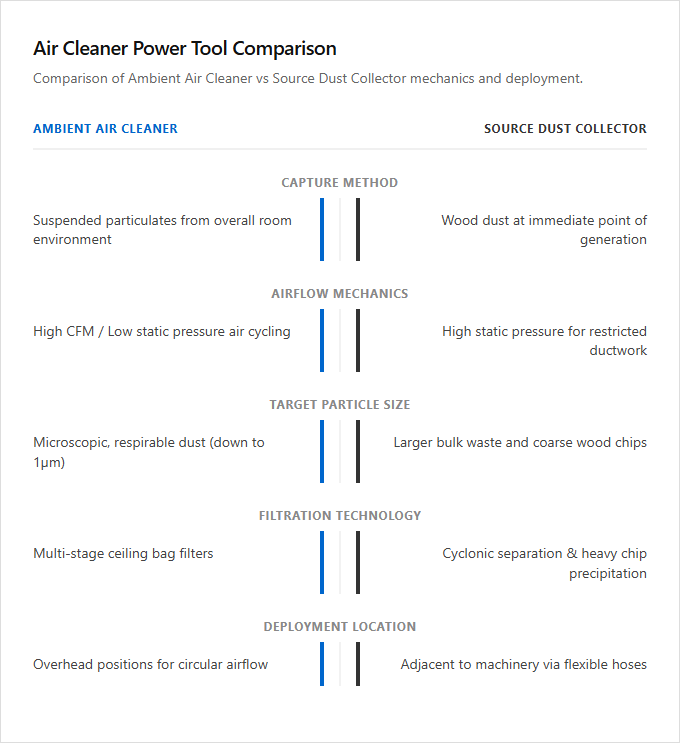
| Capture Method | Ambient air cleaners filter suspended particulates from the overall room environment, whereas source dust collectors capture wood dust at the immediate point of generation using localized extraction. |
| Airflow Mechanics | Ambient units utilize high CFM (Cubic Feet per Minute) and low static pressure to cycle air, while source collectors require high static pressure to pull heavy debris through restricted ductwork. |
| Target Particle Size | Ambient filtration systems target microscopic, respirable suspended dust down to 1 micron, while source collectors are designed to capture larger bulk waste and coarse wood chips. |
| Filtration Technology | Ambient systems generally use multi-stage bag filters to clean circulating air, whereas source dust collectors often employ cyclonic separation to precipitate heavy chips before final filtration. |
| Deployment Location | Ambient cleaners are installed in overhead positions to establish circular airflow patterns, whereas source collectors are placed adjacent to woodworking machinery and connected directly via flexible hoses. |
High-Pressure Source Dust Collectors for Heavy Chips
Maintaining a safe workshop environment requires understanding the distinct roles of ambient air cleaners and source dust collectors. Source dust collectors are designed for immediate containment, requiring high static pressure and high CFM to capture heavy chips and waste directly at the point of generation. This powerful, localized suction prevents large debris from scattering into the workspace and settling on surfaces.
In contrast, ambient air cleaners continuously filter the general room air, capturing the fine, microscopic dust particles that remain suspended in suspension. Source collectors are essential for production-oriented woodworkers operating heavy machinery like planers and table saws, while ambient air cleaners are ideal for detail-oriented hobbyists and carvers seeking to eliminate lingering airborne hazards from their breathing zone.
Shop Air Filtration: The 6–8 ACH Standard
Ambient air cleaners and source dust collectors serve distinct, complementary roles in maintaining workplace safety. Ambient air filtration systems rely on achieving 6 to 8 air changes per hour (ACH) to continuously clean the entire volume of shop air. This constant circulation targets the fine, suspended microscopic dust particles that escape primary collection, gradually purifying the entire room's breathing zone.
Source dust collectors connect directly to woodworking machinery to capture heavy debris and shavings at the point of generation before they disperse. High-volume industrial operators utilizing heavy machinery require the localized containment of source collectors, while craftspeople seeking to eliminate lingering fine dust in shared workshops are ideal candidates for ambient air cleaners.
Ambient Cleaners: Multi-Stage Dust Filtration
Managing workshop air quality requires understanding the distinct roles of source dust collectors and ambient air cleaners. Source dust collectors connect directly to machinery, capturing large debris and heavy sawdust at the point of generation before it enters the environment.
In contrast, ambient air cleaners address the microscopic particles that escape primary collection. These units continuously recirculate the shop's air volume, utilizing multi-stage filtration systems with high MERV ratings to capture fine, suspended dust particles that linger in the breathing zone.
Dedicated woodworkers operating heavy machinery require source collectors for immediate waste containment, while hobbyists and professionals performing detailed hand-sanding or finishing need ambient cleaners to maintain a safe, breathable workspace.
Two-Stage Cyclones Prevent Premature Filter Clogging
Maintaining a clean workshop requires understanding the distinct roles of ambient air cleaners and source dust collectors. While ambient units filter the general room air, source dust collectors capture debris directly at the machinery. High-quality source collectors utilize two-stage cyclone separation to pre-classify waste. By centrifugally spinning heavy wood chips and large dust particles into a collection drum before the air reaches the filter, this system prevents premature clogging of the primary pleated cartridge filter, ensuring consistent airflow and suction.
Ambient air cleaners run continuously to capture the fine, suspended particulate that escapes localized extraction. Ambient air cleaners are ideal for hobbyists seeking general workshop air filtration, whereas source dust collectors are essential for active woodworkers requiring immediate debris containment at the tool.
Source Capture vs. Ambient Airflow Systems
Source dust collectors and ambient air cleaners employ fundamentally different engineering principles to manage workshop particulates. Source collectors rely on high localized capture velocity to capture heavy debris directly at the tool's exhaust point before it disperses into the shop environment. In contrast, ambient filtration systems depend on establishing continuous, room-wide airflow patterns to circulate the entire air volume, which actively prevents stagnant dead zones where fine, respirable dust can accumulate.
Selecting the appropriate system depends entirely on your specific workflow and shop layout. Dedicated source collectors are ideal for stationary woodworkers generating high volumes of waste at specific machinery, whereas ambient systems are best suited for craftspeople in multi-activity spaces who require ongoing mitigation of lingering, microscopic airborne particles.
Ambient Air Cleaners Target Escaped PM2.5
In woodshops and industrial workspaces, effective dust management requires a coordinated strategy using source dust collectors and ambient air cleaners. Source collectors connect directly to machinery to capture bulk debris at the point of generation, though microscopic hazards frequently bypass these primary systems.
Ambient air cleaners are specifically designed to target the dangerous respirable PM2.5 particulates that escape source collection, continuously cycling the room's air to capture invisible dust. Source dust collectors are ideal for operators running high-volume machinery, while ambient air cleaners are suited for craftspeople and professionals prioritizing comprehensive, long-term respiratory health.
Dual-Defense Air Quality: Source Capture and HEPA
Maintaining clean workshop air requires understanding the distinct roles of source dust collectors and ambient air cleaners. Source collectors connect directly to machinery to capture heavy waste at the point of generation, while ambient air cleaners continuously cycle and filter the fine, suspended particles that escape into the room.
Combining a high-efficiency source collector with a HEPA-filtered ambient unit creates a comprehensive dual-defense air quality system. This integrated approach ensures both immediate containment of large debris at the tool and continuous purification of the shared breathing zone.
Stationary woodworkers operating heavy machinery require high-capacity source collectors, whereas craftspeople working in confined spaces with lingering fine dust are best served by ambient air filtration units.
Leave a comment