
Managing fine airborne dust is a persistent struggle for professional woodworkers and fabricators, as microscopic particulates compromise both respiratory health and final finish quality. While workshop managers often look to standard funding sources, such as capital equipment budgets or occupational safety grants, to address these hazards, selecting the correct machinery is critical.
Implementing a dedicated ambient air cleaner grants workshops the ability to continuously scrub the air, drastically reducing ambient PM2.5 levels. However, as an important educational stipulation, these systems are engineered to complement, rather than replace, dedicated source-capture extractors. Leading facilities utilizing industrial ambient air cleaners-such as the Jet AFS series to meet rigorous OSHA air-quality guidelines-demonstrate the power of this dual-layer mitigation.
This article compares the localized efficiency of the Downdraft Sanding Table against the room-wide reach of the Overhead Air Filtration Unit, helping you optimize your workshop's dust control strategy.
| Factor | Summary |
|---|---|
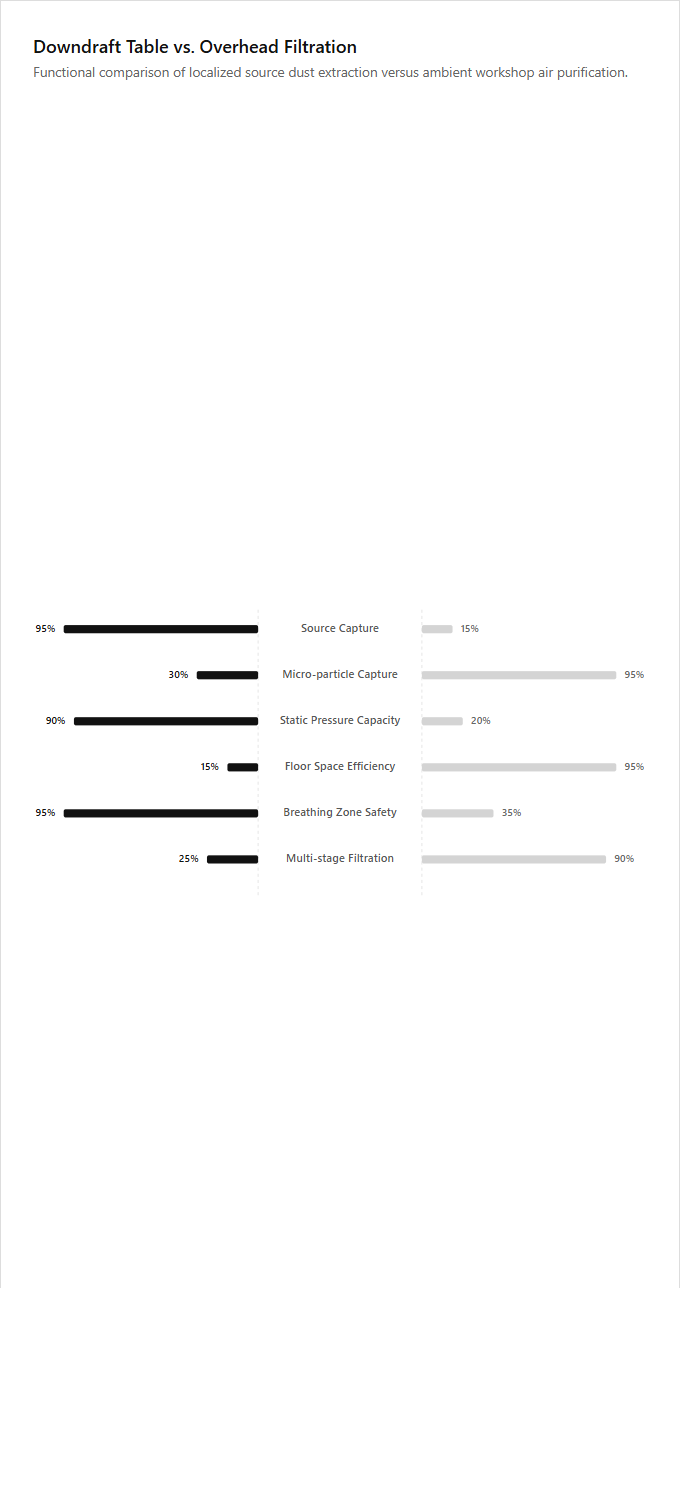
| Dust Capture Mechanism | While the downdraft table relies on direct source capture at the workbench level, the overhead unit focuses on general ambient air filtration throughout the workshop. |
| Target Particle Size | Downdraft tables primarily collect larger sawdust particles and heavy debris, whereas overhead filtration units target suspended microscopic particulates as small as 1 micron. |
| Airflow Dynamics | Downdraft tables require high static pressure to pull dust downwards, while overhead units prioritize a high cubic feet per minute (CFM) rating for rapid air exchange. |
| Spatial Footprint | The downdraft table occupies functional workshop floor space as a physical workbench, whereas the overhead unit utilizes ceiling-suspended mounting to optimize workspace ergonomics. |
| Operator Exposure Reduction | Downdraft tables immediately mitigate respirable dust at the operator's breathing zone during active sanding, while overhead units control cumulative background dust concentration. |
| Filtration Stages | Downdraft tables typically use simple single-stage filters, whereas overhead units frequently employ multi-stage setups including electrostatic pre-filters to capture fine dust. |
Downdraft Tables: Capturing Heavy Dust at the Source
Woodworking facilities require effective dust management strategies to maintain air quality and workshop safety. A downdraft sanding table serves as a localized source capture system, drawing heavy particulate downward directly at the point of generation before it can disperse. This immediate extraction prevents fine dust from entering the operator's breathing zone, making it highly efficient for intensive hand sanding and routing tasks where waste is concentrated.
In contrast, an overhead air filtration unit circulates and cleans the ambient air throughout the entire room, capturing the lighter, airborne dust that escapes primary containment. Downdraft tables are ideal for dedicated furniture makers and fabricators performing high-volume, stationary hand-sanding, while overhead filtration units are suited for general hobbyists and multi-station professionals who require continuous, shop-wide air purification.
Overhead Units for Whole-Room Air Purification
In professional woodworking and fabrication environments, managing airborne dust is critical for maintaining a safe workspace. While both downdraft sanding tables and overhead air filtration units control particulates, they employ different mechanical approaches. Overhead units are designed to clean the entire room volume by drawing ambient air upward and maintaining a targeted rate of air changes per hour, which purifies the broader atmosphere of the workshop over time.
In contrast, downdraft sanding tables provide localized source capture, drawing dust directly downward through the work surface before it can enter the operator's breathing zone. Downdraft tables are ideal for individual artisans performing detailed, stationary hand-sanding, whereas overhead filtration systems are best suited for operators in high-production, multi-station facilities requiring continuous, shop-wide air purification.
High-Pressure Blower Requirements for Downdraft Tables
Downdraft sanding tables and overhead air filtration units serve distinct roles in workshop dust management. While overhead units capture fine, airborne particulates circulating throughout a room, downdraft tables draw heavy dust downward directly at the source. This localized extraction requires downdraft tables to utilize specialized blowers engineered to overcome the high static pressure created by internal baffling systems and tight filtration media.
Overhead filtration systems rely on high-volume, low-pressure airflow to continuously cycle the ambient air. Choosing the right system depends on workflow and workshop layout. Overhead units are ideal for hobbyists seeking general ambient air clarity, while downdraft tables are suited for professional woodworkers performing intensive, localized hand-sanding.
Overhead HEPA Air Cleaners Trap Microscopic Dust
When managing workshop dust, choosing the right filtration system is essential for maintaining a safe environment. Downdraft sanding tables serve as a primary containment measure, drawing heavy particles and sanding debris downward directly from the work surface before they can disperse into the breathing zone.
Overhead air filtration units address ambient airborne hazards by continuously cycling the room's air. These ceiling-mounted systems utilize high MERV or HEPA-rated filters to trap microscopic respirable dust that escapes initial source containment, protecting the lungs from invisible, lingering particulates.
Downdraft tables are highly suitable for craftspeople performing concentrated hand-sanding at a single station, whereas overhead filtration units are best for multi-user production spaces requiring continuous, facility-wide air purification.
Dual-Device Multi-Stage Filtration for Waste and PM2.5
Downdraft sanding tables and overhead air filtration units serve distinct yet complementary roles in maintaining workshop safety and air quality. A downdraft table actively pulls heavy wood dust and larger debris downward directly from the work surface, preventing waste accumulation at the source. In contrast, overhead filtration units continuously circulate the room's air to capture the finer, suspended particulates that escape into the surrounding environment.
Combining both devices establishes a highly effective multi-stage filtration system that controls both heavy workshop waste and hazardous, airborne PM2.5 particles. This dual-action approach ensures comprehensive debris management and superior respiratory protection. Downdraft tables are ideal for craftsmen performing intensive hand-sanding at a dedicated station, while overhead units are best suited for general woodworkers requiring continuous, shop-wide air purification.
Optimizing Overhead Filtration Through Laminar Airflow
In professional workshop environments, managing airborne particulates requires a strategic choice between downdraft sanding tables and overhead air filtration units. The efficiency of an overhead filtration system depends heavily on establishing proper laminar flow and consistent air movement patterns to capture fine dust before it disperses. Without these optimized circulation paths, overhead units cannot effectively intercept the micro-particles that rise and linger in the breathing zone.
In contrast, downdraft tables pull gravity-assisted debris directly downward at the source, offering immediate localized containment for specific tasks. Downdraft tables are ideal for individual artisans performing high-volume hand-sanding at a single station, whereas overhead filtration units are best suited for operators managing larger, multi-station workshops that require continuous, facility-wide ambient air purification.
Optimizing Downdraft Table Capture Velocity
In workshop dust management, choosing between a downdraft sanding table and an overhead air filtration unit depends on the nature of the particulate control required. A downdraft table pulls heavy sanding dust downward directly at the source. Effective downdraft table operation requires sufficient capture velocity across the work surface area to prevent fine dust from escaping into the operator's breathing zone.
Overhead air filtration units circulate and clean the ambient air, capturing lighter, suspended particles that escape source collection. While downdraft tables excel at immediate local containment during intensive hand-sanding, overhead units manage overall workshop air quality over extended periods. Downdraft tables are ideal for detail woodworkers performing constant hand-sanding, while overhead filtration units are best suited for multi-station crafters seeking general ambient dust reduction.
Leave a comment