
Managing microscopic dust is a persistent challenge for woodworkers; despite running a dust collector, a fine, hazardous haze often settles over the shop, compromising both respiratory health and finishing quality. Traditionally, operators rely on standard 5-micron cloth bags-the default filtration media included in standard equipment budgets.
However, upgrading to high-efficiency filtration grants your workshop near-total containment of invisible PM2.5 particulates, drastically purging the air of carcinogens. Stipulation: While a 1-micron canister filter offers superior protection, it is critical to recognize that tighter filtration can increase static pressure, requiring a well-matched fan motor to prevent a drop in CFM (airflow). For example, when CNC-routing MDF or sanding oily hardwoods, this upgrade prevents the finest, most dangerous dust from bypassing the collector.
In this article, we will compare 1-micron versus 5-micron filters, analyze their impact on system performance, and outline how to optimize your workshop's air quality.
| Factor | Summary |
|---|---|
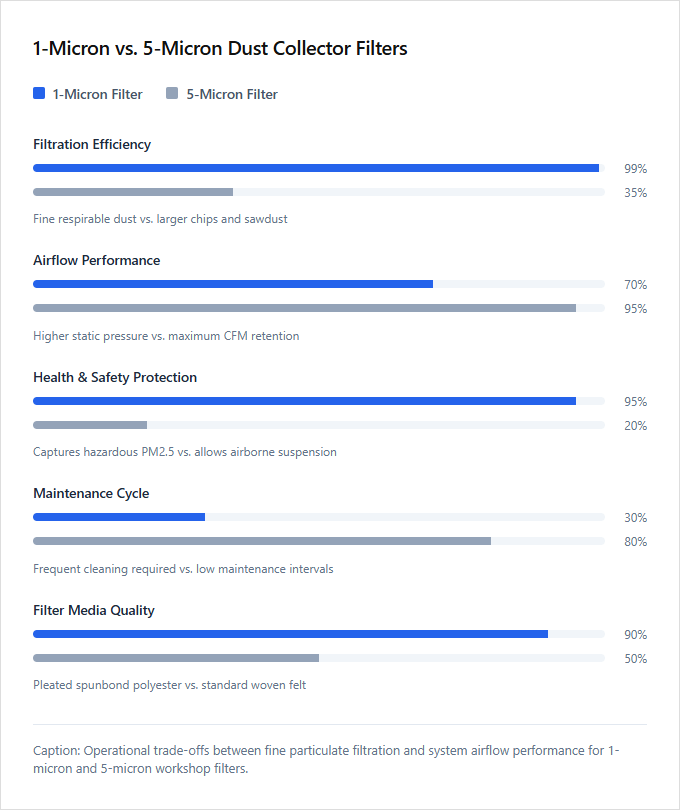
| Filtration Efficiency | The 1-micron filter captures fine respirable dust like crystalline silica, whereas the 5-micron filter only traps larger sawdust and chips. |
| Airflow Performance | A 5-micron filter maintains higher CFM airflow because its larger pore size offers less static pressure resistance. |
| Health and Safety | Using a 1-micron filter significantly reduces the concentration of suspended particulate matter, or PM2.5, in the workshop environment. |
| Maintenance Cycle | The 1-micron filter requires more frequent cleaning due to rapid dust cake formation from finer particles. |
| Filter Media Material | High-efficiency 1-micron filters often feature pleated spunbond polyester, whereas standard 5-micron filters typically utilize woven felt. |
PM2.5 vs. PM10 Dust Capture Rates
When selecting a dust collection system, the filter rating directly impacts workshop air quality. A standard 5-micron filter efficiently traps coarse particulate matter classified as PM10, which includes visible sawdust and wood shavings. While highly effective at maintaining general shop cleanliness and preventing heavy debris buildup, these coarser filters allow smaller, invisible particles to bypass the media and recirculate into the workspace.
In contrast, a 1-micron filter provides critical protection against respirable dust, specifically targeting PM2.5 fine particulates. These microscopic particles bypass the body's natural defenses and penetrate deep into the lungs, posing the greatest long-term health risks. Standard 5-micron filtration is suitable for casual hobbyists working in well-ventilated garage shops, while high-efficiency 1-micron systems are necessary for professional woodworkers operating daily in enclosed commercial environments.
Static Pressure and CFM Airflow Rate
A dust collector's efficiency depends heavily on its filtration rating, which directly influences static pressure resistance and volumetric airflow rate. A 5-micron filter offers minimal resistance, allowing the system to maintain a high cubic feet per minute (CFM) rate and maximize debris movement. Conversely, a 1-micron filter features a much tighter weave that increases static pressure. This resistance restricts the volumetric airflow rate, requiring a more robust motor to pull air through the denser media.
Choosing between these options involves balancing air volume against air purity requirements. High-volume shops prioritizing bulk waste removal from jointers and planers are best suited for the high-CFM 5-micron filter, while CNC operators, fine-scale woodworkers, and those processing toxic hardwoods require the strict containment of a 1-micron filter to protect respiratory health.
Pleated Canister Surface vs. Felt Bag Depth Filtration
The choice between dust collector filters depends on filtration mechanics and efficiency. A 1-micron pleated spunbond polyester canister utilizes surface filtration, leveraging a vast surface area created by tight pleats to capture fine, hazardous particles without restricting airflow. This design prevents microscopic dust from re-entering the workspace, maintaining high air quality.
A 5-micron woven needle-felt bag relies on depth filtration, trapping larger waste particles within the thick, fibrous matrix of the fabric. While highly durable and economical for high-volume chip collection, this system allows smaller, respirable dust to pass back into the shop.
Professional woodworkers prioritizing respiratory health and fine sanding dust capture should choose the 1-micron canister, whereas casual hobbyists focusing on bulk debris and coarse shavings are better served by the 5-micron bag.
MERV Rating Comparison for Sub-Micron Particle Capture
When selecting a dust collector filter, the performance variance between 1-micron and 5-micron media is defined by their Minimum Efficiency Reporting Value (MERV). Standard 5-micron filters typically carry a lower MERV rating, successfully trapping visible sawdust but allowing hazardous, sub-micron particulate matter to bypass filtration and recirculate into the workshop atmosphere.
High-efficiency 1-micron canister filters achieve MERV 15 or 16 ratings, capturing up to 95% of sub-micron particles. This level of filtration is critical for controlling fine respirable dust that poses long-term health risks.
Five-micron filters are suitable for occasional hobbyists operating in well-ventilated outbuildings, while one-micron filters are required for professional woodworkers and enclosed shop environments where respiratory health is a priority.
Surface loading filtration mechanism versus depth-loading dust cake accumulation
A 1-micron dust collector filter operates primarily on a surface loading filtration mechanism. It captures extremely fine particulate matter immediately on the media exterior, preventing penetration and maintaining consistent airflow through easy cleaning cycles.
In contrast, a 5-micron filter relies on depth-loading, allowing larger particles to lodge within the filter matrix. This process facilitates dust cake accumulation, where the trapped dust itself begins to act as an additional, finer filter barrier, though at the cost of eventual airflow restriction.
The 1-micron option serves professional woodworkers handling fine MDF or sanding dust, while the 5-micron version is suited for general hobbyists generating primarily coarse sawdust and wood chips.
Triboelectric charge dissipation and static-conductive filter media treatments
When selecting between a 1-micron and a 5-micron dust collector filter, the management of static electricity is a critical technical factor. Airflow through the filter media generates a triboelectric charge, which can cause fine dust particles to cling stubbornly to the fibers, leading to premature clogging. High-efficiency 1-micron filters frequently utilize advanced static-conductive media treatments, such as aluminized or carbon-infused fibers, to safely dissipate this charge and maintain optimal air velocity. Standard 5-micron filters generally rely on untreated polyester or paper, which experience higher static retention but present less resistance to bulk airflow.
The choice of filtration level directly dictates workshop safety and maintenance frequency. A premium 1-micron filter is ideal for professional fabricators and CNC operators handling hazardous fine dust, whereas a standard 5-micron filter is best suited for general hobbyists generating primarily coarse sawdust and wood chips.
Two-stage cyclonic pre-separation necessity to prevent premature filter blinding
When selecting a dust collector, the choice between 1-micron and 5-micron filtration significantly impacts workshop air quality and system efficiency. A 1-micron filter captures fine, hazardous particulate, whereas a 5-micron filter is suited for larger sawdust and wood chips. Capturing these finer particles increases the risk of premature filter blinding, where dust cakes the filter pores and restricts airflow. A two-stage cyclonic pre-separator is essential to mitigate this, as it drops heavy debris into a bin before the air reaches the filter, maintaining optimal static pressure.
Standard 5-micron single-stage collectors are ideal for casual hobbyists primarily generating coarse chips from jointer and planer operations, while high-efficiency 1-micron systems paired with cyclonic pre-separators are necessary for professional woodworkers requiring clean air during heavy sanding and CNC machining.
Leave a comment