
Choosing the Right Motor Technology for Industrial Dust Collection
Workshop operators and industrial facility managers constantly battle premature equipment failure and safety hazards caused by fine, abrasive airborne particulates infiltrating their dust collection systems. While procuring these vital systems typically relies on standard capital equipment budgets or workplace safety grants, the true return on investment lies in the technical specifications of the machinery itself.
Specifically, selecting the correct motor configuration grants operators long-term reliability, lower maintenance overhead, and vital protection against combustible dust hazards. As a critical stipulation, however, one must understand that neither motor design is a one-size-fits-all solution; efficiency hinges heavily on your specific operational environment. For example, a heavy-duty commercial cabinetry shop processing fine MDF dust faces vastly different thermal and sealing requirements than a light-duty metalworking bay.
Below, we break down the critical engineering differences between Totally Enclosed Fan Cooled (TEFC) and Open Drip-Proof (ODP) technologies, analyzing their design, durability, and cost-efficiency to guide your next procurement decision.
| Factor | Summary |
|---|---|
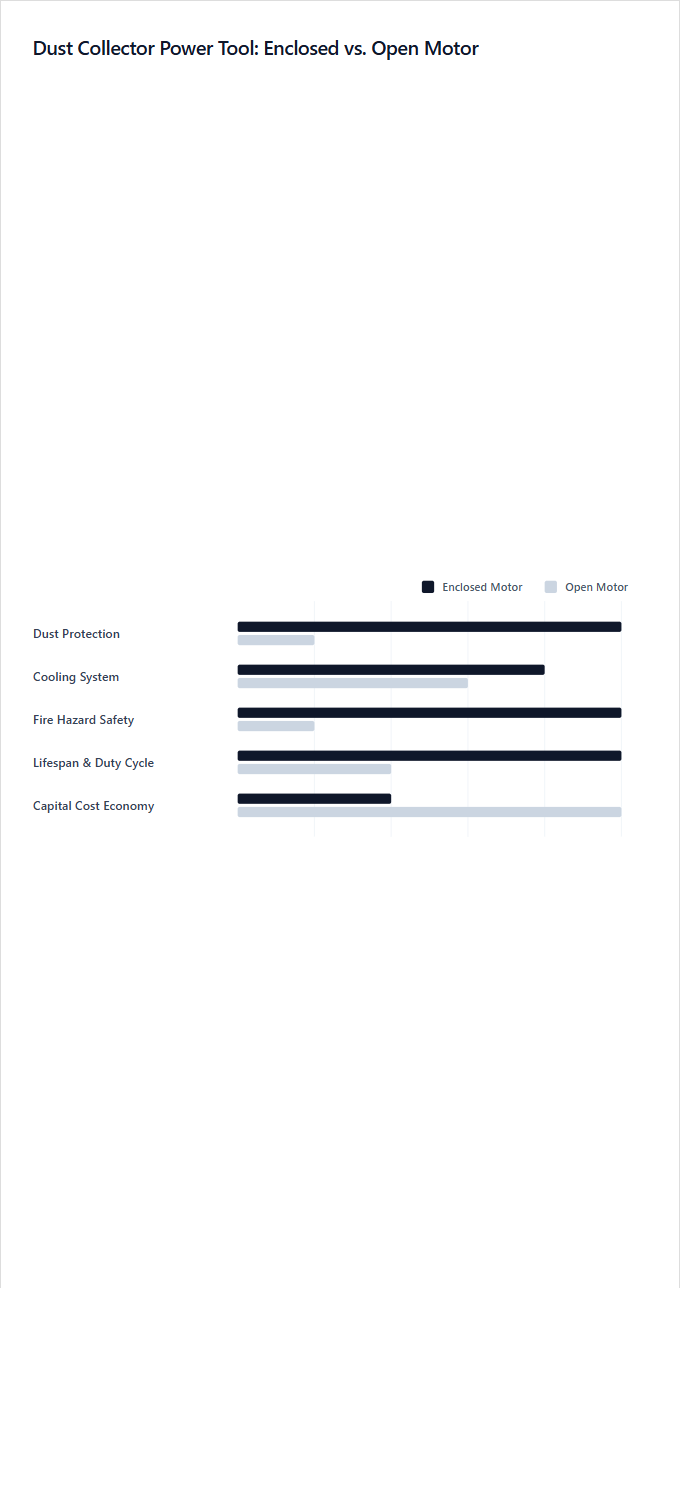
| Dust Protection | Enclosed motors utilize a sealed housing to prevent hazardous fine particulate ingress, whereas open motors allow ambient sawdust to accumulate directly on the internal electrical windings. |
| Cooling System | Enclosed models rely on an external shaft-mounted fan blowing air over cooling fins (TEFC design), while open motors draw cooling air directly through the internal rotor assembly. |
| Fire Hazard Risk | Open motors pose a combustion risk in workshop environments due to potential arcing at the starting switch or brushes contacting volatile wood dust, which is mitigated by the sealed chamber of an enclosed motor. |
| Maintenance and Lifespan | Enclosed motors offer a significantly longer duty cycle because their internal components are shielded from abrasive debris that accelerates bearing wear in open-drip-proof (ODP) configurations. |
| Capital Cost | Open motors have a simpler manufacturing design resulting in a lower initial purchase price, whereas enclosed motors command a premium due to the engineering required for robust thermal dissipation. |
TEFC Motors Prevent Internal Particulate Buildup
When selecting a dust collector, the motor design plays a critical role in system longevity and safety. Open motors rely on ambient air flowing directly through the motor windings for cooling, which exposes internal electrical components to fine airborne debris. In contrast, Totally Enclosed Fan Cooled (TEFC) motors provide superior Ingress Protection (IP) ratings. This sealed configuration prevents harmful particulate accumulation on sensitive internal components, significantly reducing the risk of electrical shorts and thermal overload in high-dust environments.
While open motors offer a cost-effective solution for light-duty operations, TEFC motors deliver the durability required for continuous, heavy-duty extraction. Open-motor collectors are best suited for occasional hobbyists working in low-dust environments, whereas enclosed TEFC models are ideal for professional woodworkers and industrial operators who require reliable, daily particulate management.
ODP Motor Insulation Vulnerability to Abrasive Dust
When selecting a dust collector, the choice between an Open Drip-Proof (ODP) motor and a Totally Enclosed Fan-Cooled (TEFC) motor is critical for machine longevity. ODP motors rely on ambient air circulating directly through their internal components for cooling. This open design makes ODP motors highly susceptible to stator winding insulation degradation from airborne abrasive dust, which easily penetrates the housing and causes premature electrical failure.
In contrast, enclosed motors completely isolate the internal windings from the workshop environment, preventing fine particulates from compromising the electrical system. Enclosed motors are ideal for professional woodworkers requiring reliable, continuous duty in high-volume shops, whereas open motors are suitable for budget-conscious hobbyists performing light, intermittent work in well-ventilated spaces.
TEFC Fins: Efficient, Contamination-Free Cooling
Selecting the right motor for a workshop dust collector is critical for machine longevity and operational safety. Standard open motors rely on ambient air passing directly through the internal windings for cooling, which unfortunately introduces fine, abrasive wood dust into sensitive electrical components. In contrast, Totally Enclosed Fan Cooled (TEFC) motors completely isolate the internal mechanisms from the surrounding workshop environment. TEFC external cooling fins ensure optimal thermal dissipation without circulating contaminated airstreams, preventing premature motor failure and reducing fire hazards.
While open motors are typically more economical, they lack the robust protection required for high-debris environments. Open-motor collectors are best suited for budget-conscious hobbyists performing light, intermittent tasks, whereas TEFC systems are indispensable for professional woodworkers and commercial operators requiring continuous, heavy-duty dust extraction.
Class II Division 1 Explosion-Proof TEFC Designs
Selecting the right dust collector motor is critical for safety and efficiency. Open motors allow ambient air to flow through the windings, leaving them vulnerable to fine particulates. Enclosed motors, specifically Totally Enclosed Fan Cooled (TEFC) designs, seal internal components to prevent contamination and electrical failure.
For hazardous environments, explosion-proof TEFC designs are necessary. These motors conform to Class II Division 1 standards, ensuring that any internal sparks cannot ignite combustible dust in the surrounding atmosphere. This robust construction prevents catastrophic fires when handling fine wood, metal, or agricultural dust.
Open motors are suited for hobbyists in low-dust home workshops, while explosion-proof TEFC motors are designed for industrial professionals managing hazardous, high-volume manufacturing environments.
Dust Contamination Accelerates ODP Bearing Failure
When selecting a dust collector, the choice between an open and an enclosed motor directly impacts machine longevity. Open Drip-Proof (ODP) motors rely on ambient airflow for cooling, which drawing fine wood dust into the housing. In these high-particle environments, dust contamination in ODP bearings increases rotational resistance and accelerates mechanical bearing failure, leading to premature motor decline.
Totally Enclosed Fan Cooled (TEFC) motors mitigate this risk by completely sealing vital components from external debris. This isolation prevents abrasive particulates from degrading lubricants and compromising the motor shaft's rotation. Occasional hobbyists working in well-ventilated, low-production spaces can utilize open motors, while commercial workshop operators requiring continuous, heavy-duty filtration should invest in enclosed motors.
How TEFC Motors Maintain Efficiency Through Dust Prevention
When selecting a dust collector, the choice between a Totally Enclosed Fan-Cooled (TEFC) motor and an open motor significantly impacts long-term performance. Open motors draw ambient air directly through their internal components, which exposes them to fine particulate accumulation. In contrast, TEFC motors isolate the electrical components from the surrounding workshop atmosphere.
This isolation is crucial for maintaining consistent electromagnetic field efficiency. By preventing dust deposits from settling in the critical air gap between the rotor and stator, TEFC motors preserve optimal magnetic flux and prevent thermal degradation. This design ensures the machinery delivers steady, reliable suction power without premature voltage drops.
Open-motor collectors are suitable for occasional hobbyists performing light-duty tasks in well-ventilated spaces, whereas TEFC systems are designed for professional woodworkers requiring continuous, high-volume extraction in industrial environments.
TEFC Technology Optimizes Industrial Fan Drive MTBF
When selecting a dust collector, the choice between open and enclosed motors significantly impacts system longevity. Open motors draw ambient air directly through the windings, exposing internal components to airborne particulates that accelerate wear. Conversely, Totally Enclosed Fan Cooled (TEFC) motors isolate the motor windings from external contaminants. Implementing TEFC technology optimizes the Mean Time Between Failures (MTBF) of the industrial fan drive by preventing abrasive dust accumulation and minimizing thermal stress.
This protective enclosure ensures consistent performance and reduces maintenance overhead in demanding woodwork or metalworking environments. Open-motor collectors are best suited for hobbyists and light-duty workshops with intermittent operation, while TEFC-equipped units are ideal for industrial professionals requiring reliable, continuous dust extraction in high-debris environments.
Leave a comment