
Selecting the wrong workshop machinery often leads to costly errors, wasted materials, and project delays-a frustrating reality for professionals and DIYers alike when deciding between a chop saw and a miter saw. Historically, operators relied on basic circular saws or standard hand tools, attempting to force a single utility tool to meet every cutting demand. However, identifying the correct specialized power tool grants you the capability to achieve flawless finishes while drastically reducing your physical labor times.
It is important to stipulate, however, that neither tool is a universal solution; each operates within strict material and mechanical boundaries. For instance, slicing through heavy-duty steel studs requires the brute, high-speed abrasive cutting power of a chop saw, whereas fitting delicate oak crown molding demands the multi-angle precision beveling of a compound miter saw.
This guide will demystify the key differences between these two workshop giants, analyzing their cutting mechanisms, motor capacities, and ideal applications so you can invest with absolute confidence.
| Factor | Summary |
|---|---|
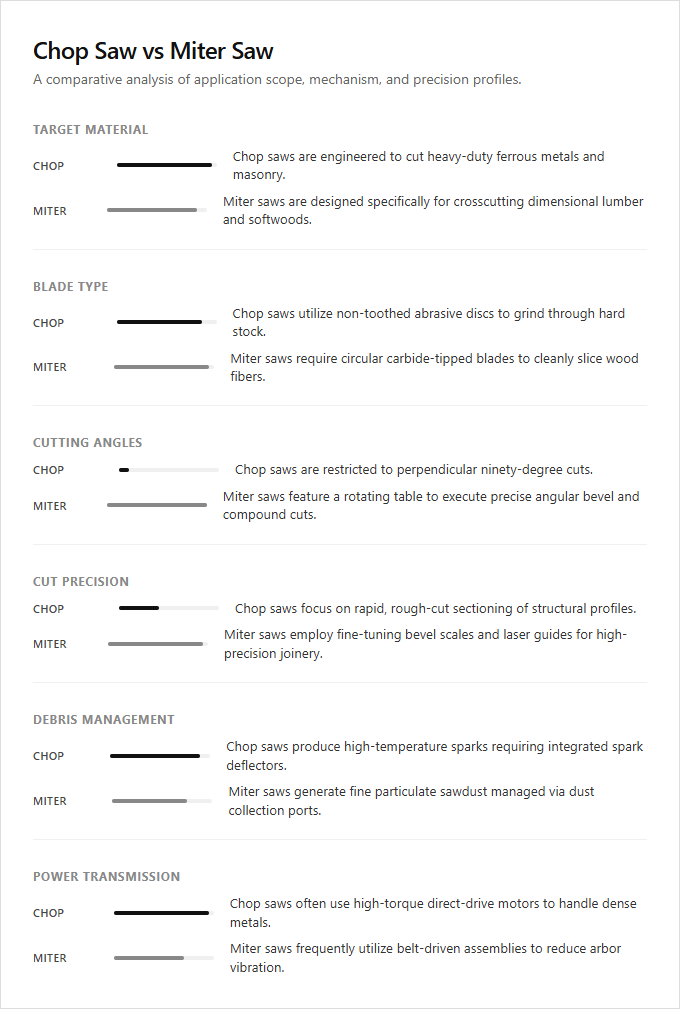
| Target Material | Chop saws are engineered to cut heavy-duty ferrous metals and masonry, whereas miter saws are designed specifically for crosscutting dimensional lumber and softwoods. |
| Blade Type | Chop saws utilize non-toothed abrasive discs to grind through hard stock, while miter saws require circular carbide-tipped blades to cleanly slice wood fibers. |
| Cutting Angles | Chop saws are restricted to perpendicular ninety-degree cuts, whereas miter saws feature a rotating table to execute precise angular bevel and compound cuts. |
| Cut Precision | Miter saws employ fine-tuning bevel scales and laser guides for high-precision joinery, while chop saws focus on rapid, rough-cut sectioning of structural profiles. |
| Debris Management | Chop saws produce high-temperature sparks requiring integrated spark deflectors, whereas miter saws generate fine particulate sawdust managed via dust collection ports. |
| Power Transmission | Chop saws often use high-torque direct-drive motors to handle dense metals, while miter saws frequently utilize belt-driven assemblies to reduce arbor vibration. |
Chop Saws vs. Miter Saws: Cutting Mechanisms Compared
When selecting the appropriate power tool for precision fabrication, understanding the mechanical distinctions between a chop saw and a miter saw is essential. Chop saws utilize high-speed abrasive wheels for friction sawing, making them highly effective for slicing through tough, ferrous metals. Miter saws employ carbide-tipped teeth for chip-removal cutting, which allows for clean, precise, and highly detailed angles in wood and composites.
The structural design of each tool dictates its operational environment and material compatibility. While both tools feature a drop-down cutting action, the miter saw offers rotating tables and beveling options for complex joinery. Chop saws are ideal for steel fabricators and construction workers needing rapid, raw metal cutting, while miter saws are best suited for woodworkers and finish carpenters requiring precise, angled trim work.
Miter Saws vs. Chop Saws: Angled vs. Straight Cuts
While chop saws and miter saws share a similar footprint, their mechanical capabilities serve distinctly different workshop demands. Miter saws feature a rotating turntable and a beveling pivot, allowing operators to execute precise miter, bevel, and complex compound angles. Chop saws, by contrast, are generally restricted to perpendicular plunge cuts, relying on a fixed wheel to slice straight down through dense materials without any angular adjustments.
This mechanical divergence determines the ideal application for each machine. Chop saws are best suited for industrial metalworkers needing rapid, heavy-duty straight cuts through steel, whereas miter saws are the preferred choice for finish carpenters and woodworkers who require extreme precision for intricate trim, molding, and framing installations.
Chop Saws vs. Miter Saws: Metal vs. Wood
Chop saws and miter saws serve distinct functions in industrial workshops and construction sites. Chop saws are engineered specifically for heavy-duty ferrous metal fabrication, employing high-speed abrasive wheels to cut through structural steel, pipes, and rebar. Their design prioritizes raw cutting power, making them essential for demanding metalworking environments.
In contrast, miter saws are optimized for finish carpentry and precision woodworking. Equipped with fine-tooth blades and rotating tables, these tools allow operators to execute highly accurate angle cuts in delicate wood trim and lumber. Metal fabricators and structural welders depend on the rugged power of the chop saw, whereas finish carpenters, cabinetmakers, and woodworkers require the precise control of the miter saw.
Miter Saws vs. Chop Saws: The Precision Advantage
Chop saws and miter saws serve distinct roles in professional workshops, primarily distinguished by their capacity for angular precision. While chop saws are engineered for straight, 90-degree cuts through dense materials, miter saws offer superior versatility for complex geometry. Specifically, miter saws utilize integrated dual-bevel scales and miter detents for exact angular indexing, which standard chop saws lack.
This technical sophistication allows operators to execute precise compound cuts with repeatable accuracy. Heavy-duty industrial fabricators prioritizing raw speed and straight cuts in steel find the robust simplicity of a chop saw ideal, whereas finish carpenters and detailed woodworkers require the precise angular control of a miter saw for intricate trim and molding installation.
Chop Saw vs. Miter Saw: Motor Differences
Chop saws and miter saws serve distinct cutting purposes, largely defined by their internal motor configurations. Chop saws are engineered to slice through dense, hard materials like structural steel and masonry. To handle this intense resistance, they require high-torque induction motors that maintain consistent power under heavy loads, ensuring durability and preventing stalls during repetitive, straight-line industrial cuts.
In contrast, miter saws prioritize precision and adaptability for making angled and compound cuts in wood and synthetics. These tools often utilize compact universal motors equipped with electronic speed control, allowing the operator to manage RPMs for clean, splinter-free finishes. Chop saws are ideal for metal fabricators and demolition contractors tackling heavy-duty material processing, whereas miter saws are best suited for finish carpenters and woodworkers who demand meticulous accuracy for trim and framing.
Sliding Miter Saws vs. Fixed Chop Saws
When selecting between a chop saw and a miter saw, understanding their mechanical differences is essential for project planning. The primary distinction lies in their movement and capacity. Miter saws incorporate sliding guide rails to increase crosscut capacity, allowing users to cut wider boards. Chop saws rely on a fixed pivot arm, restricting the blade to a straight downward plunge that limits the cut width to the blade's diameter.
This structural variance dictates the application and efficiency of each tool. Chop saws excel at making rapid, perpendicular cuts through heavy steel or timber, whereas miter saws offer the versatility needed for complex angled joints. Chop saws are best suited for industrial metalworkers and rough framers requiring speed, while miter saws are ideal for finish carpenters and woodworkers who demand precision and wide crosscut capabilities.
Chop Saw Sparks vs. Miter Saw Dust
Chop saws and miter saws serve distinct roles in material fabrication, primarily differentiated by their cutting mechanisms and waste management systems. Chop saws utilize abrasive wheels to cut through tough metals, a process that generates high thermal energy. To mitigate the intense heat and airborne embers, these machines require integrated spark deflectors to ensure operator safety and protect the surrounding workspace.
Miter saws employ toothed blades designed for precise wood and composite cutting, producing fine sawdust rather than thermal sparks. These tools utilize dedicated dust collection ports to manage kerf debris and maintain a clean, visible cutting line. Heavy-duty metal fabricators and structural steel workers require the rugged power of the chop saw, whereas finish carpenters and cabinetmakers are best suited for the precision-oriented miter saw.
Leave a comment