
Machinists and shop managers frequently struggle to maximize throughput without accelerating tool wear, often bottlenecking cycle times on the milling machine. While standard operations typically rely on conventional tooling budgets and baseline feeds to manage these costs, achieving peak efficiency requires a more strategic approach. Selecting the correct cutter geometry grants operators the ability to dramatically optimize Material Removal Rates (MRR) and reduce production overhead.
This optimization is subject to the stipulation that machine horsepower and setup rigidity are properly aligned with tool demands. For instance, when roughing heavy aluminum blocks or facing tool steel plates, choosing the wrong cutter will cause deflection or catastrophic failure. In this guide, we will compare the capabilities of end mills versus face mills, dissecting their unique cutting actions and outlining how to leverage each tool to maximize your machining efficiency.
| Factor | Summary |
|---|---|
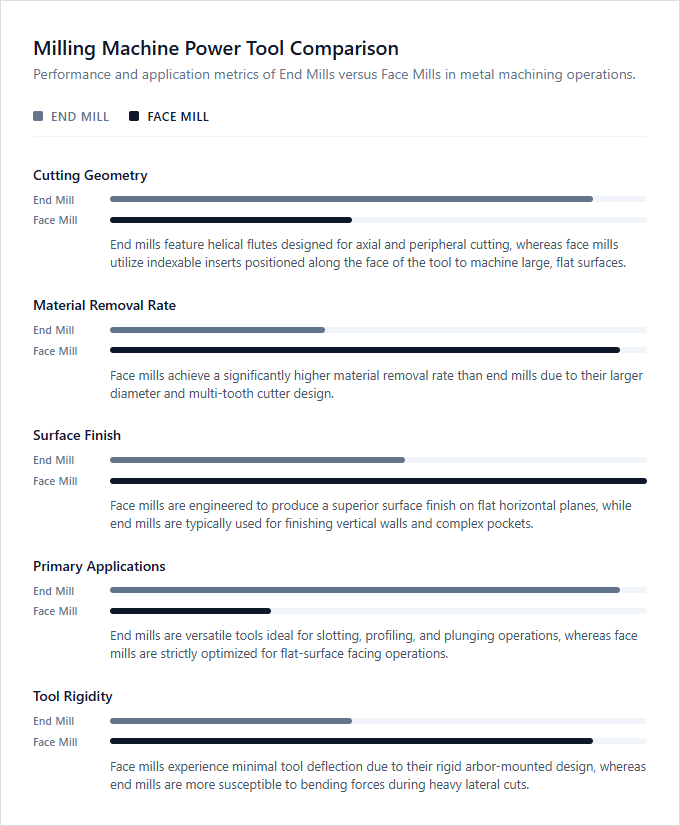
| Cutting Geometry | End mills feature helical flutes designed for axial and peripheral cutting, whereas face mills utilize indexable inserts positioned along the face of the tool to machine large, flat surfaces. |
| Material Removal Rate | Face mills achieve a significantly higher material removal rate than end mills due to their larger diameter and multi-tooth cutter design. |
| Surface Finish | Face mills are engineered to produce a superior surface finish on flat horizontal planes, while end mills are typically used for finishing vertical walls and complex pockets. |
| Primary Applications | End mills are versatile tools ideal for slotting, profiling, and plunging operations, whereas face mills are strictly optimized for flat-surface facing operations. |
| Tool Deflection | Face mills experience minimal tool deflection due to their rigid arbor-mounted design, whereas end mills are more susceptible to bending forces during heavy lateral cuts. |
Lead angle chip thinning effect on feed rate
End mills typically feature a 90-degree lead angle, meaning the programmed feed rate directly corresponds to the actual chip thickness. Because there is no inherent chip thinning effect with a square shoulder, operators must maintain standard feed rates to avoid overloading the tool during intricate profiling and slotting operations.
Face mills utilize reduced lead angles, often 45 degrees, which create a significant chip thinning effect. This geometry produces a chip that is thinner than the actual feed per tooth, allowing machinists to safely increase the programmed feed rate and maximize material removal rates on flat surfaces.
Precision toolmakers requiring intricate contouring benefit most from end mills, whereas high-volume production machinists prioritizing rapid surface flattening are best suited for face mills.
Radial depth of cut engagement limits and stepover ratio
End mills are designed for versatile cutting applications, accommodating varying radial depths of cut. They typically operate at lower stepover ratios, often between 10% and 50% of the cutter diameter, to manage heat dissipation and prevent tool deflection during peripheral milling. This limited radial engagement allows for deep axial cuts while maintaining tool stability.
Face mills feature a larger diameter and are optimized for high-efficiency surface finishing. They utilize a much larger stepover ratio, generally ranging from 60% to 80% of the cutter diameter, to ensure flat surface generation and optimal tool engagement. Their design limits radial depth of cut to wide, shallow passes that distribute cutting forces axially.
Machinists requiring intricate slotting and pocketing benefit most from the adaptability of end mills, whereas high-volume production operators seeking rapid, flat surfacing are ideal candidates for face mills.
Axial depth of cut capabilities in heavy roughing
In heavy roughing operations, end mills offer significant axial depth of cut capabilities. Their design allows for deep vertical engagement, enabling machinists to utilize the tool's peripheral cutting edges to remove substantial material in a single, deep pass. This approach is highly effective for deep pocketing and slotting, though it subjects the tool shank to considerable bending forces.
Face mills, by contrast, are limited to shallow axial depths of cut but excel in radial engagement. They employ multiple indexable inserts to distribute cutting forces across a wide surface area, ensuring high stability and rapid metal removal without deflecting. Deep-pocketing machinists benefit most from the versatile axial reach of end mills, whereas surface-facing specialists requiring flat, rapid squaring prefer the stability of face mills.
Tool deflection and static rigidity under high cutting forces
In milling operations, tool deflection and static rigidity directly dictate machining accuracy. End mills, characterized by their high length-to-diameter ratio, experience greater lateral deflection under high cutting forces. This reduced static rigidity limits their material removal rate in deep pocketing, as excessive bending forces induce chatter and dimensional inaccuracy.
Face mills feature a robust, short-overhang design that maximizes static rigidity. By distributing cutting forces axially across multiple indexable inserts, face mills minimize tool deflection, allowing for aggressive feed rates and exceptional surface flatness. Precision mold makers requiring intricate cavity profiling benefit most from end mills, whereas high-volume manufacturing engineers prioritizing rapid flat surfacing find face mills indispensable.
Tooth pitch and indexable insert density configuration
End mills and face mills serve distinct roles determined by their tooth pitch and insert density configurations. End mills typically feature a lower density of widely spaced teeth, which maximizes chip clearance during deep slotting and profiling operations. This spacious pitch prevents chip clogging in confined channels, maintaining cutting efficiency and tool integrity.
Face mills utilize high-density, indexable insert configurations along their periphery. This closely spaced tooth pitch distributes the thermal and mechanical load across multiple cutting edges, enabling rapid material removal and superior surface finishes on flat planes. High-volume production machinists requiring rapid facing of large surfaces benefit most from face mills, whereas detail-oriented operators performing intricate pocketing and profile work find end mills indispensable.
Spindle horsepower and torque requirements for large cutter diameters
Face milling utilizes large-diameter cutters to clear broad surfaces, requiring substantial spindle horsepower and torque. Because the cutting forces are distributed across multiple inserts over a wider area, the machine's spindle must deliver high torque at lower RPMs to maintain structural stability and prevent stalling. Heavy-duty face mills demand robust, high-power milling machines to efficiently remove bulk material without overloading the spindle motor.
In contrast, end mills feature smaller diameters and operate at higher spindle speeds with lower torque demands, making them ideal for contouring, slotting, and intricate details. While face mills excel at flat surfacing, they necessitate heavy industrial machinery with high-torque gearboxes. High-production manufacturing facilities require face mills for rapid surface leveling, whereas prototype machinists and toolmakers benefit more from the versatility and lower power requirements of end mills.
Radial chip thinning factor in high-efficiency milling toolpaths
High-efficiency milling (HEM) relies heavily on the radial chip thinning factor to optimize material removal rates. When utilizing end mills at small radial depths of cut, this phenomenon allows operators to significantly increase feed rates because the actual chip thickness is thinner than the feed per tooth. This reduces thermal stress on the cutting edge and substantially extends tool life during complex profiling maneuvers.
In contrast, face mills typically operate with larger radial engagements, making radial chip thinning less influential to the toolpath strategy. Instead, face milling leverages specific lead angles to achieve chip thinning, distributing cutting forces to maximize surface finish quality on broad planes. End mills are ideal for precision machinists requiring intricate slotting and profiling, while face mills are best suited for production operators prioritizing rapid, flat-surface leveling.
Leave a comment