
Selecting the wrong collation system for your pneumatic nailer often leads to costly job site bottlenecks, frequent reloading disruptions, and unnecessary physical fatigue. When addressing these inefficiencies, contractors typically look to standard funding sources-such as quarterly capital expense budgets or equipment financing lines-to upgrade their tool fleets.
However, choosing the precise collation method grants your crew an immediate competitive advantage by drastically reducing labor hours per square foot. To set realistic expectations, we must stipulate that no single collation type is a universal solution; performance varies based on local building codes and material requirements. For example, residential framing crews frequently rely on 21-degree plastic strip nailers for precise placement, while roofing contractors depend on high-capacity wire coil systems.
To help you optimize your tool strategy, this article evaluates the critical differences between coil and strip collation, comparing magazine capacity, tool weight, maneuverability, and long-term fastener costs.
| Factor | Summary |
|---|---|
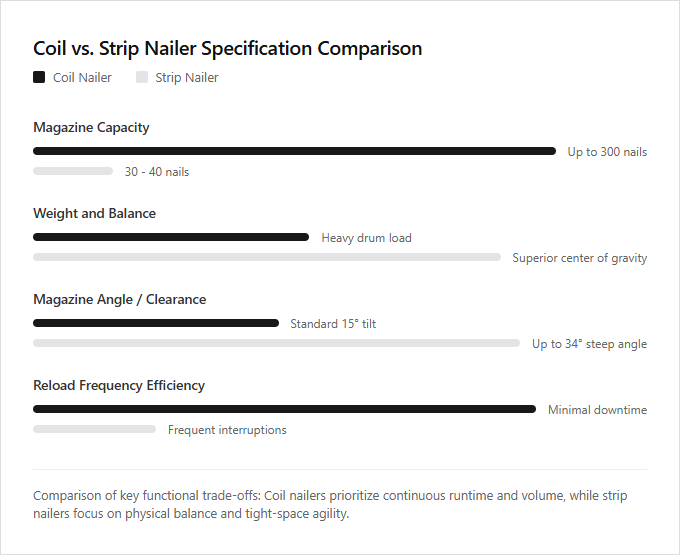
| Magazine Capacity | Coil nailers utilize a circular canister to hold up to 300 fasteners, whereas strip nailers are limited to linear collation strips of roughly 30 to 40 nails. |
| Weight and Balance | Strip nailers provide a superior center of gravity for overhead tasks, while loaded coil nailers exert more physical strain due to the heavy bulk of the drum magazine. |
| Collation Medium | Coil fasteners are typically bound by thin weld wire, whereas strip fasteners are joined using plastic, paper, or adhesive collation bands. |
| Magazine Angle | Strip nailers feature steep magazine angles up to 34 degrees for maneuvering in tight joist spaces, while coil nailers generally maintain a standard 15-degree tilt. |
| Reload Frequency | Coil nailers optimize duty cycle efficiency by reducing reload downtime, whereas strip nailers require frequent interruption to insert new stick fasteners. |
| Primary Application | Coil models are highly favored for high-volume siding installation, whereas strip models are the standard choice for structural framing. |
Magazine holding capacity of drum-loaded coil systems versus stick-fed channels
Drum-loaded coil nailers utilize a circular magazine that accommodates a high volume of fasteners, typically holding between 200 and 300 nails connected by wire or plastic collation. This high-capacity design significantly reduces downtime spent reloading, allowing for continuous operation on large-scale projects.
Strip-fed nailers employ a linear, stick-fed channel that holds a substantially smaller payload, usually ranging from 30 to 90 nails per strip. Although this lower capacity requires more frequent reloading pauses, the resulting tool profile is narrower and easier to balance in tight spaces.
High-volume roofing and siding contractors benefit most from the continuous operation of coil systems, whereas residential remodelers and framing carpenters often prefer the maneuverability and lighter weight of strip-fed nailers.
Collation material variations including wire-weld, paper-tape, and plastic-strip
Coil nailers utilize wire-weld collation to hold a high volume of fasteners in a circular drum, significantly minimizing reload frequency. Strip nailers rely on linear collation systems, typically using paper-tape or plastic-strip formats. Paper-tape collation offers a clean shear with minimal job site debris, while plastic-strip collation resists moisture damage but can scatter debris during operation.
The choice between these designs directly impacts tool weight, capacity, and maneuverability. High-volume framing and roofing professionals benefit most from the continuous capacity of wire-weld coil nailers, whereas residential remodelers and finish carpenters prefer the lighter weight and precise handling of paper or plastic strip nailers.
Fastener head geometry compatibility regarding full-round-head versus clipped-head nails
Coil nailers primarily utilize full-round-head nails held together by wire collation. This design ensures maximum holding power and consistently complies with strict municipal building codes. In contrast, strip nailers accommodate both clipped-head and offset full-round-head nails, which are collated with paper or plastic at a steep angle to allow for tight nesting within the magazine.
The choice between these systems depends heavily on structural engineering requirements and project scale. While clipped-head strip nails offer increased magazine capacity in a lightweight tool, certain jurisdictions mandate full-round heads for seismic and high-wind framing. High-volume roofing and siding contractors benefit most from the uninterrupted, high-capacity operation of coil systems, whereas residential framing carpenters typically prefer the balance, portability, and versatile code-compliance of strip nailers.
Nailer Magazine Angles: 15° to 30°
Coil nailers typically utilize a 15-degree magazine angle, housing up to 300 nails in a circular canister. This design minimizes reloading interruptions during large-scale installations. The specific 15-degree tilt allows the tool to remain relatively compact despite the high fastener capacity, maximizing efficiency during continuous fastening applications.
Strip nailers utilize stick-collated fasteners angled at 21 or 30 degrees. The 21-degree models hold plastic-collated nails, while 30-degree variants use paper-collated strips to offer superior maneuverability in tight spaces. These steeper angles keep the tool profile slim, improving access to joists and studs.
High-capacity 15-degree coil nailers are ideal for high-volume siding and roofing contractors, while the nimble 21-degree and 30-degree strip nailers best serve framing carpenters and renovators working in confined structural environments.
Tool ergonomics and center of gravity differences affecting operator fatigue
When comparing coil and strip nailers, weight distribution and center of gravity significantly impact operator fatigue. Coil nailers feature a circular magazine that concentrates weight lower and closer to the trigger, providing a balanced, compact center of gravity that minimizes forearm leverage. Conversely, strip nailers utilize a long, angled magazine that shifts the tool's balance point backward, which can increase wrist strain during extended vertical or overhead use.
These ergonomic differences determine physical strain over a long workday. High-production siding and roofing installers favor the compact balance and high capacity of coil nailers, whereas framing carpenters and residential contractors requiring agility in tight spaces are better suited for the lightweight, linear design of strip nailers.
Collation Debris: Plastic Flagging vs. Clean Paper Tape
Coil nailers utilize high-capacity drums, typically feeding nails bound by plastic collation. During rapid-fire operation, this plastic material shatters upon impact, discharging sharp flagging debris across the job site. This output poses eye injury hazards to operators and leaves behind a tedious cleanup of scattered microplastics.
Strip nailers often employ paper tape collation. As the driver blade strikes, the paper is cleanly sheared and driven directly into the lumber, leaving virtually no airborne debris or hazardous waste. This mechanism maintains a safer workspace and eliminates the annoyance of flying plastic shards.
High-volume framing contractors prioritizing continuous firing speed benefit most from coil nailers, while meticulous remodelers and indoor carpenters requiring pristine, debris-free environments are better suited for paper-collated strip nailers.
Reload frequency and duty cycle efficiency for high-volume pneumatic applications
In high-volume pneumatic applications, coil nailers offer superior duty cycle efficiency due to their high-capacity drum magazines. Holding up to 300 nails per coil, these tools drastically reduce reload frequency, allowing operators to maintain a continuous workflow on busy job sites or production lines. This minimizes downtime and maximizes hourly fastening output during large-scale operations.
In contrast, strip nailers hold fewer fasteners, typically around 30 to 40 nails, requiring more frequent interruptions for reloading. While this reduces overall efficiency in rapid-fire scenarios, the linear design of strip nailers provides better tool balance and a lighter weight profile. Coil nailers are ideal for high-production industrial manufacturers and roofers who prioritize uninterrupted runtime, whereas strip nailers best serve residential framers and remodelers who require maneuverability and precise tool control.
Leave a comment